Nervous / VISUAL EXPLAINER
How Multiple Sclerosis Damages the Protective Myelin Layer
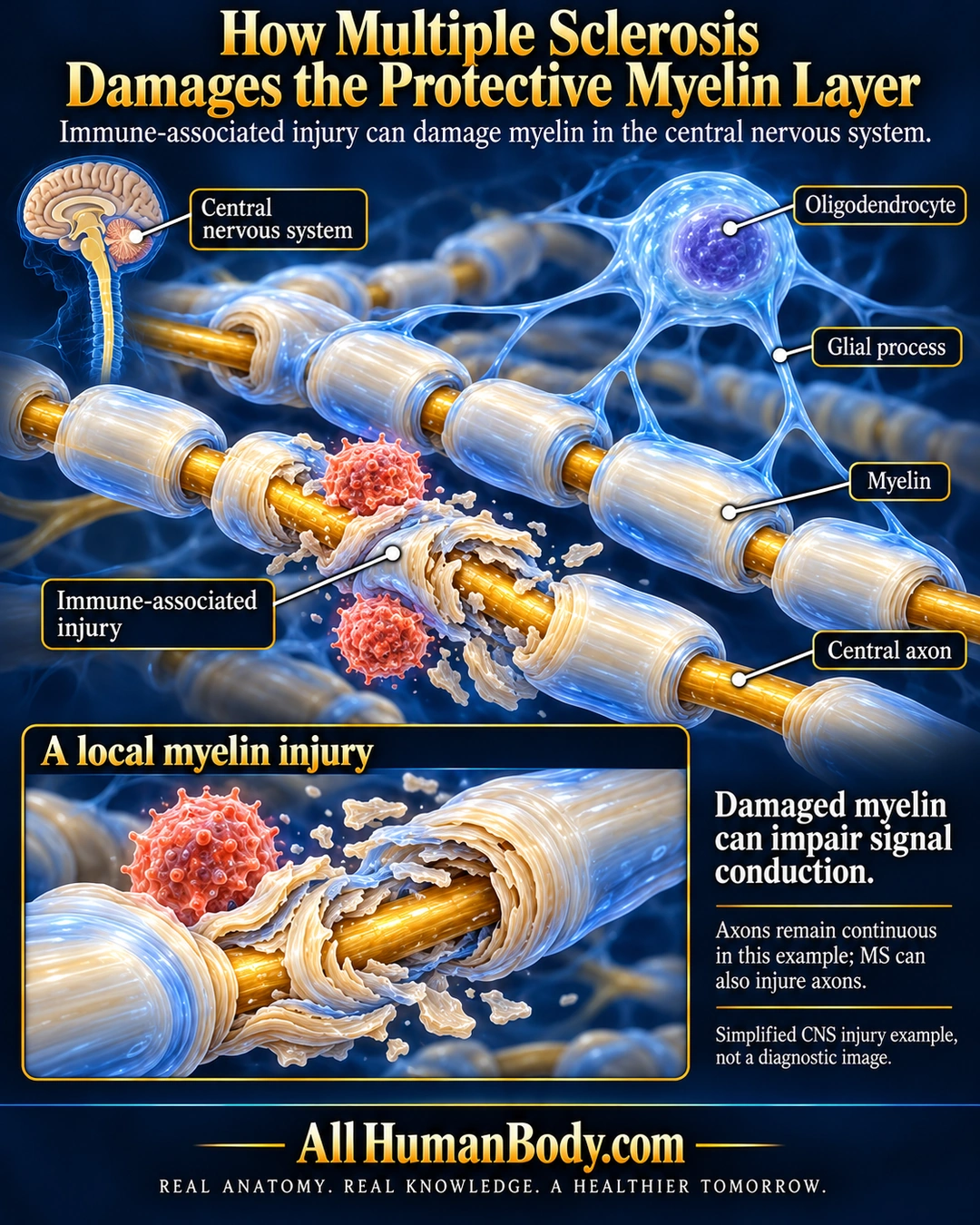
Multiple sclerosis affects the central nervous system. Immune-associated inflammation can damage myelin and impair signal conduction. Axons remain continuous in this example, but MS can also injure axons.
READ THE IMAGE
What the illustration shows
Navy and gold educational poster titled How Multiple Sclerosis Damages the Protective Myelin Layer. An upper-left brain and spinal-cord locator establishes the central nervous system. Several golden axons run through ivory-blue myelin segments. A blue oligodendrocyte at upper right sends thinner processes to sheath surfaces. Coral cells sit near a locally disrupted myelin region; the golden axon core remains continuous. Labels distinguish cell body, glial process, myelin, central axon and immune-associated injury. A lower detail enlarges disrupted layers around a continuous axon. Text explains that damaged myelin can impair conduction and that MS can also injure axons. Gold AllHumanBody.com and the full slogan appear on a plain navy footer.
How to interpret this poster
- Simplified local CNS injury, not MRI lesion, exact immune subtype, universal axon sparing or all MS injury. No symptoms, prognosis, trigger or therapy advice.
- AI-assisted educational illustration; not physician certification, a diagnosis or individualized medical advice.
- Fine annotations require enlargement; preserve the full uncropped illustration and its qualifiers.
AI-assisted educational illustration, adapted into web-sized images without changing its composition. This is general education, not an individual diagnosis or treatment recommendation.
EVIDENCE / CONTEXT
Sources and what they support
- MedlinePlus: Multiple sclerosis ↗
CNS immune-associated myelin injury and conduction impairment.
- Nikić et al2011 axon damage study ↗
Axon injury can occur in MS; only visible caution supported.
Evidence correspondence is limited to the abstract.