NORMAL PHYSIOLOGY / TISSUE → CIRCULATION → SURROUNDINGS
Temperature & Heat Balance
Heat is produced inside. Exchange happens at the boundary. Regulation connects both.
Start with high-detail brain and skin anatomy. Follow heat production and physical transfer, then compare neural coordination, sweating, skin blood flow and muscle thermogenesis without confusing their different jobs.
30 SECONDS / SEE THE CONNECTED JOBS
A brain coordinates. Tissues produce heat. A surface exchanges it.
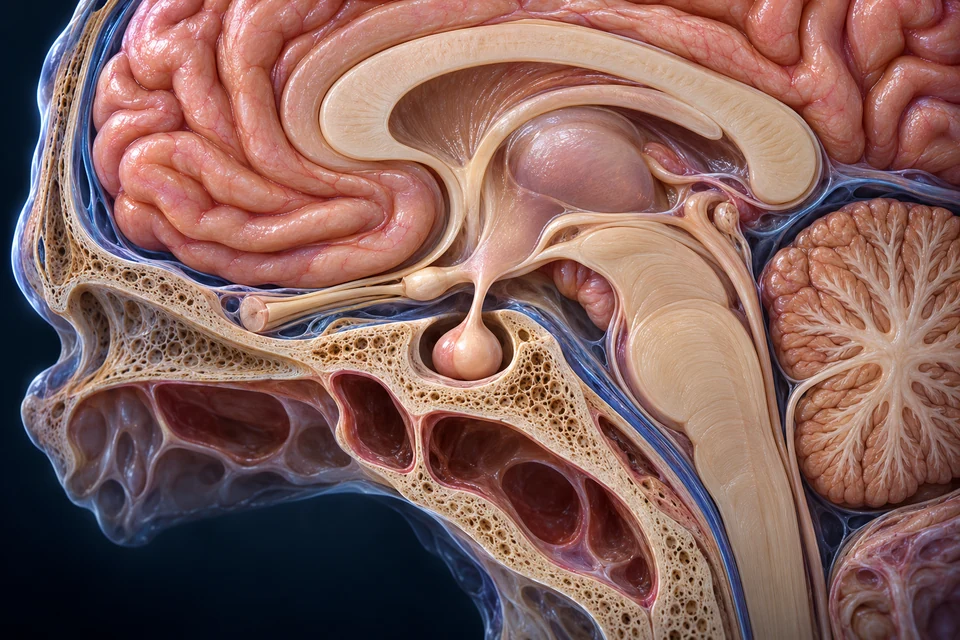
Coordinate · brain region
Structure notes · further context
- Hypothalamic region
- The region belongs to the base of the diencephalon. Individual nuclei and the generated ventricle/optic contours are not identified or claimed verified here.
- Pituitary stalk
- The infundibulum carries neural processes and vessels. It is not a duct carrying a brain fluid into the pituitary.
- Pituitary gland
- The anterior endocrine and posterior neural regions are enlarged in the next distinct view. This regional view establishes location, not all vascular junctions.
- Bony seat
- The pituitary lies in this bony depression below the brain. Bone and adjacent cavity contours are illustrative, not operative boundaries or a measured cross-section.
Broad hypothalamic context, not a resolved map of thermal nuclei or a direct pituitary route.
Transfer and exchange · living skin
Structure notes · further context
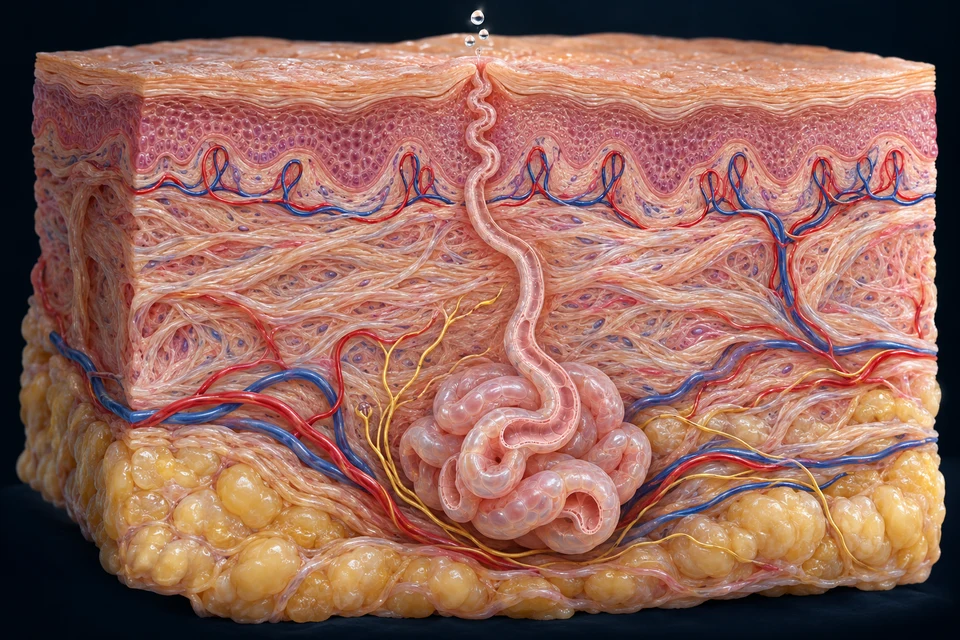
- Follow a tube, not a branching tree
- Eccrine glands are simple coiled tubular glands. The cut-open ends in this teaching view reveal selected parts of the coil; only one duct is followed to a surface opening.
- Secretion and modification differ
- Ion transport in the secretory segment supports fluid secretion. The duct recovers salt and has relatively low water permeability, so final sweat is usually less concentrated than plasma; composition varies with flow and adaptation. This plate does not depict individual transport proteins.
- Cooling happens during evaporation
- Sweat secretion moves fluid to the surface. Evaporation then removes heat; liquid that simply drips off does not provide the same evaporative cooling. Humidity, airflow and clothing affect evaporation.
- Not the same as a kidney tubule
- Sweat composition is not a direct reading of blood composition, and the duct is not drawn as a vasopressin-regulated water-recovery system. Kidney urine concentration and cutaneous cooling have different purposes.
Gold arrow: outward gland-fluid route, not heat, blood flow or a neural fibre. Rings select contexts, not measured activity.
- ProduceMetabolism in living tissues releases heat; active muscle can increase it.
- RedistributeBlood links deeper tissues and surface. This is not yet net loss.
- ExchangeThe surface and its surroundings determine heat transfer and evaporation.
Increase transfer and support evaporation.
Reduced constrictor drive and active cutaneous vasodilation can increase surface perfusion; eccrine sweating supplies water. Actual heat loss still depends on environmental exchange. These effects are not a measurement of flow or gland output.
- Skin circulation: redistribute heat
- Sweat gland: supply fluid
- Environment: determine net exchange
These retained anatomy views are at different scales. The relationship between brain, tissues and skin is a functional explanation, not a continuous traced human nerve pathway or a three-stage response every person must follow.
Sources for this mechanism: Morrison and Nakamura · Central thermoregulatory circuits · Cramer et al. · Human temperature regulation · Existing Skin course · sources and anatomy
02 / HEAT BUDGET
Heat production, transfer and storage are different quantities.
Metabolism releases energy throughout living tissue. Some energy performs external work; the remainder contributes to body heat. Internal redistribution is different from exchange across the body boundary.
Equal-interval teaching budget · invented energy units
- Metabolic heat
- 8
- Environmental gain
- + 2
- Heat loss
- − 10
- Change in stored heat
- 0
Inputs and outputs balance in this invented interval.
Auxiliary conservation example alongside the anatomical atlases. No watts, exposure time, body mass or temperature prediction is implied.
Heat is energy transferred because of a temperature difference. Temperature describes a thermal state; it is not a count of all the energy stored in the body. Mass, tissue composition and the distribution of temperature matter when relating the two.
For a selected interval, metabolic heat plus net environmental gain minus net heat loss determines a change in stored heat. The body can be storing heat while it is visibly sweating. A rise in output from a cooling effector does not by itself establish that total balance has been restored.
Why movement can warm the body
Converting chemical energy to muscular work is not perfectly efficient. ATP turnover and associated metabolism release heat even when little useful external work is produced. Exercise heat and a rise in metabolic demand are distinct from simply being surrounded by hot air.
What the interactive budget can and cannot tell you
The teaching values below are invented energy units for equal intervals. They illustrate conservation, not a physiological model. They do not predict temperature, sweat loss, exercise safety or a person’s response.
Sources for this mechanism: OpenStax · Energy and Heat Balance · Cramer et al. · Human temperature regulation
03 / CORE AND SHELL
The surface and the deeper body do not have one temperature.
Deep organs, skeletal muscle, blood and skin participate in a changing thermal system. The outer shell is a functional description, not a separate hollow anatomical bag.
A cool hand does not establish that every deep organ is equally cool. Peripheral temperature varies with the environment and local blood supply. Heat can move through tissue and be carried by flowing blood, linking metabolic sources with the surface.
The retained tissue images show actual compartments at different scales. They should not be read as a single cross-section through an entire person. No colour in these illustrations is a thermometer or an acquired thermal image.
Insulation and a variable shell
Subcutaneous tissue and clothing affect resistance to heat transfer. Changing skin perfusion also changes the thermal relation between deep tissue and surface. The shell is therefore not fixed at a particular depth in every body region.
Sources for this mechanism: Cramer et al. · Human temperature regulation · OpenStax · Energy and Heat Balance
04 / ENVIRONMENTAL EXCHANGE
Name the route—and check which way heat can move.
Conduction, convection and radiation can exchange heat in either direction. Evaporation removes energy when water changes into vapour, subject to the surrounding conditions.
Conduction · direct contact
Heat can pass from warmer skin to a cooler contacting object, or into skin from a warmer object. The contact and thermal properties matter.
Direction: Either direction, depending on the temperature relation.
Conduction · direct contact
Heat can pass from warmer skin to a cooler contacting object, or into skin from a warmer object. The contact and thermal properties matter.
Either direction, depending on the temperature relation.
Convection · moving fluid at the boundary
Air or water carries energy away from or towards the surface. Hotter moving air can produce dry heat gain even if movement also helps evaporation.
Either direction; airflow alone does not determine the net result.
Radiation · exchange without contact
The body exchanges radiant energy with surrounding surfaces. A hot radiant surface can supply heat even when it does not touch the skin.
Net direction depends on the radiant environment and body surface.
Evaporation · a phase change with a fluid cost
Energy leaves when water evaporates at the body surface. Available moisture, the vapour-pressure relation, air movement and clothing constrain the result. Dripping sweat is not the same event.
Evaporative loss is not established by secretion or wetness alone.
Select a physical route, not an exposure recommendation. The comparison does not predict heat strain or prescribe cooling equipment.
Direct contact transfers heat between skin and a surface. Moving air or water exchanges heat at the body boundary. Radiation exchanges energy without physical contact, so the temperature of surrounding surfaces matters as well as air temperature.
Evaporation depends on the skin-to-environment water-vapour relation and resistance imposed by the boundary air and clothing. Sweat that remains liquid or falls away has not delivered the same latent-heat loss as water that evaporates from the surface. No single sweat-output value establishes cooling effectiveness.
Air movement is not automatically cooling
Moving cooler air can support dry heat loss and can assist evaporation. When air is hotter than the skin, convection can instead supply heat. The combined result also depends on moisture and clothing, so this course does not prescribe fan use or exposure conditions.
Why fixed heat-loss percentages mislead
The relative contributions of radiation, air movement, contact and evaporation change with activity and surroundings. A familiar resting-room percentage should not be carried unchanged into water, hot sun or exercise.
Sources for this mechanism: OpenStax · Energy and Heat Balance · Ashworth · Sweat evaporation in humans · Cramer et al. · Human temperature regulation
05 / SKIN BLOOD FLOW
Blood carries heat to a surface that still needs an exchange route.
Cutaneous perfusion connects deeper tissue with the body boundary. Flowing blood does not leave a vessel and become sweat.
During cold defence, sympathetic adrenergic vasoconstrictor activity can reduce skin blood flow and limit transfer of heat toward the surface. In warming, withdrawal of constrictor activity and active vasodilation contribute in different ways and in different skin regions.
Human non-glabrous skin has a sympathetic cholinergic active-dilator system as well as the adrenergic constrictor system. Active vasodilation is not simply a parasympathetic switch, and it is not identical to secretion by a sweat gland. Their controls and participating mediators are related but distinguishable.
Return to the separate vessel and gland compartments →
A larger delivery route is not a guarantee of net heat loss
Blood redistribution moves energy within the body. Heat must still cross the skin boundary to leave it. In a hot environment, dry environmental exchange can be inward even while skin blood flow is elevated.
Not every skin region uses one vascular design
Glabrous areas such as palms and soles have specialised vascular arrangements. Do not assign the full non-glabrous active-dilator mechanism to every tiny vessel drawn in the retained gland illustration.
Sources for this mechanism: Wong and Hollowed · Active vasodilation in human skin · Cramer et al. · Human temperature regulation
06 / SWEAT AND EVAPORATION
A gland supplies water. Evaporation provides the cooling step.
Eccrine secretory tissue produces fluid, a duct modifies its composition, and a separate surface pore releases it. The retained high-detail skin plate keeps these routes distinct.
Sympathetic cholinergic input is important for human thermoregulatory sweating. It acts on a living secretory structure; the gland is not a broken blood vessel. The secretory coil and salt-reabsorbing duct have different jobs.
Final sweat composition depends on flow and adaptation. More surface water does not establish a fixed salt concentration or a fixed cooling rate. Environmental moisture, air movement and clothing influence whether the water can leave as vapour.
Follow the preserved coil, duct and surface pore →
A fluid cost and a thermal benefit are separate outcomes
Sweat loss removes water and electrolytes from the body. The thermal benefit depends on evaporation. This is why visible wetness is not a direct measure of heat removed, hydration status or the efficiency of an individual’s gland.
Sources for this mechanism: Existing Skin course · sources and anatomy · Ashworth · Sweat evaporation in humans · Cramer et al. · Human temperature regulation
07 / SENSING AND COORDINATION
Temperature information reaches parallel control systems.
Peripheral thermal afferents and information from the deeper body contribute to central regulation. Preoptic/hypothalamic regions participate in coordinating effector-specific responses.
Skin temperature can provide early information about an environmental change before a large deep-body change has occurred. Central thermal information and peripheral input are not interchangeable measurements. Behaviour, autonomic outputs and somatic motor activity also differ.
Thermoregulatory circuits are distributed and organised by effector. A broad hypothalamic highlight does not identify every participating nucleus or demonstrate every synapse. Many precise circuit experiments come from non-human preparations; their full wiring should not be claimed as traced in the illustrated human tissue.
Why the pituitary is visible but is not the rapid-control switch
The retained regional atlas locates hypothalamic tissue above the pituitary stalk. Its endocrine neighbours do not mean that every rapid sweat, skin-vessel or shivering response first passes through pituitary hormones. Neural control and endocrine influences operate through different routes and timescales.
Feedback need not wait for one identical threshold
Effector responses have different control properties, and peripheral information can contribute anticipatory influence. The teaching states group responses for understanding; they are not three universal temperatures or a compulsory sequence for all people.
Sources for this mechanism: Morrison and Nakamura · Central thermoregulatory circuits · Cramer et al. · Human temperature regulation
08 / MUSCLE HEAT
A contracting skeletal fibre can produce heat without moving the body far.
Shivering recruits skeletal-muscle activity through somatic motor pathways. The fibre remains a striated skeletal cell, not a sweat-gland cell or a sympathetic smooth-muscle ring.

Structure notes · further context
- Striated fibre
- Repeating sarcomeric organisation gives the cell a banded appearance.
- Peripheral nucleus
- A long skeletal fibre contains many nuclei near its surface.
- Myofibrillar interior
- Parallel contractile structures occupy much of the fibre.
Contraction and relaxation involve energy turnover. During shivering, repeated involuntary activity increases metabolic heat production while generating little useful external movement. Voluntary muscular activity can also increase heat production, but is not the same motor pattern.
The retained fibre cutaway shows striated architecture, peripheral nuclei and a myofibrillar interior. It does not show a firing record, a moving sarcomere or every motor unit recruited during cold defence. Gold emphasis locates tissue, not a measured temperature increase.
Two different meanings of muscle in temperature regulation
Skeletal muscle can generate additional metabolic heat through activation. Vascular smooth muscle changes vessel calibre and therefore distribution. Their neural control, cellular organisation and immediate effect are different; one generic muscle arrow should not replace both explanations.
Sources for this mechanism: OpenStax · Skeletal Muscle · Morrison and Nakamura · Central thermoregulatory circuits · Cramer et al. · Human temperature regulation
09 / NON-SHIVERING HEAT
Mitochondria can contribute heat without a visible shiver.
Brown adipose tissue is specialised for thermogenesis. UCP1 can increase proton conductance across the inner mitochondrial membrane, reducing coupling to ATP synthesis and supporting heat production.
This is not a claim that a mitochondrion converts ATP into heat through UCP1, or that all fat cells perform the same thermogenic role. Fuel oxidation, the proton gradient and ATP synthesis must be distinguished. Ordinary metabolism in many tissues already contributes to heat production.
Cold-activated brown adipose tissue has been demonstrated in adult human studies. The retained 2009 study concerned men under specific exposure and imaging conditions. It does not establish one amount or activity for every adult, and the absence of a visible shiver does not isolate a single tissue’s contribution.
Why a positive PET signal is not a personal heat-output percentage
Tracer uptake, tissue mass and energy expenditure are related but different measurements. The chapter introduces the tissue and mechanism without calculating individual thermogenic power or promoting cold exposure, supplements or weight-loss treatments.
Sources for this mechanism: van Marken Lichtenbelt et al. · Cold-activated brown adipose tissue · Morrison and Nakamura · Central thermoregulatory circuits
10 / COORDINATION
Thermal balance shares resources with the rest of the body.
Working muscle, skin circulation and fluid balance interact. A locally useful response can have a cost elsewhere, so the whole system cannot be inferred from one gland or vessel.
In activity, muscle demand and transfer of heat toward the skin can occur together. Sweating changes body fluid balance. Cardiovascular responses support these demands, but their capacity and control are not unlimited or identical between people.
Repeated heat exposure can alter sweating and cardiovascular responses. These adaptations depend on context and should not be represented as one permanent upgrade that prevents all heat strain. Body size, age, clothing, activity and environment also influence the result.
Learning routes rather than another duplicate kidney course
The renal and endocrine chapters explain water conservation and volume regulation in detail. Here they supply the broader coordination context. Cooling water at the skin and conserving water in the kidney are distinct tasks; the sweat duct should not be labelled as a renal collecting duct.
Sources for this mechanism: Cramer et al. · Human temperature regulation
11 / VARIATION AND EVIDENCE
Regulated temperature is not one immutable number.
Daily rhythms and measurement location matter. The lesson explains normal control, not how to diagnose a fever or choose an emergency threshold.
Core temperature can follow an endogenous daily rhythm while remaining regulated. A changing reading is not automatically loss of all control. Skin measurements and deeper measurements should not be treated as identical substitutes.
A thermogram records surface radiation under defined measurement conditions; an anatomical illustration does not. No generated image in this chapter is labelled as a patient scan. Fine neural nuclei, individual transport proteins, artificial state magnitudes and a person’s safe exposure limits are not certified here.
What remains outside this normal-physiology course
Fever, heatstroke, hypothermia, individual symptoms and medical management need their own evidence and clinical safeguards. They cannot be added by extending the normal warm/cold buttons into diagnosis or treatment advice.
Sources for this mechanism: Circadian rhythmicity and homeostatic stability in thermoregulation · Cramer et al. · Human temperature regulation
Check the route, the tissue and the physical event.
Does a sweating body have to be cooling overall?
No. Evaporation may remove energy while total heat gain still exceeds loss. Secretion, evaporation and whole-body balance are separate quantities.
Are the blue/red vessels part of the sweat duct?
No. They are a separate dermal circulation. A gland secretes fluid through its own lumen and duct to the surface.
Is shivering controlled by the same peripheral pathway as a skin-vessel wall?
No. Shivering uses skeletal-muscle motor activity; vascular tone uses autonomic pathways acting on vascular smooth muscle.
Can the pituitary in the regional image be called the rapid sweat switch?
No. The image supplies anatomical context. Rapid thermoeffector coordination is not a compulsory pituitary-hormone relay.
Does every adult have the same measured brown-fat contribution?
No. Human studies demonstrate cold-activated tissue under particular conditions, not a universal amount, fraction or treatment effect.
Does a normal daily variation mean that regulation stopped?
No. Rhythmic variation can coexist with regulated stability. Measurement site and context must also be identified.
Sources, image identity and teaching limits
Normal physiology source check: 22 October 2026. Existing book-inventory topics FB007 and FB097 guide coverage and organisation; the original book is not copied or claimed freshly re-read. Current access boundaries are recorded with the sources below.
- OpenStax · Energy and Heat BalanceIntroductory heat exchange and metabolism. No fixed percentage of heat loss or universal thermal-neutral temperature is adopted.
- Cramer et al. · Human temperature regulationHuman thermoeffectors, heat balance and the factors that alter responses. Readable PubMed abstract and figure descriptions; not a claim of full review access.
- Morrison and Nakamura · Central thermoregulatory circuitsParallel thermoeffector circuits and peripheral/core information. Official indexed passages consulted; much fine circuit evidence is from non-human experiments.
- Wong and Hollowed · Active vasodilation in human skinAdrenergic constrictor and cholinergic active-dilator systems in non-glabrous human skin. Official indexed passages; full PMC returned an access challenge.
- Ashworth · Sweat evaporation in humansReadable 2026 review abstract: phase change, vapour-pressure relations, airflow and clothing. No personal heat tolerance is calculated.
- van Marken Lichtenbelt et al. · Cold-activated brown adipose tissueOriginal adult-male cold-exposure/PET study; official publisher indexed findings. Detection under study conditions is not a universal percentage of heat production.
- Circadian rhythmicity and homeostatic stability in thermoregulationOfficial indexed abstract for the distinction between regulated stability and daily variation; not a clinical reference range.
- OpenStax · Skeletal MuscleRetained qualified chapter source for fibres, striation and muscle context. No new claim of fine organelle or motor-terminal verification.
- Existing Skin course · sources and anatomyRetained qualified eccrine anatomy and its original source checks, unchanged native pixels and six anatomical targets.
All three main preparations are retained original generated project illustrations, not clinical thermograms, photographs or microscopy. Their original anatomical coordinates and native pixels remain unchanged. Medical facts, image structure and teaching coherence require separate checks. AI-assisted checks and Owner visual approval do not constitute physician review.
No personal diagnosis, fever threshold, cooling treatment, fluid prescription, cold-exposure programme or brown-fat treatment claim is provided. Actual fine neural wiring, generated microscopic detail, physical-phone performance and new WebGL rendering are not certified by this course.