NORMAL PHYSIOLOGY / FOOD → CELL → LYMPH → TISSUE
Lipid Digestion & Transport
One journey changes both chemical form and carrier.
Follow a long-chain dietary lipid through luminal processing, a polarised intestinal cell and a distinct lymphatic route. Learn why a micelle, a transport vesicle and a circulating lipoprotein are different objects.
30 SECONDS / LOCATE THE BOUNDARIES
Cross the lining. Build a carrier. Join lymph.
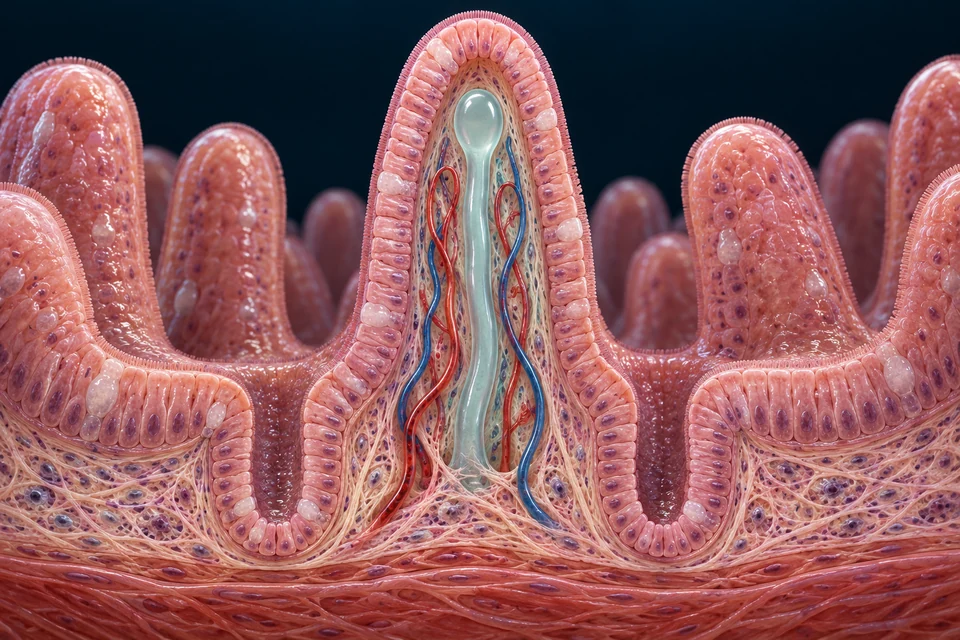
Structure notes · further context
- Villus
- Its core is supporting connective tissue, not an open digestive pipe.
- Epithelial lining
- Absorptive cells have apical microvilli. Junctions regulate passage between neighboring cells; the barrier is selective, not impermeable.
- Lamina propria
- It also contains immune and other supporting cells. A generated nucleus cannot establish a particular cell identity.
- Blood vessels
- The capillary network connects with larger vessels. Exact branch paths and red/blue vessel identities are illustrative.
- Lacteal
- Its tip is closed. It does not open into the lumen, and it does not carry every kind of absorbed nutrient.
- Intestinal crypt
- Crypts lie between villi. Stem-cell renewal and Paneth-cell roles are explained separately rather than guessed from generated cell colors.
1 · Surface delivery
The intestinal lumen lies outside the villus lining. Digestion products must cross the epithelium before they reach internal tissue.
- Lumen → apical surfaceDigestion products reach the outside of an absorptive cell.
- ER → Golgi → tissue faceProcessing and secretion create an onward carrier.
- Lacteal → lymph → bloodChylomicrons reach systemic blood by a route distinct from portal sugars.
Retained original generated anatomy, not microscopy. Semantic names, cues and text remain separate from the bitmaps. Gross organelle and tissue context is shown; hidden molecular machinery and individual particle identities are not inferred from the texture.
Mechanism evidence: Hussain · Intestinal lipid absorption and lipoprotein formation · Mansbach and Siddiqi · Biogenesis of chylomicrons · Xiao et al. · Post-assembly regulation of chylomicron secretion
3 MINUTES / IDENTIFY WHAT IS MOVING
Same journey; different structures.
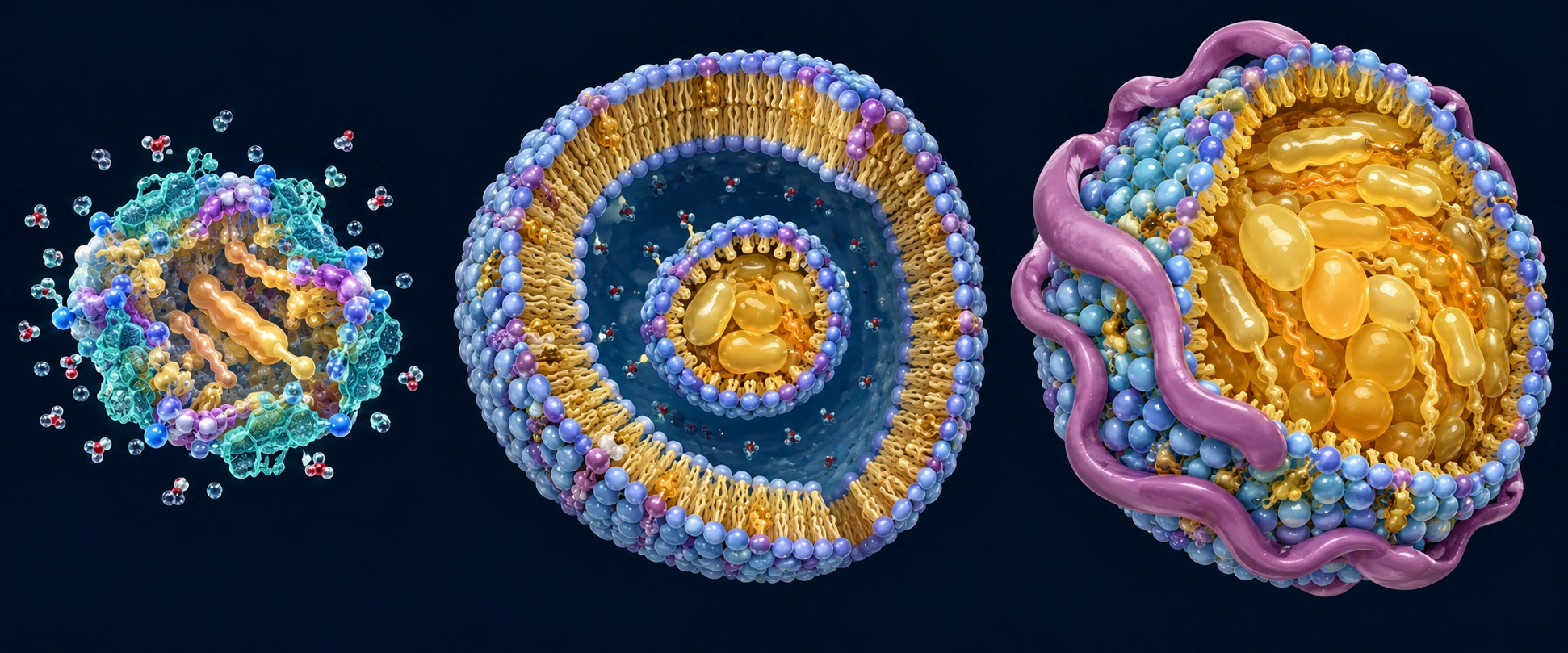
Structure notes · further context
- Mixed micelle
- Idealised mixed amphipathic aggregate in the lumen; not a bilayer vesicle or atomic molecular model.
- Where it belongs
- Digestive lumen
- How it is organised
- A dynamic amphipathic aggregate, not a cellular phospholipid-bilayer bag.
- What it does
- Helps solubilise and deliver lipid products near the surface. It is not secreted intact as an apoB48 particle.
Mechanism evidence: Hussain · Intestinal lipid absorption and lipoprotein formation · Mansbach and Siddiqi · Biogenesis of chylomicrons · Shiau · Mechanisms of intestinal fat absorption
01 / LUMEN AND SURFACE
Disperse the fat. Hydrolyse it. Deliver the products.
Three cooperating actions are not the same process.
Pancreatic lipase acts at a fat-water interface, releasing fatty acids and monoacylglycerols from triacylglycerol. Colipase helps the enzyme work at an interface in the presence of bile salts. Emulsification improves access; it is not itself cleavage of a chemical bond.
Bile-salt-rich mixed micelles can carry poorly water-soluble digestion products through the watery environment near the brush border. The products transfer to the epithelial surface. A mixed micelle is not a complete package that normally travels intact through the cell into lymph.
The epithelial membrane is a separate boundary. Diffusion and protein-associated processes contribute to uptake, with their importance depending on substrate and conditions. Naming CD36 or another protein does not establish a universal exclusive entry gate.
Why the interface matters
A large fat globule has less exposed interface per volume than many smaller droplets. Enzymes and amphipathic bile components therefore influence different aspects of access. Micellar solubilisation and enzyme action cooperate, but they must not be collapsed into “bile digests fat”.
Mechanism evidence: Shiau · Mechanisms of intestinal fat absorption · Hussain · Intestinal lipid absorption and lipoprotein formation
02 / INSIDE THE CELL
The cell rebuilds and allocates what it absorbs.
A digestive breakdown product can become part of a newly synthesised lipid.
Within an enterocyte, long-chain fatty acids are activated and used with monoacylglycerol to rebuild triacylglycerol. MGAT and DGAT contribute successive acyl-transfer reactions. This intracellular synthesis is distinct from the luminal lipase reactions that first made the uptake products.
The endoplasmic reticulum supports lipid synthesis and early lipoprotein assembly. Not every entering fatty acid is immediately secreted: some lipid enters cytoplasmic storage pools or is used by the cell. An absorbed amount and a simultaneously secreted amount need not be identical.
A reserve inside an absorptive cell
Transient lipid droplets help separate substrate arrival from later export. They are not the same object as an apoB-containing particle in the secretory pathway. The tissue image supplies organelle context; its individual round profiles are not identified as measured lipid stores or lipoproteins.
Mechanism evidence: Hussain · Intestinal lipid absorption and lipoprotein formation · Mansbach and Siddiqi · Biogenesis of chylomicrons
03 / BUILD THE CARRIER
A lipoprotein is assembled, not wrapped from a whole food droplet.
ApoB48 supplies a structural framework while lipid transfer supports assembly.
Intestinal apoB48 associates with lipids during early assembly in the ER. Microsomal triglyceride transfer protein, commonly called MTP and encoded by MTTP, supports lipidation. A growing neutral-lipid core and an amphipathic surface create a particle that can travel in an aqueous extracellular environment.
A chylomicron has a surface phospholipid monolayer with associated proteins and free cholesterol around a neutral-lipid-rich core. This differs from the phospholipid bilayer surrounding a transport vesicle. The particle is not a hollow cell with an aqueous cytoplasm.
Human intestinal apoB48 and hepatic apoB100 are related forms produced from the same gene through different RNA processing. This does not make an intestinal chylomicron the same as a liver-secreted VLDL particle. Mouse editing experiments illuminate function without establishing a universal human particle output.
Keep the particle and the vehicle distinct
A membrane-bound intracellular carrier can enclose a developing lipoprotein. On the secretory route, membrane trafficking moves cargo between compartments; the surrounding vesicle membrane is not retained as a permanent extra bilayer around the released chylomicron.
Mechanism evidence: Hussain · Intestinal lipid absorption and lipoprotein formation · Lo and Coschigano · ApoB48 and intestinal lipid transport · Endotext · Introduction to lipids and lipoproteins
04 / ER TO TISSUE
Assembly, trafficking and release are separate steps.
The ER and Golgi cooperate with a directional secretory pathway.
Developing particles move from the ER toward the Golgi in specialised transport carriers. Further processing precedes transfer toward the basolateral membrane. Fusion of a secretory carrier with that membrane releases its contents into the tissue-facing space.
Basolateral release does not mean a particle has already entered a lymphatic lumen. The lamina propria and the lacteal wall remain between the enterocyte and flowing lymph. Particle assembly, epithelial exit and lymphatic transport can each influence the timing of delivery.
Why no universal moving-particle animation?
Carrier formation, cargo selection, extracellular movement and lymphatic entry are studied with different preparations. A static ER/Golgi picture can locate compartments, but it cannot establish a measured itinerary or a rate-limiting step for every living human meal.
Mechanism evidence: Mansbach and Siddiqi · Biogenesis of chylomicrons · Xiao et al. · Post-assembly regulation of chylomicron secretion
05 / LYMPH TO BLOOD
The first vascular destination is not the portal vein.
New intestinal chylomicrons take a lymphatic route before systemic blood.
After entering lacteals, particles travel through intestinal lymphatic pathways and larger lymphatic conduits. Thoracic-duct drainage returns this lymph to venous blood. This supplies the systemic circulation before the later hepatic handling of remnants.
Bile-acid recovery follows a different loop: intestinal reabsorption and portal return to the liver. The bile components helping luminal lipid delivery do not simply remain attached to every chylomicron for the entire lymphatic journey.
A route distinction, not an absolute rule for every fatty acid
Shorter-chain fatty acids can be delivered more readily through portal blood without the same long-chain packaging route. Chain length, lipid form and experimental conditions matter. This lesson gives no universal carbon-number cutoff or percentage and does not replace a separate course on colonic microbial fatty acids.
Mechanism evidence: Endotext · Introduction to lipids and lipoproteins · Xiao et al. · Post-assembly regulation of chylomicron secretion · Shiau · Mechanisms of intestinal fat absorption
06 / USE THE CARGO
A blood-side enzyme acts on a circulating carrier.
Pancreatic lipase and lipoprotein lipase work at different locations.
Lipoprotein lipase (LPL) acts at the blood-facing capillary interface to hydrolyse triacylglycerol carried by particles. Released fatty acids can support tissue uptake, use or storage. This is downstream of digestion in the intestinal lumen; the two lipases should not be drawn as one enzyme moving along with the food.
As lipid is removed and particle composition changes, remnants can be cleared by the liver. The body does not need to push every whole chylomicron directly inside a muscle cell before its fatty acids become available.
Chylomicrons are important but do not account for every intestinal lipid route. Cholesterol and some other lipid classes also participate in pathways involving different transport systems and lipoproteins. A selected long-chain triacylglycerol lesson must not become an all-lipid exclusivity claim.
Concentration is not the same as delivery rate
A circulating particle concentration reflects both entry and removal. It cannot by itself identify secretion, lipolysis or clearance rates. The comparisons here are anatomical and qualitative, not a blood-test interpretation or a recommendation about dietary fat.
Mechanism evidence: Endotext · Introduction to lipids and lipoproteins · Hussain · Intestinal lipid absorption and lipoprotein formation
Identify the location before naming the mechanism.
Does bile enzymatically cut triglyceride bonds?
No. Amphipathic bile components help dispersion and solubilisation; lipases perform hydrolysis.
Is the transport vesicle the same object as its lipoprotein cargo?
No. Their surface organisation and role differ, and the carrier membrane can fuse with another membrane.
Are lacteals simply blood capillaries coloured differently?
No. They are lymphatic channels with a distinct onward route.
Does LPL perform the original intestinal luminal digestion?
No. Blood-side lipoprotein processing occurs downstream of pancreatic lipase action.
Sources, image identity and limits
Directed normal-physiology checks: 22 October 2026. Existing FB118 and FB126 inventories guide tissue scales and nutrient use; external sources support the added mechanism. Original book/paper figures and wording are not reproduced.
- Hussain · Intestinal lipid absorption and lipoprotein formationReadable full review: epithelial uptake, synthesis, apoB48/MTP, secretory compartments, multiple lipid pathways. Experimental models and uncertainties remain distinct.
- Mansbach and Siddiqi · Biogenesis of chylomicronsPublic publisher abstract supports ER assembly, Golgi processing and basolateral exocytosis; subscription full methods not claimed read.
- Xiao et al. · Post-assembly regulation of chylomicron secretionIndexed review summary supports distinct extracellular passage and regulated lymphatic transport. Full page was access-limited during this check.
- Endotext · Introduction to lipids and lipoproteinsIndexed normal-physiology sections support intestinal assembly, thoracic-duct/systemic delivery and downstream LPL; no drug or clinical material adopted. Full page access-limited during this check.
- Shiau · Mechanisms of intestinal fat absorptionIndexed review describes lipase-colipase, micellar delivery and re-esterification. Historical source used for mechanism, not current clinical advice.
- Lo and Coschigano · ApoB48 and intestinal lipid transportPublic abstract distinguishes human intestinal apoB48 from hepatic apoB100; knockout-mouse findings are not human delivery percentages.
Two qualified text-free villus/cell illustrations are reused unchanged. One new original idealised molecular comparison makes carrier layers and cargo separation visible; the three source windows share one underlying bitmap. Eleven original anatomical endpoints remain; two additive ER/Golgi targets locate visible organelle context without claiming molecular resolution. Research in cultured cells, animals and humans has different limits. This is AI-assisted educational checking, not physician review, physical-phone acceptance or certification of fine generated histology. No dietary dose, diagnostic threshold or treatment instruction is provided; models and WebGL are unchanged.