Digestive / VISUAL EXPLAINER
How Hepatitis B Can Damage Liver Cells 🦠🫀
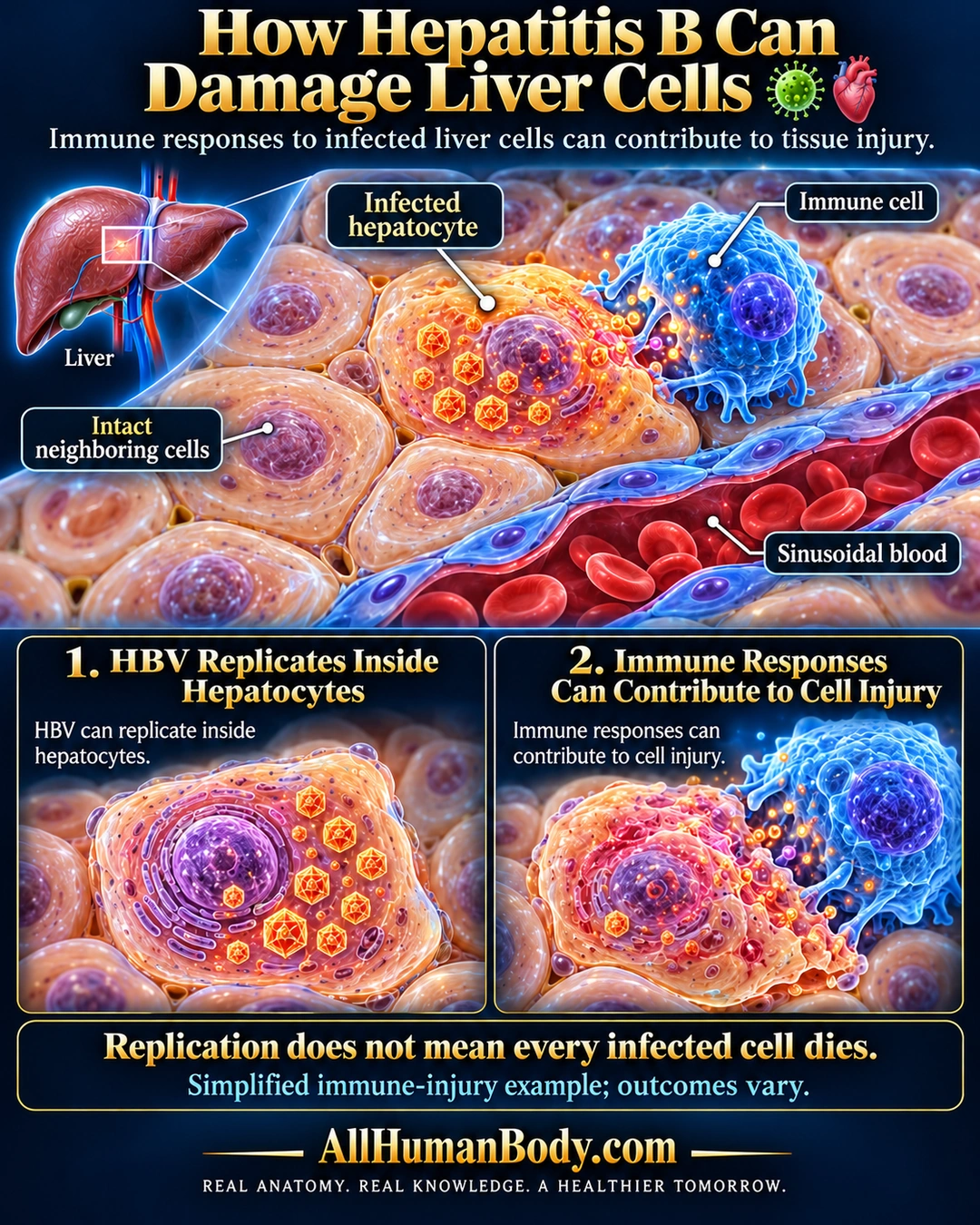
Hepatitis B virus can replicate in hepatocytes. Immune responses to infected cells can contribute to liver inflammation and injury, but replication does not mean every infected cell dies.
READ THE IMAGE
What the illustration shows
Navy and gold poster titled How Hepatitis B Can Damage Liver Cells 🦠🫀. A small liver locator connects to a magnified plate of peach hepatocytes. A cyan immune cell contacts one infected hepatocyte containing gold conceptual HBV symbols; nearby cells remain intact. Red blood cells lie inside a separate sinusoidal channel. Two lower panels distinguish replication inside a hepatocyte from a representative immune-associated injury. Text states Replication does not mean every infected cell dies and Simplified immune-injury example; outcomes vary. AllHumanBody.com and the full slogan appear below. Glowing polygon icons, their apparent intracellular positions and contact particles are conceptual, not resolved viral life-cycle or molecular anatomy.
How to interpret this poster
- No exact immune-cell subtype, universal chronic progression, transmission, screening, stigma or treatment claim. Decorative heart icon not cardiac injury.
- AI-assisted educational illustration; not physician certification, a diagnosis or individualized medical advice.
- Fine annotations require enlargement; preserve the full uncropped illustration and its qualifiers.
AI-assisted educational illustration, adapted into web-sized images without changing its composition. This is general education, not an individual diagnosis or treatment recommendation.
EVIDENCE / CONTEXT
Sources and what they support
- CDC Pink Book: Hepatitis B pathogenesis ↗
Replication in hepatocytes; historical vaccine guidance excluded.
- NIDDK: Hepatitis B ↗
Infection and varied inflammation/damage course.
- Tan, Koh and Bertoletti2015 review ↗
Immune-mediated injury and noncytolytic control, replication not inherently cell death.