Digestive / VISUAL EXPLAINER
🟢 How Gallstones Block the Bile Duct
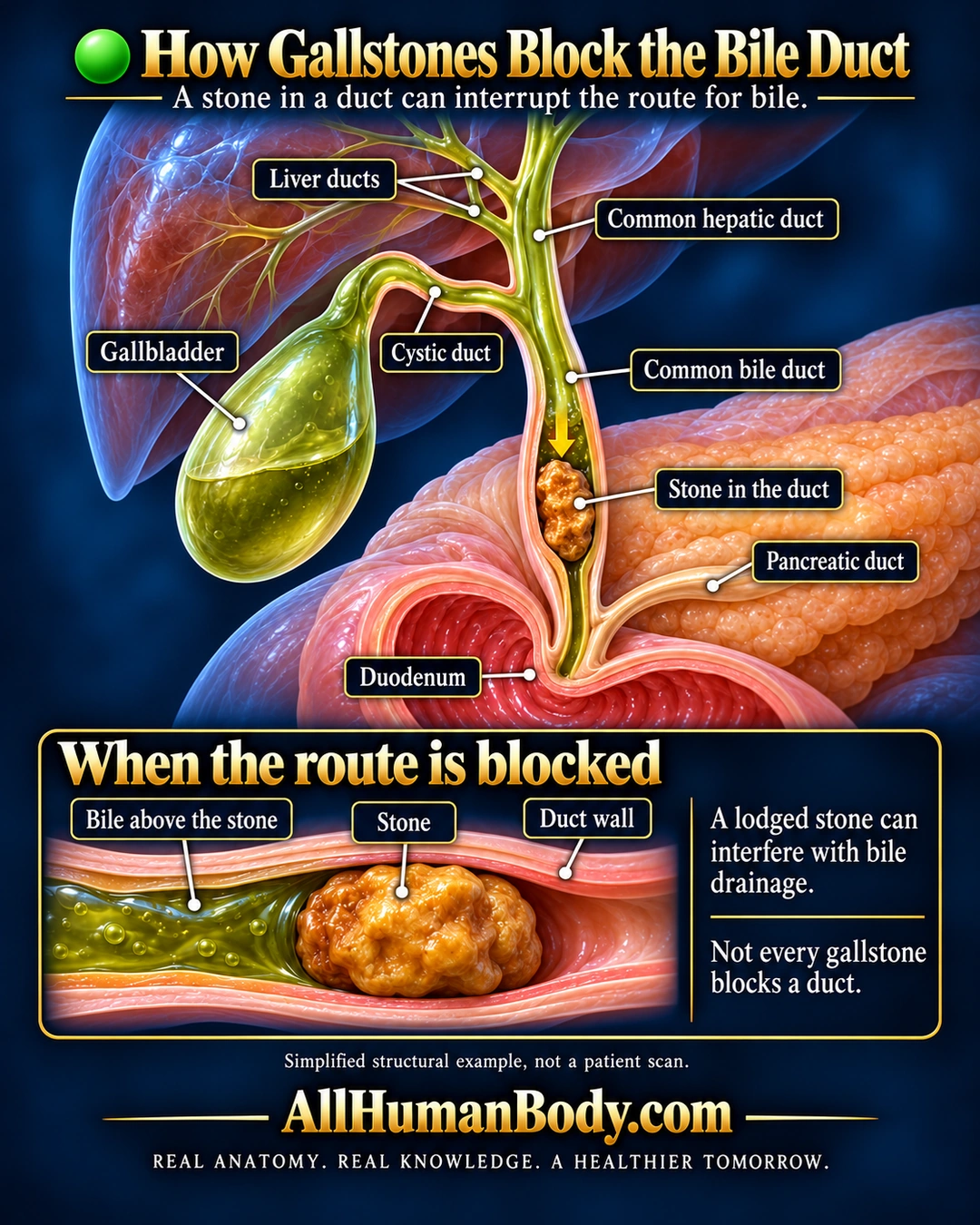
A gallstone lodged in a bile duct can interrupt bile drainage toward the duodenum. Not every gallstone blocks a duct, and this depicts one possible location.
READ THE IMAGE
What the illustration shows
Navy-and-gold anatomy poster titled ‘🟢 How Gallstones Block the Bile Duct’. Liver ducts converge into a common hepatic duct. An olive-green gallbladder on the left connects as a side branch through the cystic duct. Below that junction, a cutaway common bile duct contains one golden stone; a downward bile arrow ends above it. A pale pancreatic duct joins farther down, before a single terminal opening into the cutaway duodenum. Leaders label the ducts, gallbladder, stone and duodenum. A lower longitudinal close-up shows green bile on the upstream left of a stone occupying the duct lumen, with a pale peach duct wall. Text says a lodged stone can interfere with bile drainage and not every gallstone blocks a duct. The image is labeled a simplified structural example, not a patient scan. Gold AllHumanBody.com and the full slogan finish the plain navy footer.
How to interpret this poster
- Common-pattern junction not universal surgical map. Stone color/size, duct caliber and pressure not measured; no symptom, dietary or treatment advice.
- AI-assisted educational illustration; not physician certification, a diagnosis or individualized medical advice.
- Fine annotations require enlargement; preserve the full uncropped illustration and its qualifiers.
AI-assisted educational illustration, adapted into web-sized images without changing its composition. This is general education, not an individual diagnosis or treatment recommendation.
EVIDENCE / CONTEXT
Sources and what they support
- NIDDK: Gallstones definition and facts ↗
Duct obstruction versus nonobstructing stones and bile delivery.
- NHS: Gallstones ↗
Stones may lodge in bile ducts including common bile duct.