Musculoskeletal / VISUAL EXPLAINER
🦴 How a Hamstring Strain Happens During Sudden Movement!
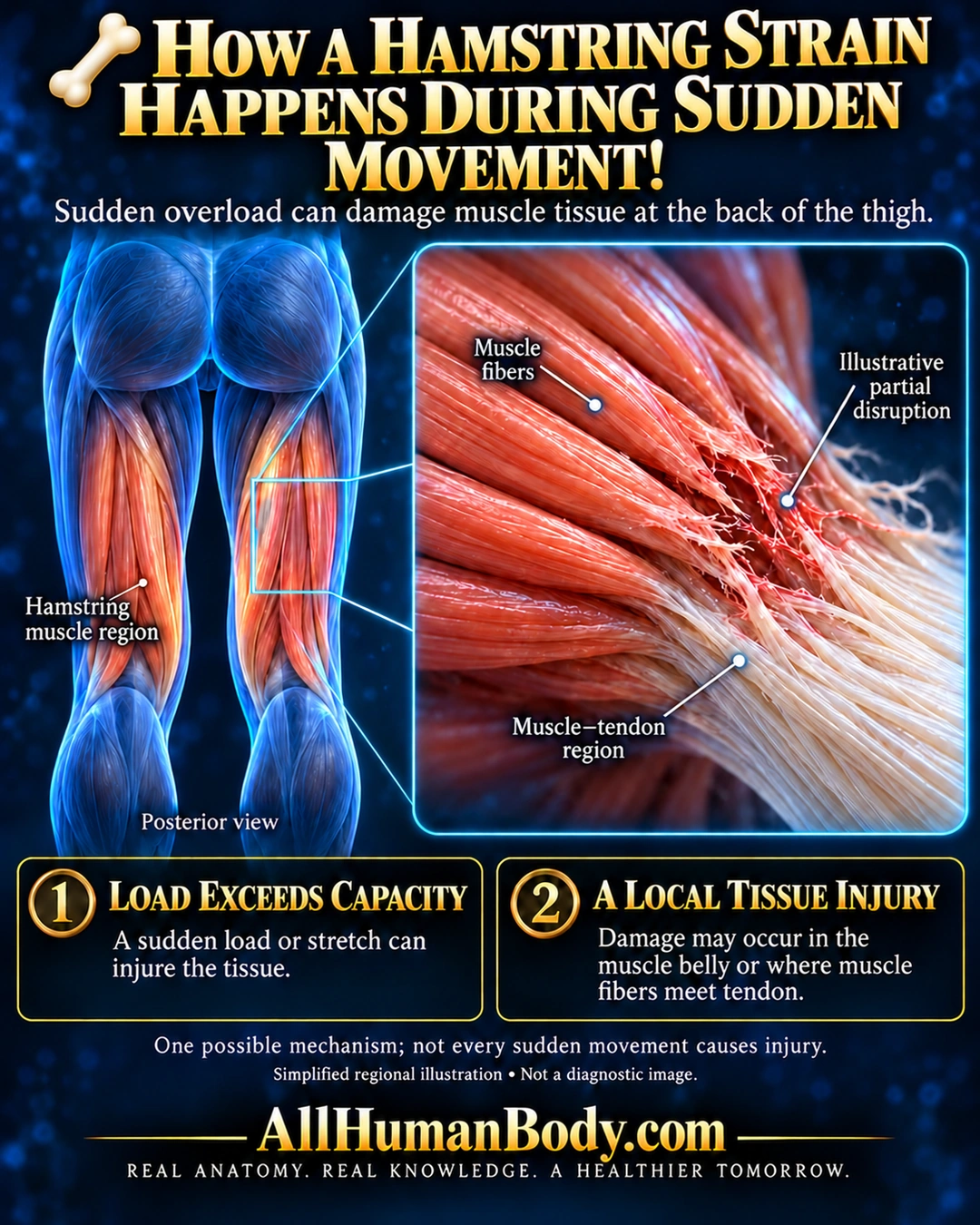
A sudden load or stretch beyond tissue capacity can strain the hamstrings at the back of the thigh. Damage may involve the muscle belly or the muscle–tendon region; not every sudden movement causes injury.
READ THE IMAGE
What the illustration shows
A bone symbol precedes the gold heading “How a Hamstring Strain Happens During Sudden Movement!”. A blue posterior lower-body locator highlights peach hamstring tissue at the back of the thighs. A labeled hamstring region and cyan selection window lead to a large local close-up of peach muscle fibers transitioning to ivory tendon. Several central fibers are frayed and disrupted while surrounding bundles remain continuous. Labels identify muscle fibers, muscle–tendon region and illustrative partial disruption. Two panels explain excess load and local tissue injury; a qualifier says not every sudden movement causes injury. Gold AllHumanBody.com and the project slogan appear below.
How to interpret this poster
- Conceptual partial disruption, not exact grade, sprint phase, safe load, recovery timeline or exercise prescription.
- AI-assisted educational illustration; not physician certification, a diagnosis or individualized medical advice.
- Fine annotations require enlargement; preserve the full uncropped illustration and its qualifiers.
AI-assisted educational illustration, adapted into web-sized images without changing its composition. This is general education, not an individual diagnosis or treatment recommendation.
EVIDENCE / CONTEXT
Sources and what they support
- AAOS: Hamstring muscle injuries ↗
Overload strain and possible muscle/myotendinous injury sites.