Digestive / VISUAL EXPLAINER
How an Esophageal Stricture Makes Swallowing Difficult
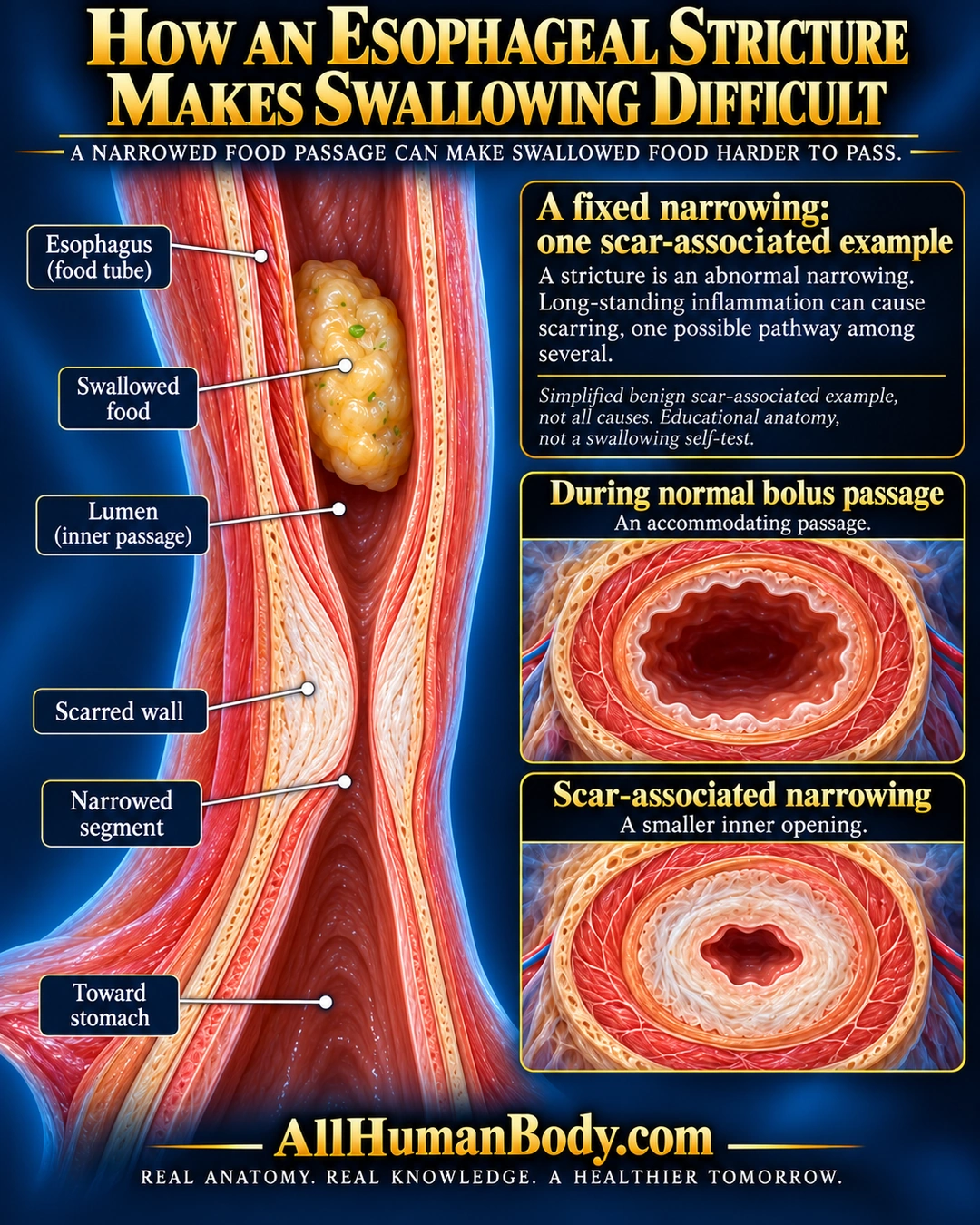
An esophageal stricture is an abnormal narrowing that can hinder swallowed food. Long-standing inflammation can cause scarring, one possible pathway among several.
READ THE IMAGE
What the illustration shows
Gold headline reads How an Esophageal Stricture Makes Swallowing Difficult. Large left longitudinal cutaway shows food within the upper esophageal lumen, above a pale scar-thickened segment. A visibly narrow dark passage stays continuous through the scar to the lower lumen toward the stomach. Leaders label food tube, food, lumen, scarred wall, narrowed segment and direction toward stomach. Two right-hand cross-sections compare an accommodating lumen during normal bolus passage with a smaller opening surrounded by scar-associated wall thickening. Copy describes one possible inflammation-to-scarring pathway and explicitly limits the example to benign scar-associated narrowing, not all causes or a swallowing self-test. Smooth navy/cyan context, luminous coral and ivory tissue, gold AllHumanBody.com and exact slogan.
How to interpret this poster
- Benign scar-associated example only; not all causes, swallowing self-test, choking assessment or treatment. Widths and food shape illustrative.
- AI-assisted educational illustration; not physician certification, a diagnosis or individualized medical advice.
- Fine annotations require enlargement; preserve the full uncropped illustration and its qualifiers.
AI-assisted educational illustration, adapted into web-sized images without changing its composition. This is general education, not an individual diagnosis or treatment recommendation.
EVIDENCE / CONTEXT
Sources and what they support
- MedlinePlus: Benign esophageal stricture ↗
Narrowing and swallowing difficulty with multiple causes.
- NIDDK: GERD definition and complications ↗
Chronic inflammation/stricture and swallowing difficulty.
- Cleveland Clinic: Esophageal strictures ↗
Fibrotic narrowing as one pathway; causes differ.