Integumentary / VISUAL EXPLAINER
How Can Fungus Change a Toenail?
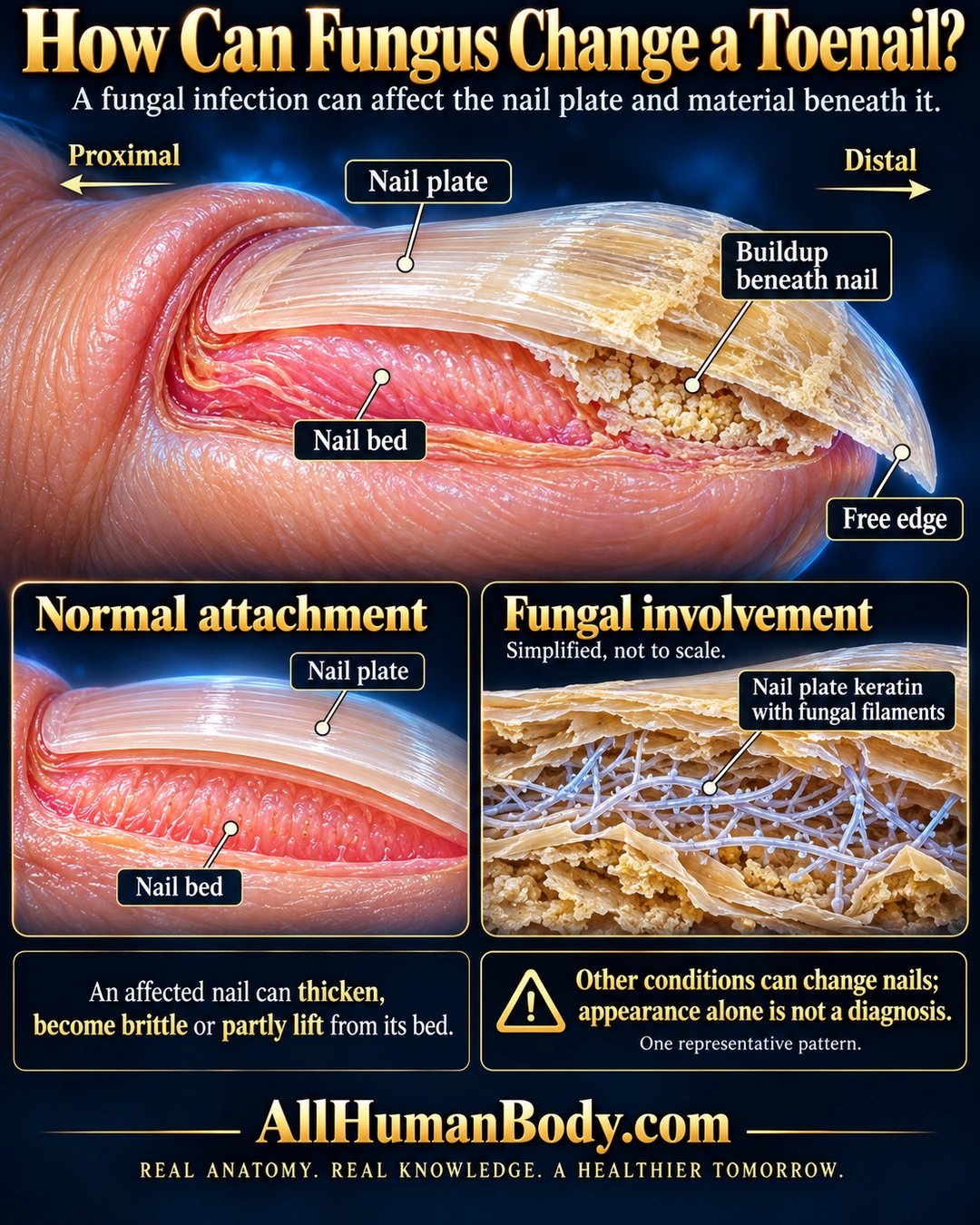
Fungal infection can affect the nail plate and material beneath it. An affected nail may thicken, become brittle or partly separate from its bed, but appearance alone does not establish a fungal cause.
READ THE IMAGE
What the illustration shows
Educational poster titled How Can Fungus Change a Toenail? A longitudinal oblique nail cutaway runs from proximal fold on the left to distal free edge on the right. The ivory nail plate stays attached proximally above a peach living nail bed. Distally, rough thickened plate overlies cream granular buildup and partial separation. Leaders identify plate, bed, buildup and free edge. Lower panels compare normal plate-to-bed attachment and enlarged schematic fungal filaments in nail keratin. Text says an affected nail can thicken, become brittle or partly lift, and that appearance alone is not a diagnosis. Gold AllHumanBody.com and the complete slogan appear on plain navy.
How to interpret this poster
- One representative pattern, not all fungal disease or species identification. Fine filaments/lamellae illustrative, no scraping or treatment advice.
- AI-assisted educational illustration; not physician certification, a diagnosis or individualized medical advice.
- Fine annotations require enlargement; preserve the full uncropped illustration and its qualifiers.
AI-assisted educational illustration, adapted into web-sized images without changing its composition. This is general education, not an individual diagnosis or treatment recommendation.
EVIDENCE / CONTEXT
Sources and what they support
- AAD: Nail fungus overview ↗
Plate/underlying involvement and diagnostic uncertainty.
- AAD: Nail fungus symptoms ↗
Thickening, brittleness, buildup and lifting.
- EADV: Fungal nail infections ↗
Plate infection and nonfungal nail changes.