Respiratory / VISUAL EXPLAINER
How Can Air Around a Lung Make It Collapse?
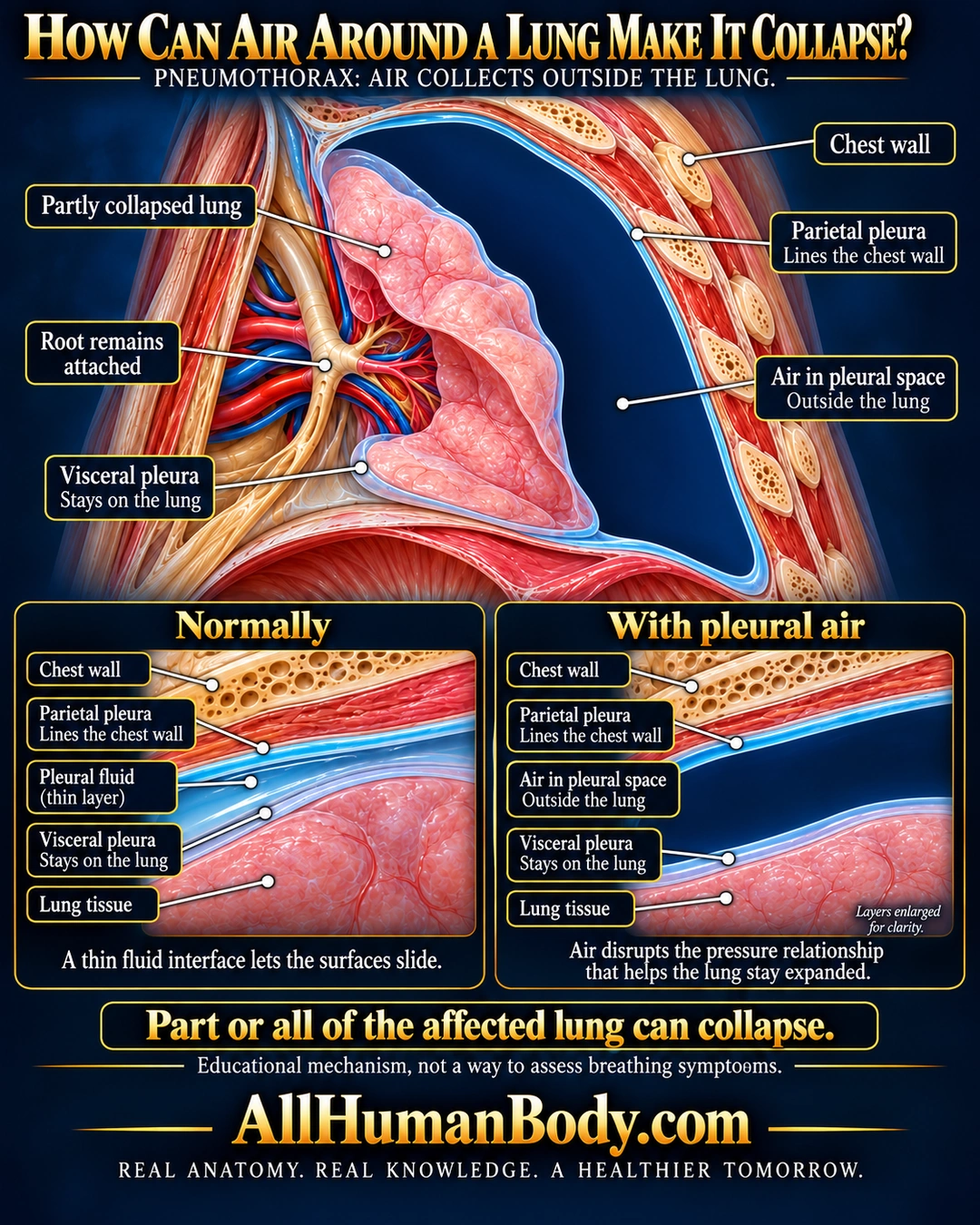
In pneumothorax, air collects outside the lung in the pleural space. This disrupts the pressure relationship that helps the lung remain expanded, so part or all of the affected lung can collapse.
READ THE IMAGE
What the illustration shows
An English educational poster titled “How Can Air Around a Lung Make It Collapse?” A single chest cutaway shows a partly retracted peach-colored lung connected at its root to a bronchus and red and blue vessels. A thin visceral covering stays directly on the lung; a separate parietal lining follows the inner rib cage and diaphragm. A wide dark-blue interval labeled air in pleural space lies between these coverings, outside the lung. Below, two enlarged layer diagrams compare the normally thin fluid interface with a widened air interval. The poster says pleural air disrupts the pressure relationship that helps keep the lung expanded and that part or all of the affected lung can collapse. It is labeled educational mechanism, not a way to assess breathing symptoms. Gold AllHumanBody.com branding appears on a plain navy footer.
How to interpret this poster
- Layers exaggerated; not numerical pressure, tension-pneumothorax progression or severity assessment. No emergency procedure or symptom-management advice.
- AI-assisted educational illustration; not physician certification, a diagnosis or individualized medical advice.
- Fine annotations require enlargement; preserve the full uncropped illustration and its qualifiers.
AI-assisted educational illustration, adapted into web-sized images without changing its composition. This is general education, not an individual diagnosis or treatment recommendation.
EVIDENCE / CONTEXT
Sources and what they support
- NHLBI: Pleural disorder types ↗
Pleural air and partial or complete collapse.
- American Thoracic Society: Spontaneous pneumothorax ↗
Air outside lung impedes expansion.
- NHLBI: Pleural disorders ↗
Two pleural layers and normal thin fluid interface.