Musculoskeletal / VISUAL EXPLAINER
Why Does a Bunion Make the Big-Toe Joint Stick Out?
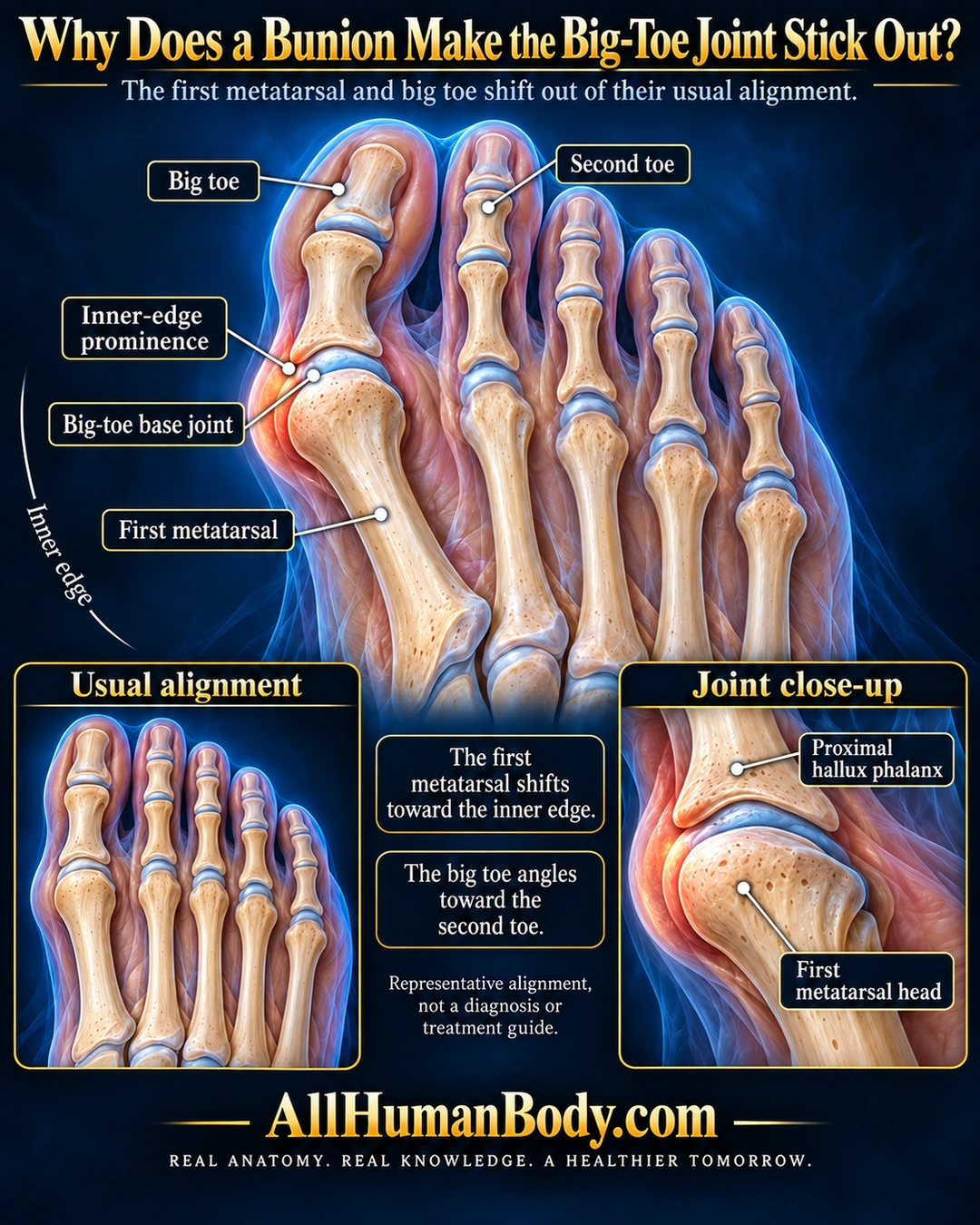
A bunion involves altered alignment around the big-toe base joint. The first metatarsal shifts toward the inner edge while the toe angles toward the second toe, making the joint region more prominent.
READ THE IMAGE
What the illustration shows
Gold headline asks why a bunion makes the big-toe joint stick out. A dorsal right forefoot has five toe rays under a translucent blue and peach skin outline. On the inner edge at image left, the first metatarsal deviates medially while the two-bone big toe angles toward the second toe. Leaders identify the first metatarsal, big and second toes, inner-edge prominence and big-toe base joint. Lower panels show usual alignment and an enlarged first metatarsal head articulating with the proximal hallux phalanx. The image states that this is representative alignment, not a diagnosis or treatment guide. Navy background with gold AllHumanBody.com and the project slogan.
How to interpret this poster
- Representative alignment, not measured angles, inevitable progression, symptom diagnosis or treatment. Not a separate loose bone growing out of the toe.
- AI-assisted educational illustration; not physician certification, a diagnosis or individualized medical advice.
- Fine annotations require enlargement; preserve the full uncropped illustration and its qualifiers.
AI-assisted educational illustration, adapted into web-sized images without changing its composition. This is general education, not an individual diagnosis or treatment recommendation.
EVIDENCE / CONTEXT
Sources and what they support
- AAOS: Bunions ↗
First-MTP prominence and opposing bone alignment.
- Guy’s and St Thomas’: Bunions ↗
Alignment changes and variable pain, not size/severity equation.