Musculoskeletal / VISUAL EXPLAINER
Why Can a Finger Catch When You Straighten It?
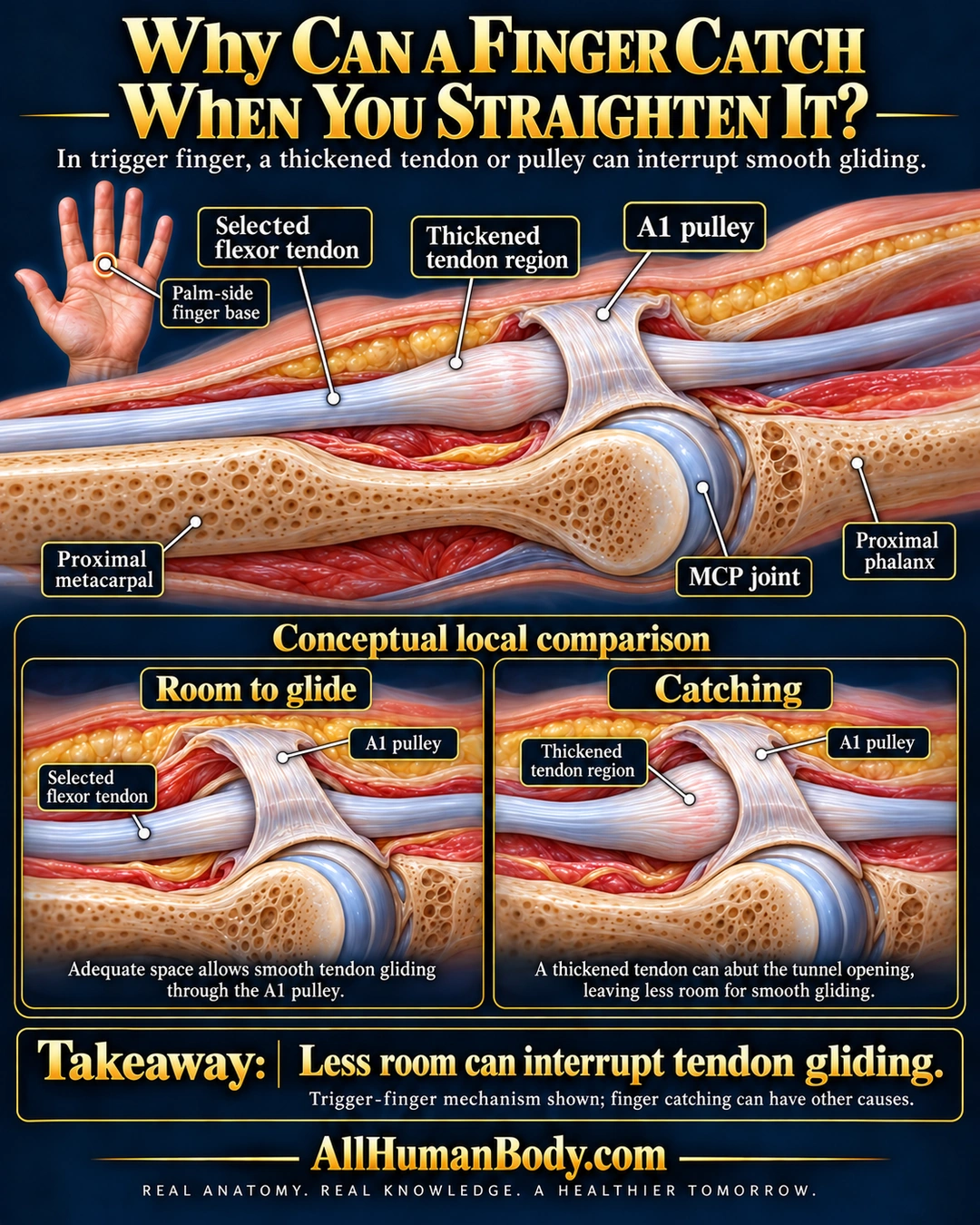
Flexor tendons normally glide beneath retaining pulleys. In trigger finger, a thickened tendon or pulley can leave less room and interrupt that glide. Finger catching can have other causes.
READ THE IMAGE
What the illustration shows
Gold headline asks why a finger can catch when straightened. A small palm-view hand marks the middle-finger base. A large local cutaway shows one continuous metacarpal meeting a proximal phalanx at the MCP joint. Above the joint on the palm side, an ivory selected flexor tendon passes through a fibrous A1 pulley; a pale peach thickened region lies beside the opening. Lower conceptual panels compare room to glide with tendon thickening abutting the opening. Text says less room can interrupt tendon gliding and that finger catching can have other causes. Navy background, gold AllHumanBody.com and the project slogan.
How to interpret this poster
- Selected tendon, not full tendon/ligament inventory. Conceptual comparison not measured clearance, compulsory lesion or treatment before/after.
- AI-assisted educational illustration; not physician certification, a diagnosis or individualized medical advice.
- Fine annotations require enlargement; preserve the full uncropped illustration and its qualifiers.
AI-assisted educational illustration, adapted into web-sized images without changing its composition. This is general education, not an individual diagnosis or treatment recommendation.
EVIDENCE / CONTEXT
Sources and what they support
- AAOS: Trigger finger ↗
A1 location, size mismatch and catching during straightening.
- NHS: Trigger finger ↗
Thickened tendon may catch and lock.