Respiratory / VISUAL EXPLAINER
How Does Emphysema Change the Lungs’ Air Sacs?
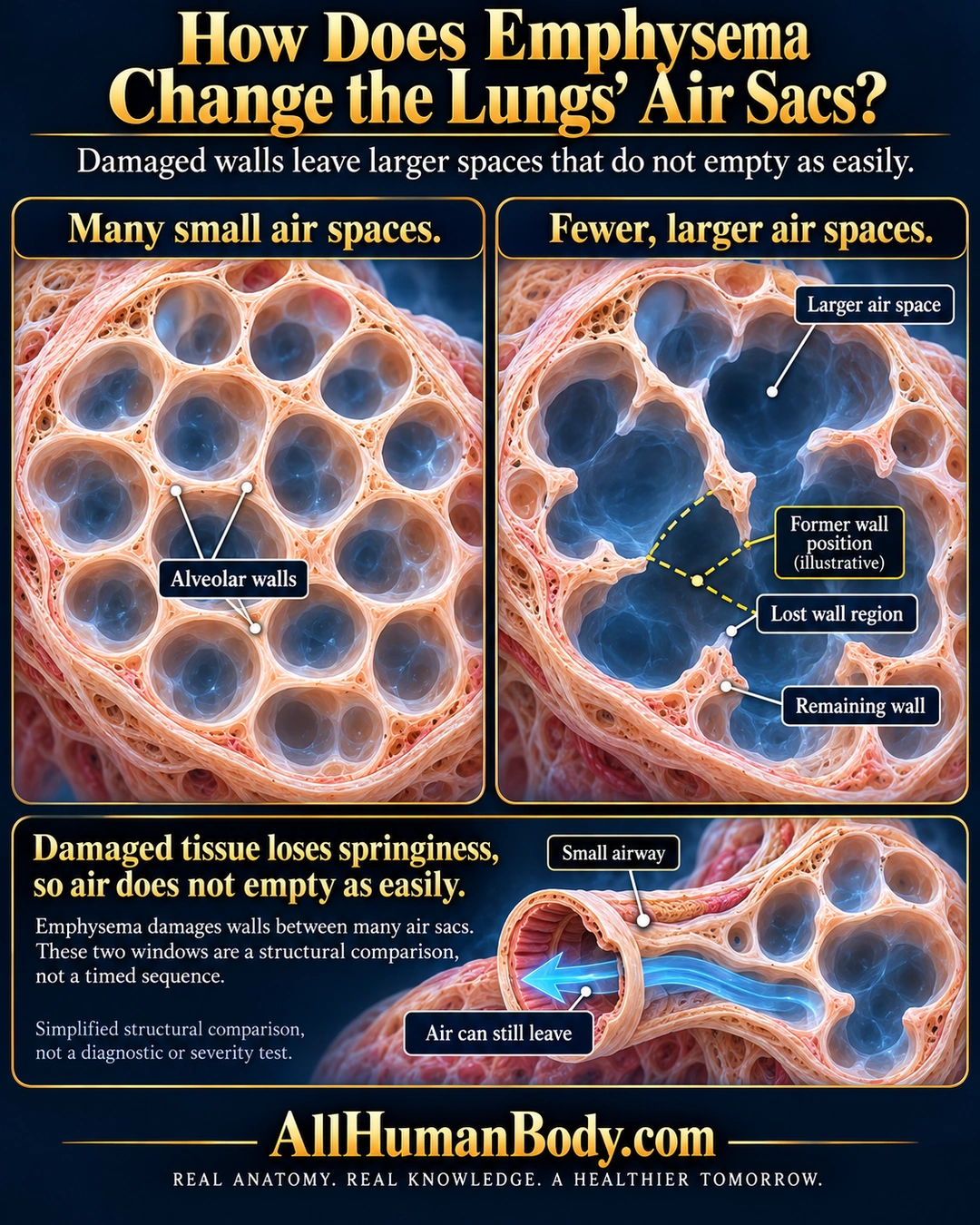
Emphysema damages walls between air sacs, leaving fewer and larger spaces. Damaged tissue loses springiness, so air does not empty as easily. Air is not completely sealed inside.
READ THE IMAGE
What the illustration shows
English educational poster titled “How Does Emphysema Change the Lungs’ Air Sacs?” on midnight navy. Two large dimensional tissue windows compare many small blue air spaces separated by peach shared walls with fewer, larger irregular communicating spaces after internal wall loss. Both keep a surrounding tissue boundary. Labels identify alveolar walls, a larger air space, lost-wall region and remaining wall. A short dashed gold trace indicates an illustrative former wall position; it is not remaining tissue. Below, text explains that damaged tissue loses springiness and air does not empty as easily. A small open airway cutaway has a cyan arrow pointing outward from the air spaces and the label “Air can still leave.” Text clarifies that the windows are a structural comparison, not a timed sequence or diagnostic or severity test. Gold AllHumanBody.com and the full slogan appear on a plain navy footer.
How to interpret this poster
- Not timed sequence, whole lungs, diagnostic/severity test or exact surface-area calculation. COPD not equated to asthma; no cause blame or treatment.
- AI-assisted educational illustration; not physician certification, a diagnosis or individualized medical advice.
- Fine annotations require enlargement; preserve the full uncropped illustration and its qualifiers.
AI-assisted educational illustration, adapted into web-sized images without changing its composition. This is general education, not an individual diagnosis or treatment recommendation.
EVIDENCE / CONTEXT
Sources and what they support
- MedlinePlus: Emphysema ↗
Damaged walls and larger airspaces.
- American Thoracic Society: COPD ↗
Emphysema wall damage, lost springiness and harder emptying.