Musculoskeletal / VISUAL EXPLAINER
How Can a Slipped Disc Irritate a Nerve?
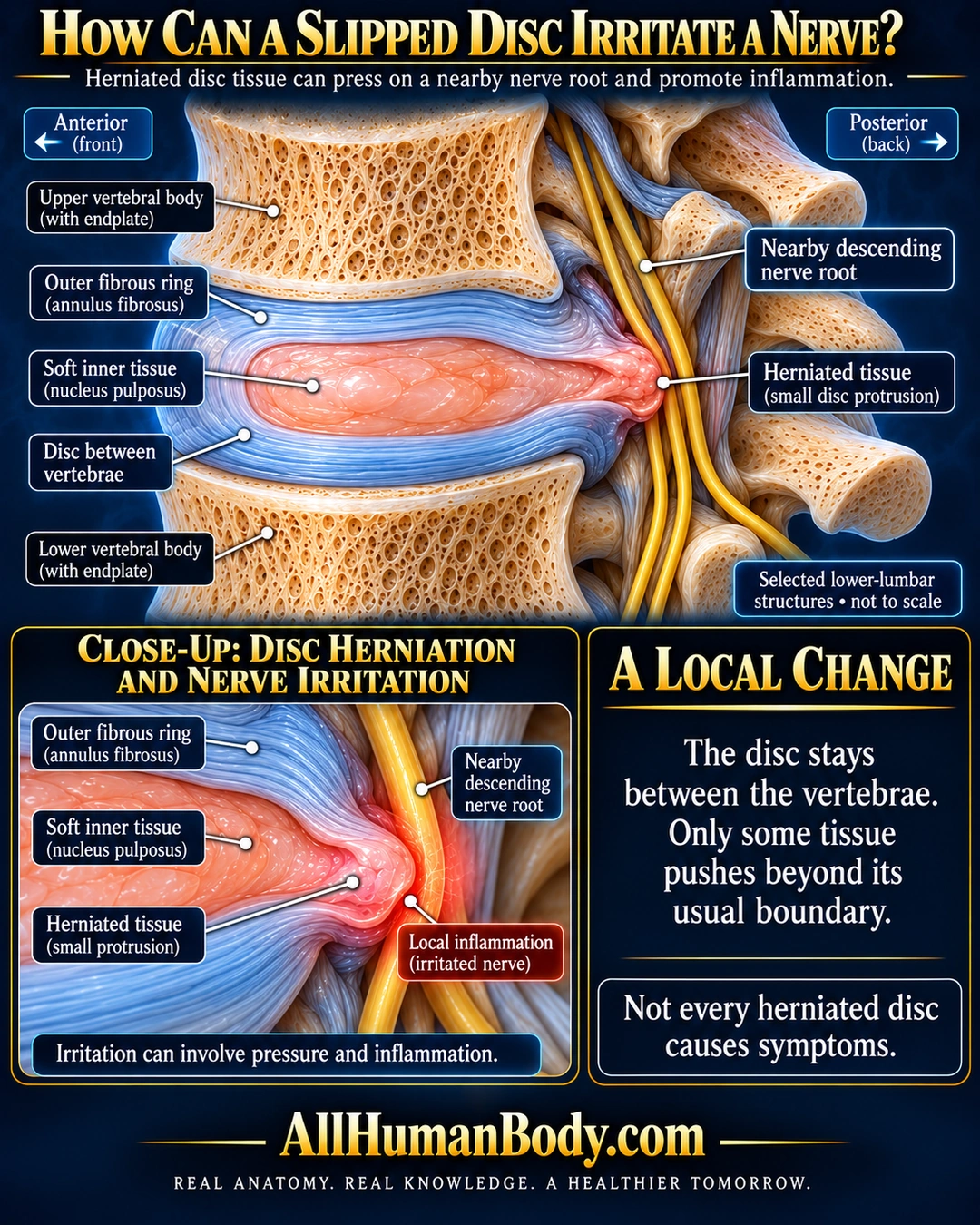
Herniated disc tissue can push beyond its usual boundary and press on a nearby nerve root. Inflammation can also contribute to irritation. Not every herniation causes symptoms.
READ THE IMAGE
What the illustration shows
English educational poster on a navy background titled How Can a Slipped Disc Irritate a Nerve? An oblique cutaway shows an ivory upper and lower vertebral body sandwiching a blue fibrous disc ring and peach inner tissue. A small posterior protrusion reaches beside slender golden descending nerve roots. Anterior is marked left and posterior right. White leaders identify vertebral bodies, outer ring, inner tissue, disc, protrusion and a nearby descending root. A lower-left close-up shows the focal protrusion and a red conceptual inflammation halo beside one continuous root. A text panel explains that the disc remains between vertebrae and only some tissue pushes beyond its usual boundary. A visible qualification says not every herniated disc causes symptoms. Gold AllHumanBody.com and the full project slogan appear on a plain navy footer. Selected structures are not to scale; no exact spinal level or symptom map is shown.
How to interpret this poster
- Selected lower-lumbar anatomy, not exact level, root trajectory, scan or symptom map. Red halo conceptual, not inflammatory measurement; no exercise or treatment.
- AI-assisted educational illustration; not physician certification, a diagnosis or individualized medical advice.
- Fine annotations require enlargement; preserve the full uncropped illustration and its qualifiers.
AI-assisted educational illustration, adapted into web-sized images without changing its composition. This is general education, not an individual diagnosis or treatment recommendation.
EVIDENCE / CONTEXT
Sources and what they support
- AAOS: Herniated disk in the lower back ↗
Disc displacement, root pressure and chemical inflammatory contribution.
- NHS: Slipped disc ↗
Not all herniations symptomatic.
- UTHealth Neuroscience Online: Spinal anatomy ↗
Adult cord ending and descending roots as anatomy guard only.