Digestive / VISUAL EXPLAINER
How Can an Ulcer Form Inside Your Stomach?
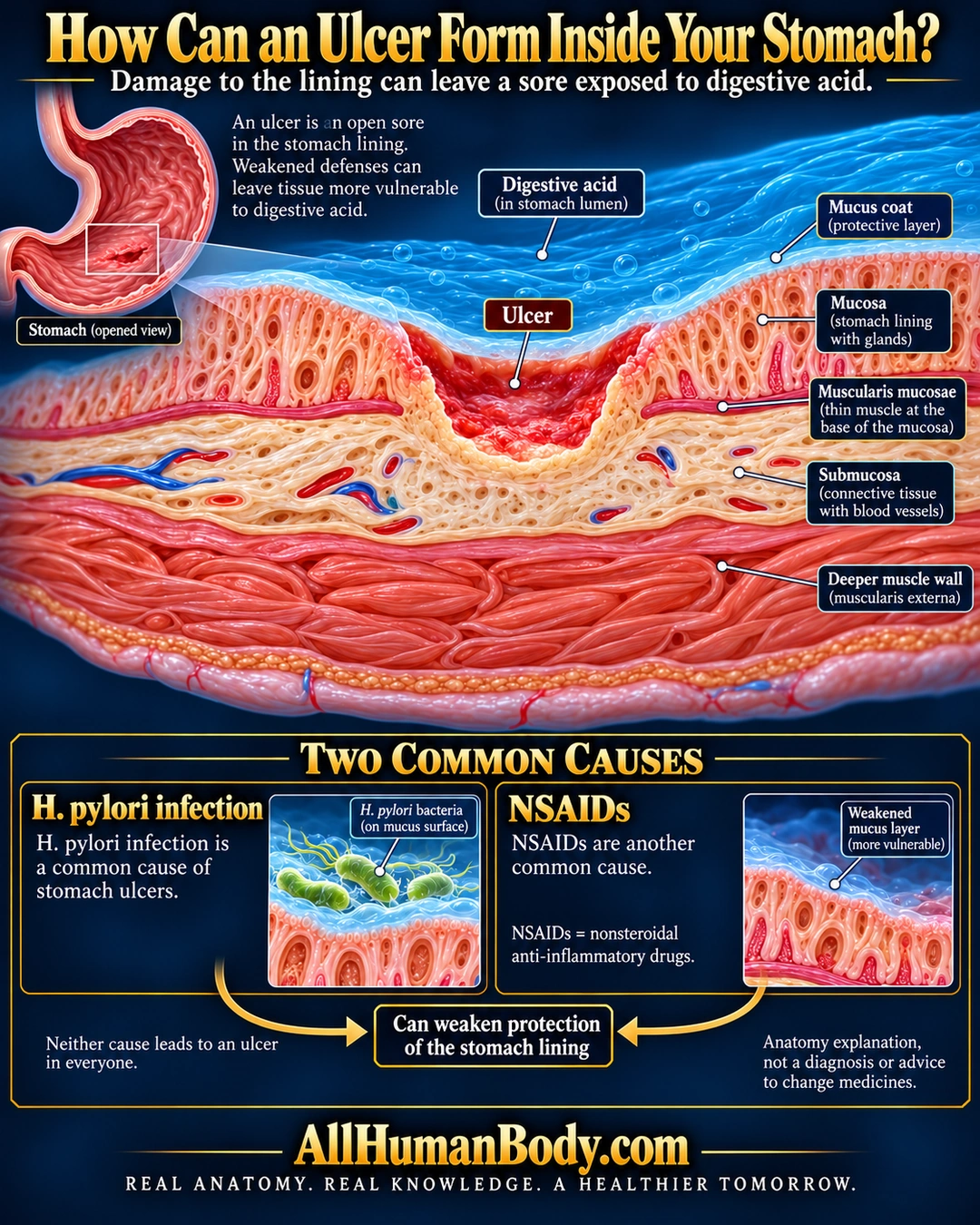
A stomach ulcer is an open sore in the lining. H. pylori infection and nonsteroidal anti-inflammatory drugs are common causes that can weaken protection, leaving tissue vulnerable to digestive acid. Neither causes an ulcer in everyone.
READ THE IMAGE
What the illustration shows
Gold-titled poster asks how an ulcer can form inside the stomach. A small opened-stomach view locates a sore. A dominant layered wall section shows a central crater crossing the lining and its thin basal muscle into shallow submucosa; deeper muscle and the outer wall remain intact. Blue stomach contents lie above a thin pale mucus coat on adjacent intact lining. Leaders identify digestive acid, mucus, mucosa, muscularis mucosae, submucosa and deeper muscle. Two lower panels name H. pylori infection and NSAIDs as common causes that can weaken protection, with a note that neither causes an ulcer in everyone. A qualifier says the image is not a diagnosis or advice to change medicines. Gold AllHumanBody.com branding and the full slogan appear below. The anatomy is illustrative and not to scale.
How to interpret this poster
- Simplified mucus depiction does not exhaust protective mechanisms. Not a perforation, symptom diagnosis or advice to start/stop/change medicines.
- AI-assisted educational illustration; not physician certification, a diagnosis or individualized medical advice.
- Fine annotations require enlargement; preserve the full uncropped illustration and its qualifiers.
AI-assisted educational illustration, adapted into web-sized images without changing its composition. This is general education, not an individual diagnosis or treatment recommendation.
EVIDENCE / CONTEXT
Sources and what they support
- NIDDK: Peptic ulcer causes ↗
H. pylori and NSAIDs as common causes.
- Mayo Clinic: Peptic ulcer ↗
Protection/acid relationship and non-universal infection outcome.
- MSD Professional: Peptic ulcer disease ↗
Ulcer depth beyond muscularis mucosae and defense disruption.