Integumentary / VISUAL EXPLAINER
Why Does Psoriasis Form Thick, Scaly Patches?
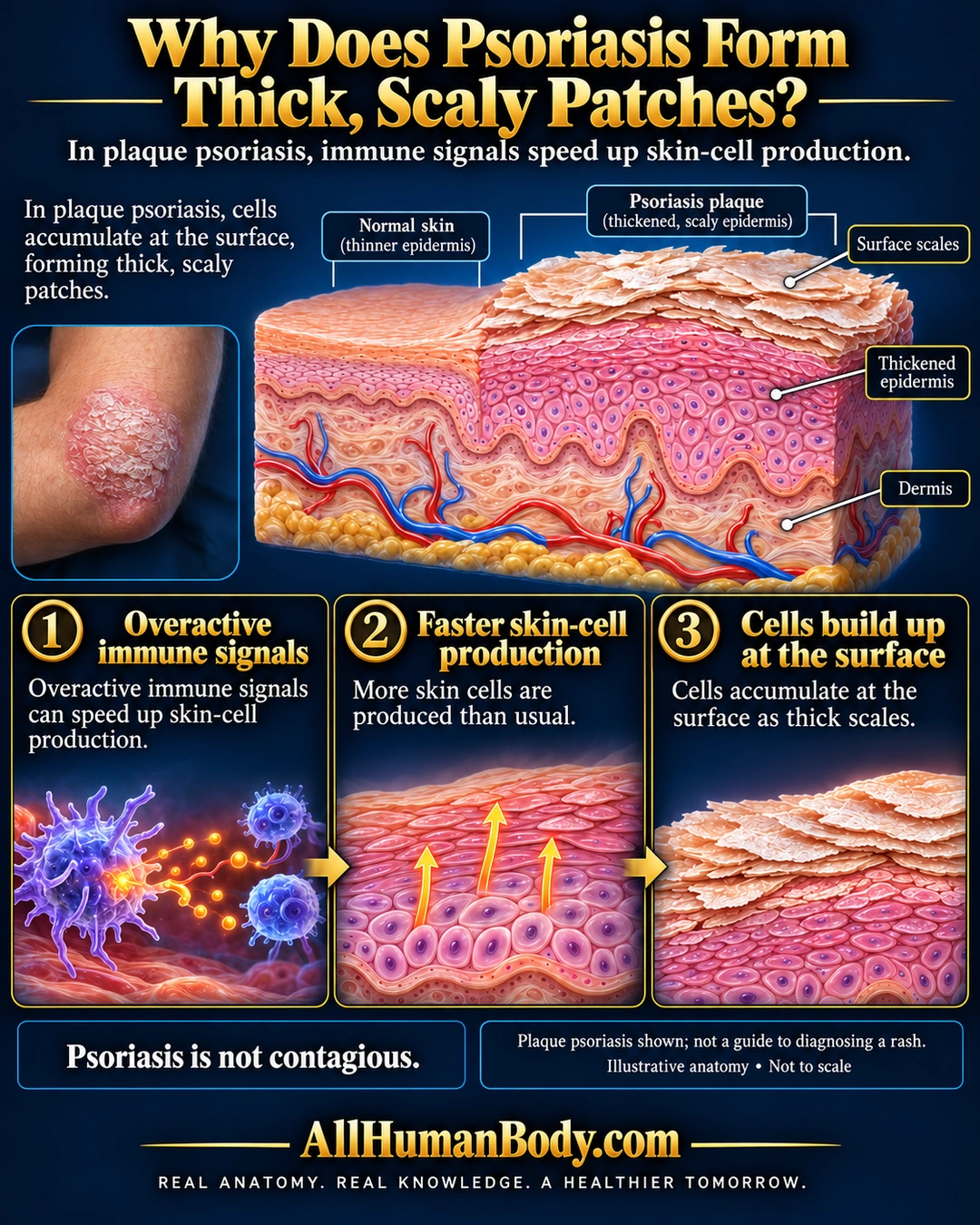
In plaque psoriasis, overactive immune signaling can speed skin-cell production and contribute to thick, scaly patches. Psoriasis is not contagious. This illustrates plaque psoriasis, not every psoriasis type or rash.
READ THE IMAGE
What the illustration shows
Gold-titled poster asks why psoriasis forms thick, scaly patches. On a navy background, an elbow inset shows a dry scaly patch. A large cutaway compares thinner normal epidermis at left with thickened cellular epidermis and stacked pale surface scales at right; the underlying dermis contains red and blue vessels. Leaders identify scales, epidermis and dermis. Three panels link overactive immune signals, faster skin-cell production and cell buildup at the surface. Text states that psoriasis is not contagious and that plaque psoriasis is shown, not a guide to diagnosing a rash. Gold AllHumanBody.com branding and the full slogan appear on a plain navy footer.
How to interpret this poster
- Numbered panels are explanatory, not an exact cellular timetable or individual cause. No rash diagnosis, treatment or hygiene blame.
- AI-assisted educational illustration; not physician certification, a diagnosis or individualized medical advice.
- Fine annotations require enlargement; preserve the full uncropped illustration and its qualifiers.
AI-assisted educational illustration, adapted into web-sized images without changing its composition. This is general education, not an individual diagnosis or treatment recommendation.
EVIDENCE / CONTEXT
Sources and what they support
- NIAMS: Psoriasis ↗
Immune overactivity and accelerated cell production.
- AAD: What is psoriasis? ↗
Surface buildup, type variation and noncontagiousness.