Digestive / VISUAL EXPLAINER
How Can Acid Wear Away Tooth Enamel?
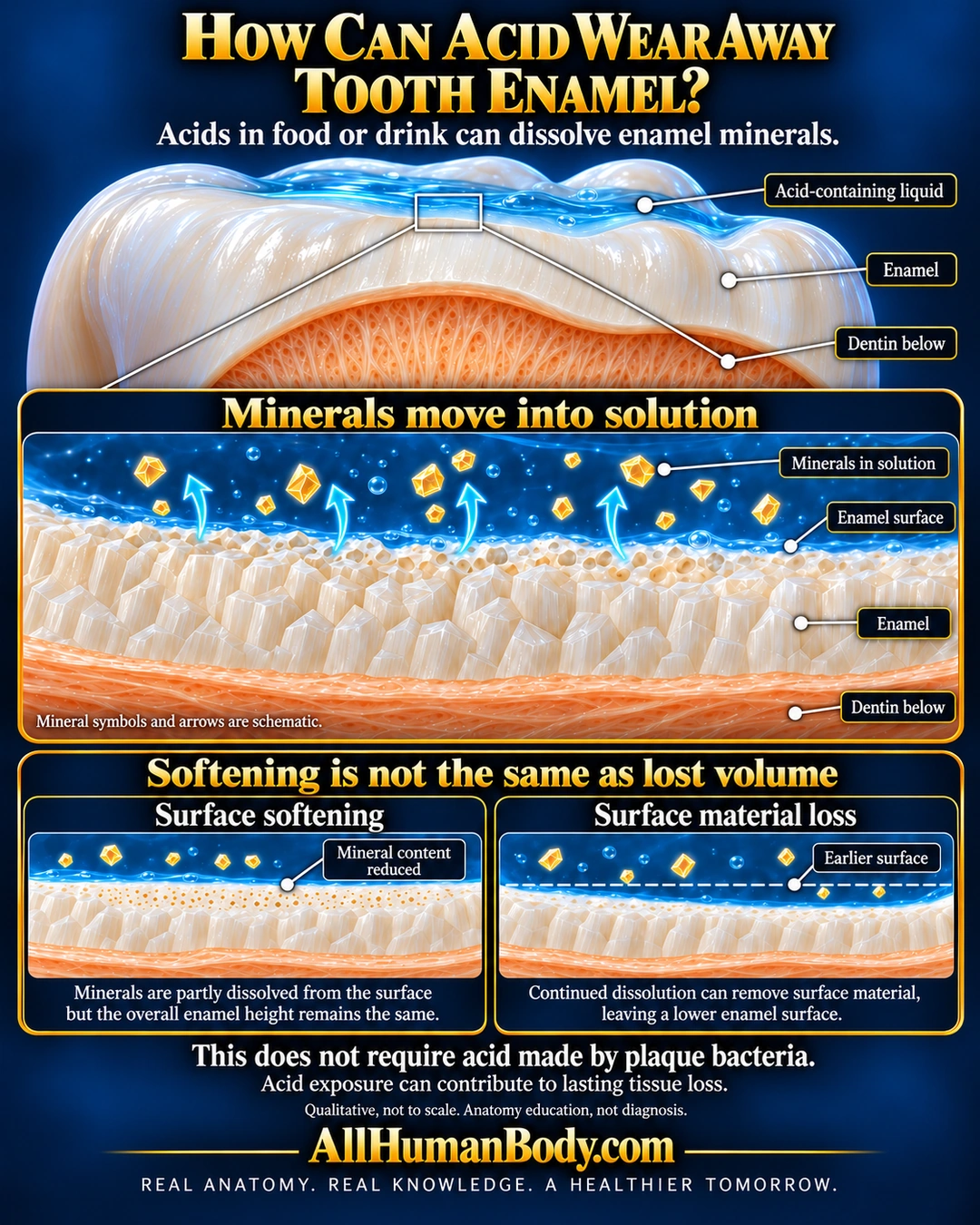
Dietary acids can dissolve enamel minerals without requiring acid made by plaque bacteria. Surface softening and loss of surface material are different changes; continued dissolution can contribute to lasting tissue loss.
READ THE IMAGE
What the illustration shows
A navy-and-gold educational poster titled 'How Can Acid Wear Away Tooth Enamel?' The upper panel shows a partial tooth crown with white enamel above peach dentin and a blue acid-containing liquid film on top. A boxed surface region links to a magnified interface. Short cyan arrows point outward from enamel into liquid containing gold mineral symbols. Labels identify minerals in solution, enamel surface, enamel and dentin below. Two lower panels distinguish surface softening, with a shallow dotted zone and preserved overall height, from surface material loss, with a lower enamel boundary beneath a dashed earlier-surface guide. Both retain enamel above dentin. Text states that the process does not require acid made by plaque bacteria and can contribute to lasting tissue loss. Symbols and arrows are explicitly schematic. The plain navy footer has gold AllHumanBody.com and the full slogan REAL ANATOMY. REAL KNOWLEDGE. A HEALTHIER TOMORROW.
How to interpret this poster
- Gold symbols are not dissolved ions drawn to scale. Idealized softening/height comparison is not a measured zero-loss patient sequence; no dietary or dental-care advice.
- AI-assisted educational illustration; not physician certification, a diagnosis or individualized medical advice.
- Fine annotations require enlargement; preserve the full uncropped illustration and its qualifiers.
AI-assisted educational illustration, adapted into web-sized images without changing its composition. This is general education, not an individual diagnosis or treatment recommendation.
EVIDENCE / CONTEXT
Sources and what they support
- ADA: Dental erosion ↗
Nonbacterial acid dissolution and irreversible mineral-substance loss, not sole support for initial-softening distinction.
- Acquired enamel pellicle and acid-induced erosion ↗
Separate hardness and tissue-volume outcomes in laboratory human enamel.
Evidence correspondence is limited to the abstract.