Integumentary / VISUAL EXPLAINER
Why Can a Tiny Hangnail Hurt So Much?
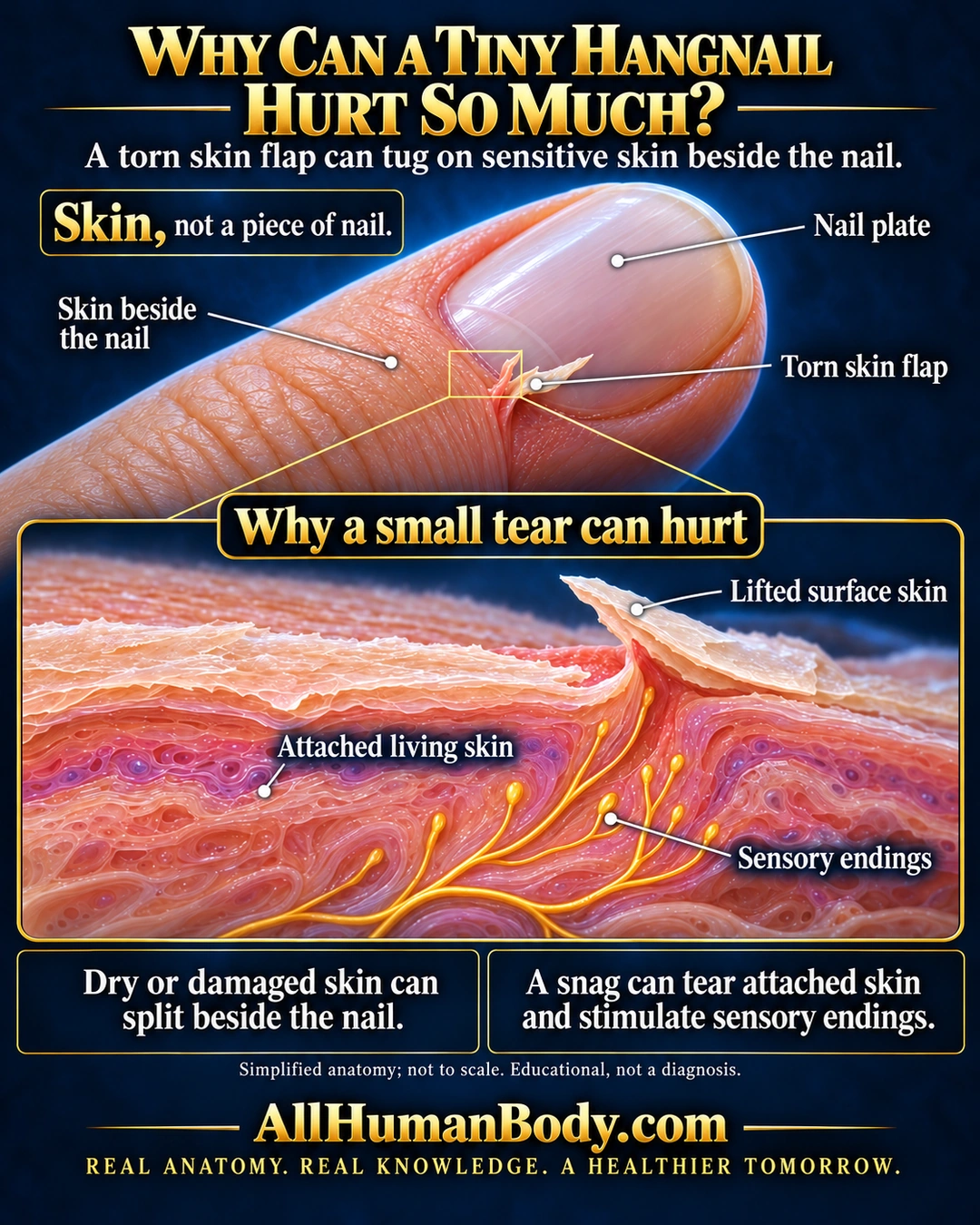
A hangnail is torn skin beside the nail, not a piece of nail plate. A snag can pull on attached sensitive skin and cause pain. Dry or damaged surrounding skin can split into a flap.
READ THE IMAGE
What the illustration shows
Educational poster titled Why Can a Tiny Hangnail Hurt So Much? on a midnight-navy background. An oblique adult finger has a smooth intact nail and a small lifted skin flap beside its edge, labeled Nail plate, Skin beside the nail and Torn skin flap. A prominent box says Skin, not a piece of nail. Gold magnification lines lead to a large skin-only cutaway showing a pale superficial flap attached at its base above living peach tissue. Sparse gold sensory branches lie within the living tissue beneath and beside the tear, not in the lifted pale flap. Labels identify Lifted surface skin, Attached living skin and Sensory endings. Two lower text boxes explain that dry or damaged skin can split and a snag can tear attached skin and stimulate sensory endings. A small educational/not-to-scale note precedes a plain navy footer with gold AllHumanBody.com and the full brand slogan.
How to interpret this poster
- No removal, manicure or prevention instructions. Sensory branches conceptual, not measured nerve density; no infection or harmlessness inference.
- AI-assisted educational illustration; not physician certification, a diagnosis or individualized medical advice.
- Fine annotations require enlargement; preserve the full uncropped illustration and its qualifiers.
AI-assisted educational illustration, adapted into web-sized images without changing its composition. This is general education, not an individual diagnosis or treatment recommendation.
EVIDENCE / CONTEXT
Sources and what they support
- Cleveland Clinic: Hangnail explanation ↗
Skin identity, dryness/damage and pain with snagging; care section excluded.
- Harvard Health: Hangnail background ↗
Skin flap rather than nail and snagging context.