Lymphatic & Immune / VISUAL EXPLAINER
Why Can Neck Glands Swell During an Infection?
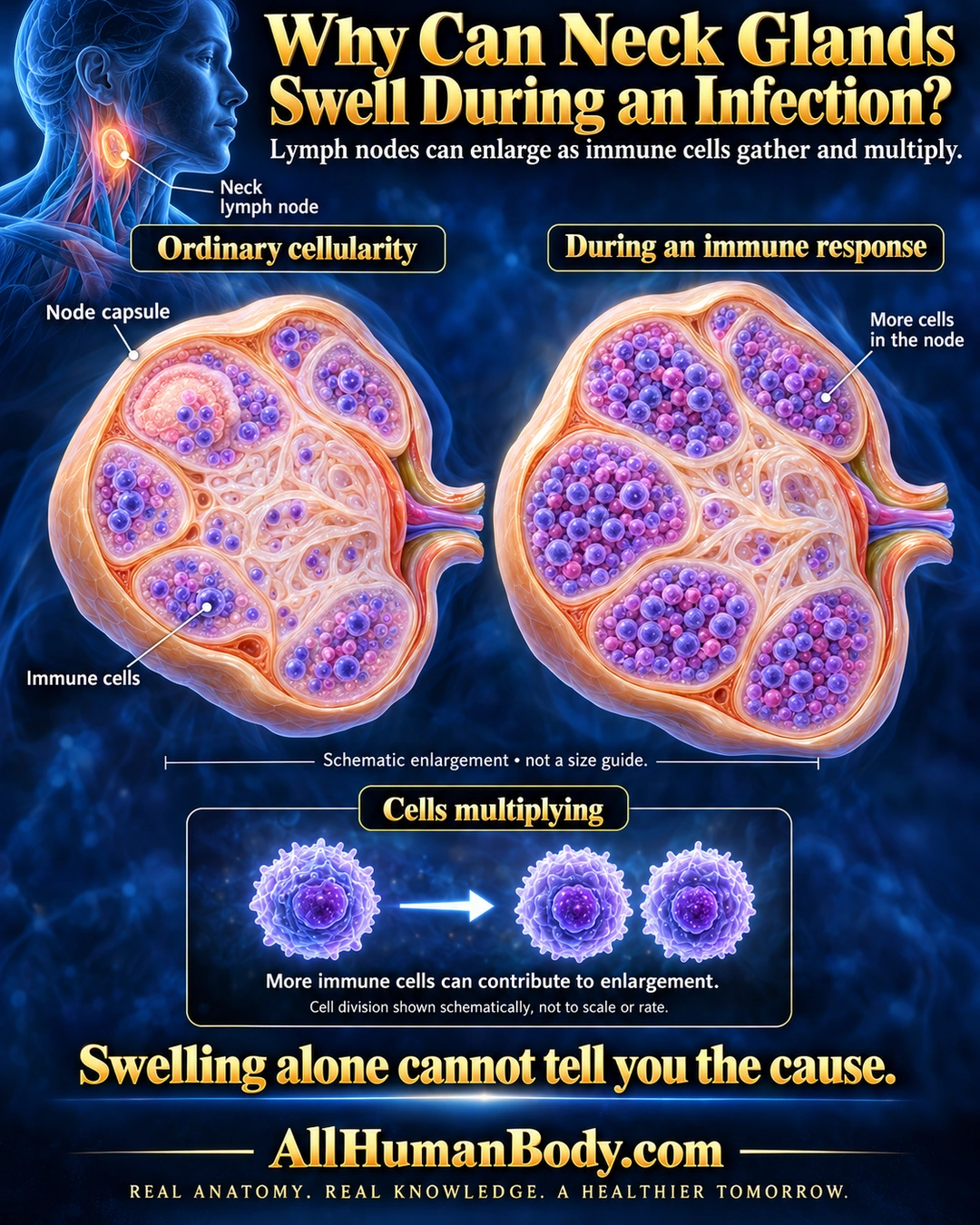
Lymph nodes can enlarge during an immune response as immune cells gather and multiply. Increased cell numbers are one contributor; swelling alone cannot identify the cause.
READ THE IMAGE
What the illustration shows
English educational poster on a navy background titled “Why Can Neck Glands Swell During an Infection?” A blue head-and-neck locator highlights one illustrative neck lymph node. Two peach bean-shaped cutaways compare ordinary cellularity with an immune response. The right node is modestly larger and contains more purple cell symbols. Leaders identify the capsule, immune cells and increased cellularity. A lower inset shows one cell, a right-pointing arrow and two cells, labeled as schematic division. Text states that more immune cells can contribute to enlargement and that swelling alone cannot tell you the cause. Gold AllHumanBody.com branding and the full slogan appear in the footer. Cell numbers, size and tissue organization are illustrative, not diagnostic measurements.
How to interpret this poster
- No palpation test, cancer reassurance or diagnostic size threshold. Fluid, vascular and stromal contributions not excluded; cell-division arrow is not a rate.
- AI-assisted educational illustration; not physician certification, a diagnosis or individualized medical advice.
- Fine annotations require enlargement; preserve the full uncropped illustration and its qualifiers.
AI-assisted educational illustration, adapted into web-sized images without changing its composition. This is general education, not an individual diagnosis or treatment recommendation.
EVIDENCE / CONTEXT
Sources and what they support
- NHS: Swollen glands ↗
Nodes may swell near infection; other causes exist.
- Lymphoma Action: Lymphatic system ↗
Lymphocyte multiplication can contribute to node enlargement.
- Acton et al.: Node expansion study ↗
Influx/proliferation and expansion corroboration, bounded experimental model.
Evidence correspondence is limited to the abstract.