Respiratory / VISUAL EXPLAINER
Why Can a Cold Make You Sound Stuffy?
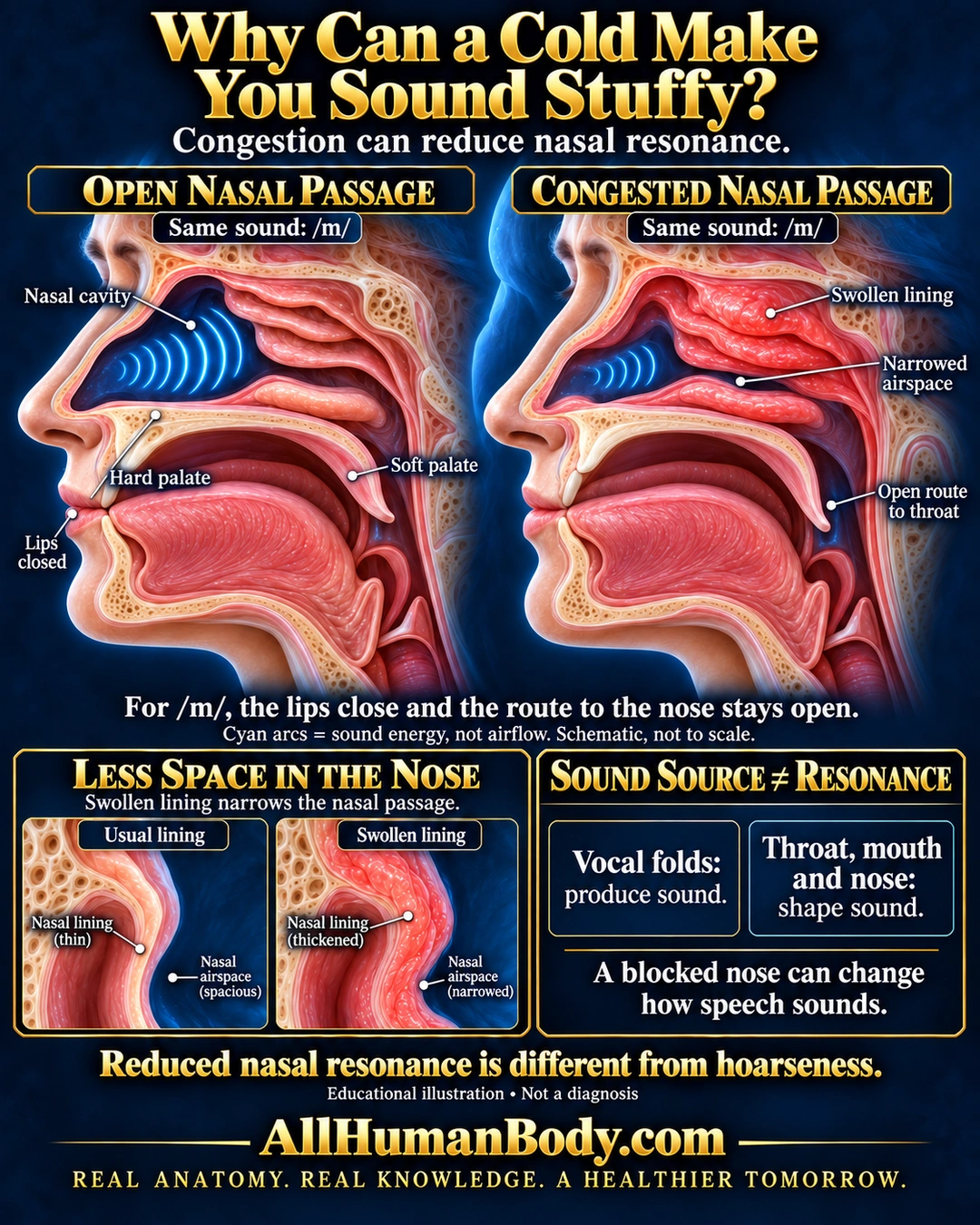
Swollen nasal lining during a cold can reduce nasal resonance and change how speech sounds. The vocal folds generate sound while the throat, mouth and nose help shape it; reduced nasal resonance is different from hoarseness.
READ THE IMAGE
What the illustration shows
English educational poster titled “Why Can a Cold Make You Sound Stuffy?” on a midnight-navy background. Two matched, left-facing sagittal sections compare an open nasal passage with a congested passage during the same intended /m/ sound. The lips meet and a gap behind the lowered soft palate connects the throat to the nasal cavity in both. White dot-ended leaders label the nasal cavity, hard and soft palates, closed lips, swollen nasal lining, remaining narrowed airspace and open route to the throat. The right nasal lining is fuller and redder. Curved cyan arcs inside each nose represent schematic sound energy, with a smaller set on the congested side; text explicitly says they are not airflow. A lower inset compares usual and thickened lining beside remaining nasal space. Adjacent text says vocal folds produce sound while the throat, mouth and nose shape it. A prominent line states that reduced nasal resonance differs from hoarseness. Gold AllHumanBody.com and the full project slogan appear on a plain navy footer.
How to interpret this poster
- Not all speech normally passes through nose. Hoarseness and congestion can coexist; no measured arc count, exact sound substitution, diagnosis or treatment.
- AI-assisted educational illustration; not physician certification, a diagnosis or individualized medical advice.
- Fine annotations require enlargement; preserve the full uncropped illustration and its qualifiers.
AI-assisted educational illustration, adapted into web-sized images without changing its composition. This is general education, not an individual diagnosis or treatment recommendation.
EVIDENCE / CONTEXT
Sources and what they support
- ASHA: Resonance disorders ↗
Obstruction/hyponasality and source-versus-resonance distinction.
- Cincinnati Children’s: Resonance disorders ↗
Congestion can reduce nasal resonance.
- ASHA: Cleft lip and palate ↗
Normal nasal-consonant open velopharyngeal route only; no cleft inference.
- Bucknell: /m/ phonetics ↗
Voiced bilabial nasal classification and lip closure.