Special Senses / VISUAL EXPLAINER
Why Can Ringing Continue After Loud Noise?
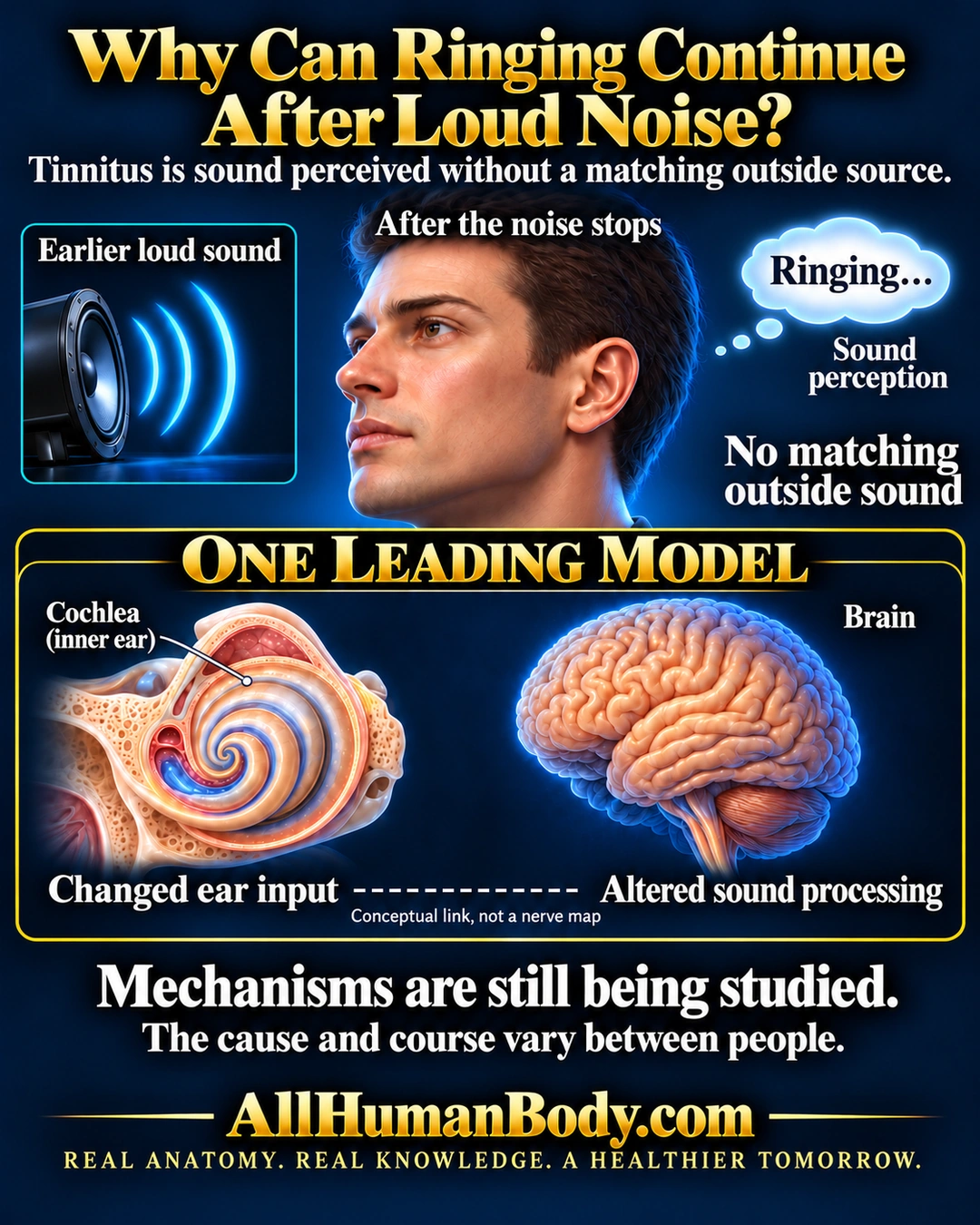
Ringing can persist after a loud sound without a matching outside source. One leading model connects changed ear input with altered sound processing, but mechanisms, causes and time course vary and remain under study.
READ THE IMAGE
What the illustration shows
Navy-and-gold educational poster titled “Why Can Ringing Continue After Loud Noise?” The subtitle defines tinnitus as sound perceived without a matching outside source. At upper left, a box labeled “Earlier loud sound” contains a loudspeaker and blue wave arcs. Beside it, a solid-skinned front-oblique adult portrait is labeled “After the noise stops.” A thought bubble says “Ringing…” and is labeled “Sound perception”; nearby text reads “No matching outside sound.” No sound waves enter the person in this scene. A lower panel headed “ONE LEADING MODEL” contains a cutaway-style cochlear spiral labeled “Cochlea (inner ear)” and a separate brain broadly labeled “Brain,” with no leader or pinpoint. Text beneath them says “Changed ear input” and “Altered sound processing,” joined only by a dashed conceptual line labeled “Conceptual link, not a nerve map.” No anatomical nerve joins the specimens. Large closing lines say “Mechanisms are still being studied.” and “The cause and course vary between people.” A plain navy footer carries gold AllHumanBody.com and the full brand slogan.
How to interpret this poster
- Model only, not a complete circuit, test or prognosis. No reassurance of harmlessness or inevitable permanence, exposure challenge or treatment advice.
- AI-assisted educational illustration; not physician certification, a diagnosis or individualized medical advice.
- Fine annotations require enlargement; preserve the full uncropped illustration and its qualifiers.
AI-assisted educational illustration, adapted into web-sized images without changing its composition. This is general education, not an individual diagnosis or treatment recommendation.
EVIDENCE / CONTEXT
Sources and what they support
- NIDCD: Tinnitus ↗
Definition, noise association and explicitly uncertain neural models.
- NIDCD: How Does Noise Damage Your Hearing? ↗
Noise-related ringing and limits of apparent recovery.
- Vasilkov et al.2023: auditory measures associated with chronic tinnitus ↗
Observational peripheral/central associations, not individual causation.
Evidence correspondence is limited to the abstract.