Integumentary / VISUAL EXPLAINER
How Does a Wart Grow on Your Hand?
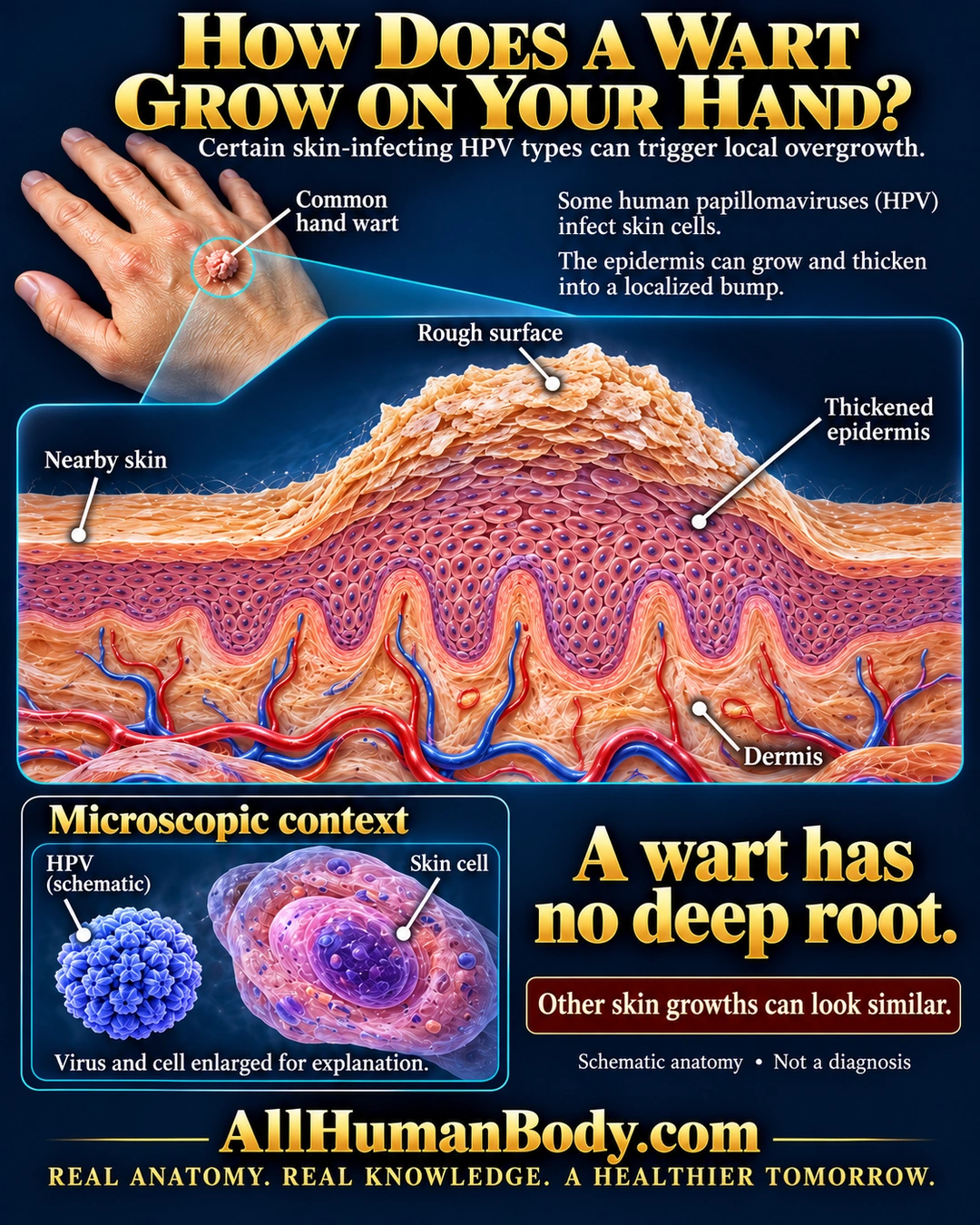
Certain skin-infecting HPV types can cause localized epidermal overgrowth and a rough wart. A wart has no deep root. Other growths can look similar, so this illustration is not a way to identify a person’s skin lesion.
READ THE IMAGE
What the illustration shows
English educational poster titled “How Does a Wart Grow on Your Hand?” on midnight navy. A relaxed adult hand with five digits has one rough bump on its back, identified as a common hand wart and linked by a cyan enlargement cone to a large skin section. The center of the epidermis forms a rough raised mound, while surrounding skin is thinner. Labels identify the rough surface, thickened epidermis, nearby skin and the peach dermis below. Red and blue vessels remain within dermis beneath the wavy epidermal boundary. A lower inset places a schematic blue HPV particle beside a larger purple skin cell. Text explains localized HPV-associated overgrowth, states that a wart has no deep root and cautions that other growths can look similar. Gold branding and the full slogan appear on a plain navy footer.
How to interpret this poster
- Common cutaneous wart example only; no sexual-transmission, cancer or immune-health inference. No removal or treatment instructions.
- AI-assisted educational illustration; not physician certification, a diagnosis or individualized medical advice.
- Fine annotations require enlargement; preserve the full uncropped illustration and its qualifiers.
AI-assisted educational illustration, adapted into web-sized images without changing its composition. This is general education, not an individual diagnosis or treatment recommendation.
EVIDENCE / CONTEXT
Sources and what they support
- AAD: Warts causes ↗
Selected cutaneous HPV types cause common warts.
- British Association of Dermatologists: Plantar warts ↗
General epidermal infection and localized thickening only; plantar-specific claims excluded.
- AAD: Warts overview ↗
No deep roots.
- AAD: Warts symptoms ↗
Variable appearance and similar-looking growths.