Integumentary / VISUAL EXPLAINER
How Does a Stye Form Beside an Eyelash?
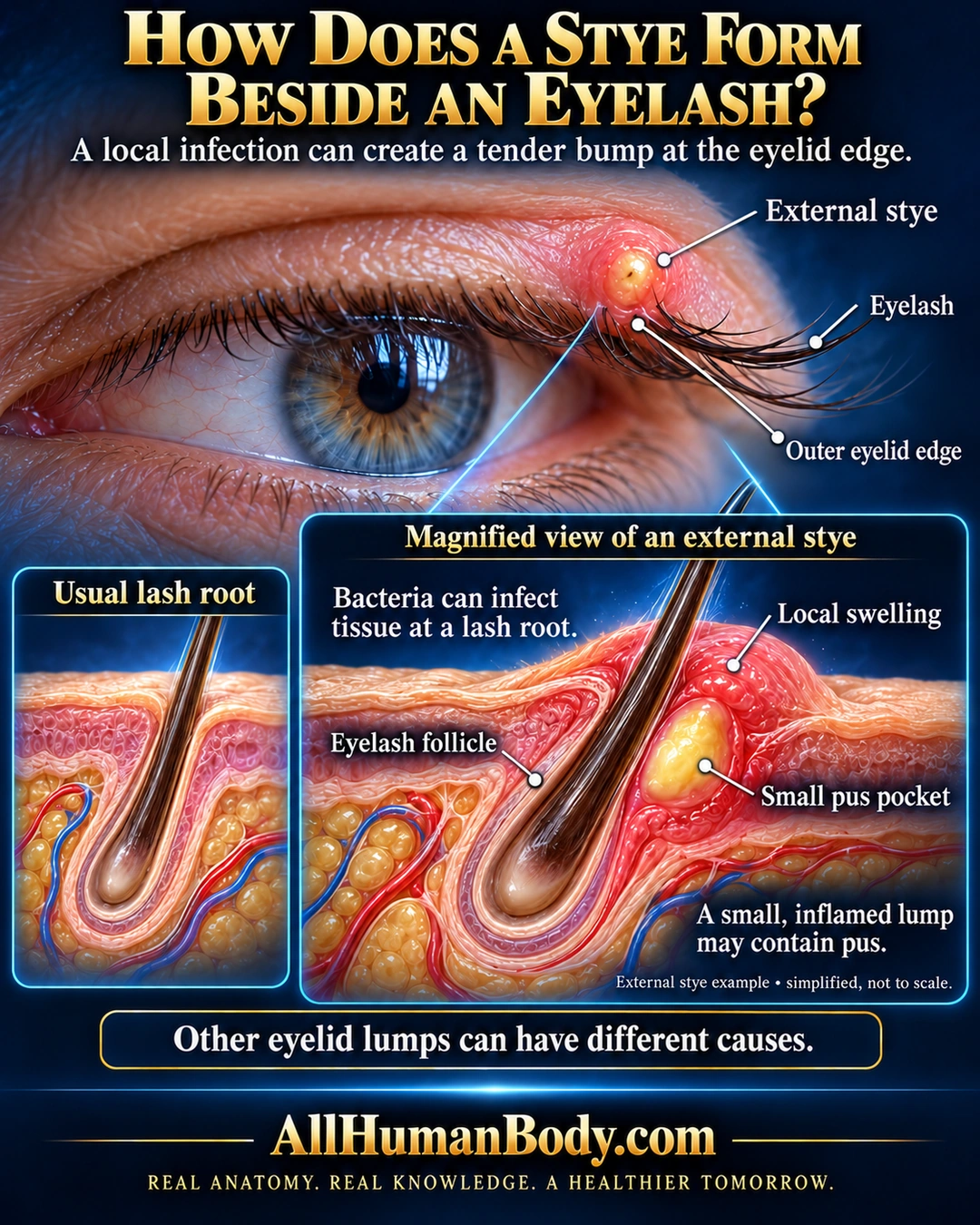
A local bacterial infection at an eyelash root can produce an external stye, a tender swelling that may contain pus. Other eyelid lumps can have different causes; this example does not diagnose them.
READ THE IMAGE
What the illustration shows
English educational poster titled “How Does a Stye Form Beside an Eyelash?” against navy blue. A realistic generated close view of an intact eye shows a localized coral swelling with a pale-yellow point beside an upper eyelash root, on the outer eyelid edge. White leaders label the external stye, an eyelash and the anterior lid margin. Cyan magnification lines lead to a large cutaway of a lash follicle with adjacent inflamed tissue and a small yellow pus pocket; a smaller usual lash-root section provides comparison. Text explains that bacteria can infect tissue at a lash root and that a small inflamed lump may contain pus. A visible qualifier says “Other eyelid lumps can have different causes.” The image identifies the example as external and simplified, not to scale. Gold AllHumanBody.com and the full project slogan sit on a plain navy footer.
How to interpret this poster
- One external lash-root example, not all gland/eyelid lesions. No squeezing, warm-compress, medication or removal instructions.
- AI-assisted educational illustration; not physician certification, a diagnosis or individualized medical advice.
- Fine annotations require enlargement; preserve the full uncropped illustration and its qualifiers.
AI-assisted educational illustration, adapted into web-sized images without changing its composition. This is general education, not an individual diagnosis or treatment recommendation.
EVIDENCE / CONTEXT
Sources and what they support
- NHS: Stye ↗
Local bacterial infection and other possible eyelid-lump causes.
- Moorfields Eye Hospital: Stye ↗
External lash-root infection/abscess.
- Moorfields clinician reference: Stye ↗
Outer-edge follicular swelling can contain pus.