Respiratory / VISUAL EXPLAINER
Why Can Your Voice Turn Hoarse?
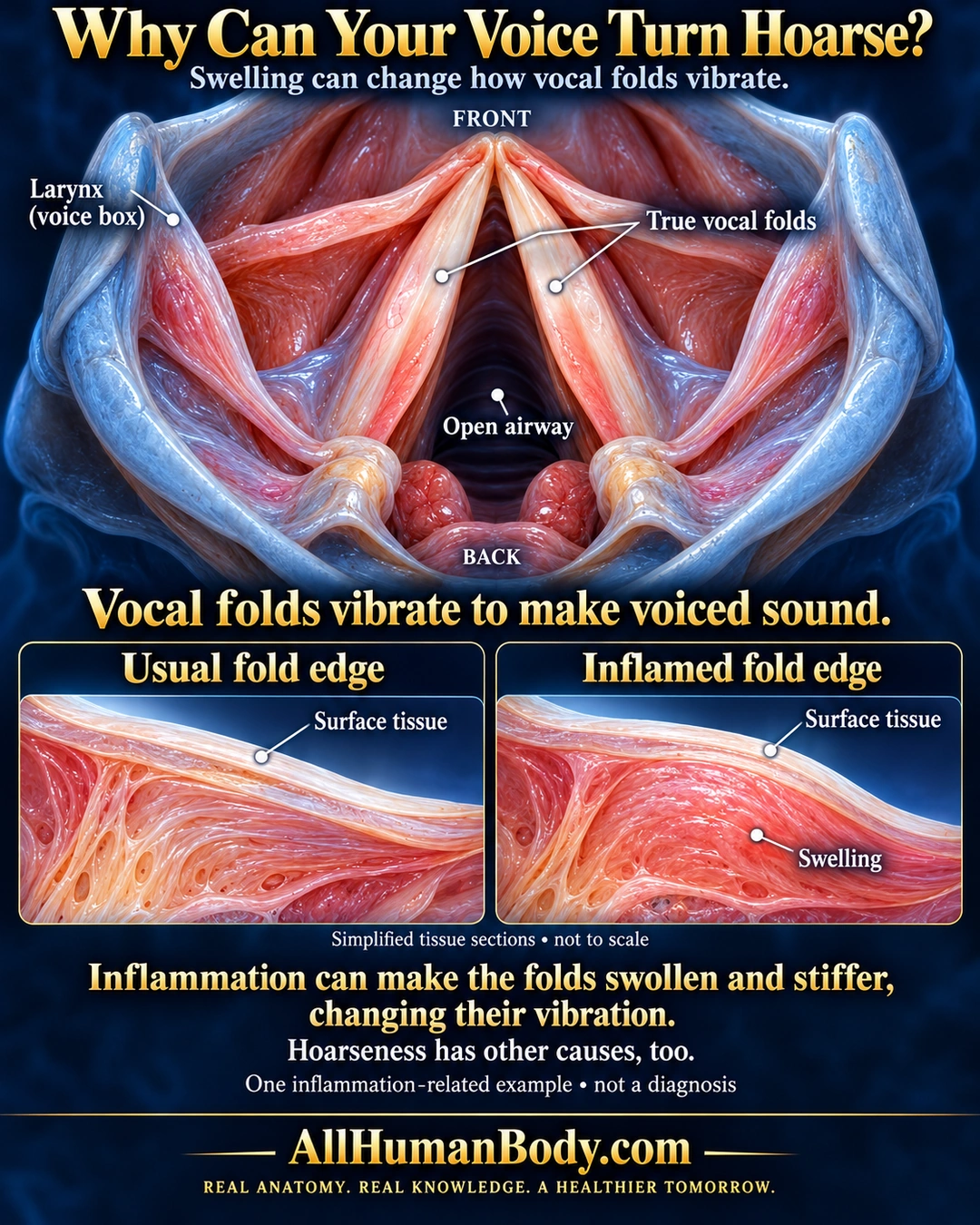
Vocal folds vibrate to produce voiced sound. Inflammation can make their tissue swollen and stiffer, changing vibration and the voice. This is one explanation for hoarseness, which also has other causes.
READ THE IMAGE
What the illustration shows
English educational poster titled “Why Can Your Voice Turn Hoarse?” on a navy background. A large superior schematic of the larynx shows two pale, attached true vocal folds bordering an open dark triangular airway, with front above and back below. White leaders identify the voice box, folds and opening. Two lower dimensional tissue sections compare a usual fold edge with a fuller, coral-colored inflamed edge; surface tissue and swelling are labeled. Text explains that vocal folds vibrate to make voiced sound and that inflammation can make them swollen and stiffer, changing vibration. It states “Hoarseness has other causes, too” and identifies the image as one non-diagnostic inflammation-related example. Gold AllHumanBody.com branding and the complete project slogan appear on a plain navy footer.
How to interpret this poster
- Not a measured stiffness/motion comparison or diagnosis. No voice exercise, prognosis or treatment advice; tissue sections are schematic.
- AI-assisted educational illustration; not physician certification, a diagnosis or individualized medical advice.
- Fine annotations require enlargement; preserve the full uncropped illustration and its qualifiers.
AI-assisted educational illustration, adapted into web-sized images without changing its composition. This is general education, not an individual diagnosis or treatment recommendation.
EVIDENCE / CONTEXT
Sources and what they support
- NIDCD: Hoarseness ↗
Swelling and multiple causes of hoarseness; inaccurate smooth-muscle wording excluded.
- Yale Medicine: Laryngitis: Why You Lose Your Voice and What Helps ↗
Laryngologist explanation of inflammation-related swelling and stiffness.
- 22.1 Organs and Structures of the Respiratory System ↗
Paired true folds and central opening; swallowing simplifications excluded.