Integumentary / VISUAL EXPLAINER
Why Can Your Skin Develop Stretch Marks?
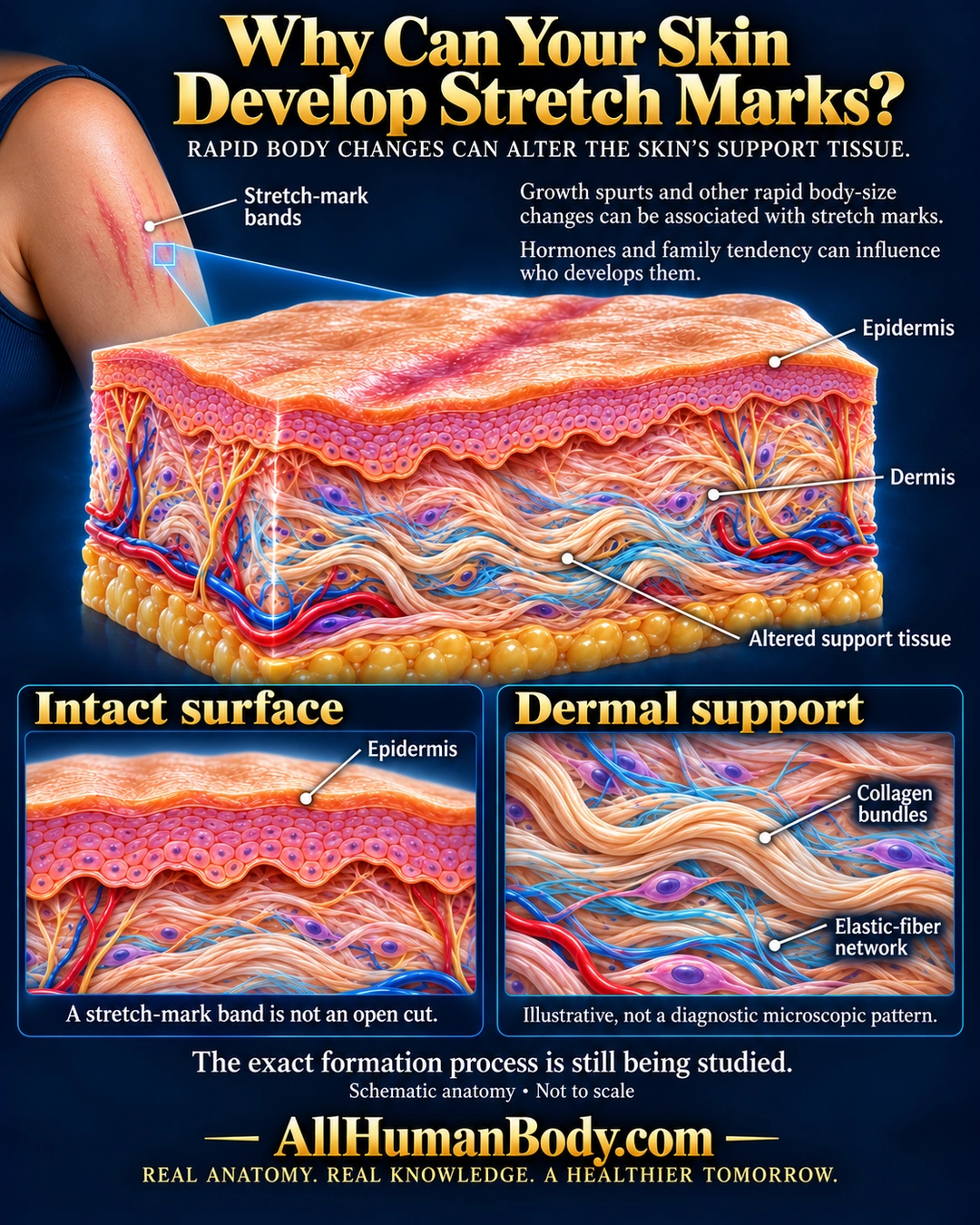
Rapid body-size changes can accompany stretch marks, while hormonal influences and family tendency affect susceptibility. The support tissue within the dermis changes, but the exact formation process is still being studied.
READ THE IMAGE
What the illustration shows
English educational poster titled “Why Can Your Skin Develop Stretch Marks?” on midnight navy. An upper-arm view shows narrow rosy bands, linked by a cyan enlargement connector to an oblique skin cutaway. The epidermis remains continuous above pale collagen bundles and finer cyan elastic fibers in peach dermis; red and blue vessels remain below the epidermis, above yellow fat. Labels identify the epidermis, dermis and altered support tissue. Two lower windows show an intact surface and the qualitative dermal fiber network. Text mentions rapid body-size changes, hormones and family tendency. A visible qualifier says the exact formation process is still being studied, and the network is illustrative rather than diagnostic. Gold AllHumanBody.com branding and the full slogan sit on a plain navy footer.
How to interpret this poster
- No personal hormonal or weight inference, diagnostic fiber pattern, prevention/removal advice or guaranteed fading.
- AI-assisted educational illustration; not physician certification, a diagnosis or individualized medical advice.
- Fine annotations require enlargement; preserve the full uncropped illustration and its qualifiers.
AI-assisted educational illustration, adapted into web-sized images without changing its composition. This is general education, not an individual diagnosis or treatment recommendation.
EVIDENCE / CONTEXT
Sources and what they support
- NHS: Stretch marks ↗
Body-size changes and family tendency.
- AAD: Stretch marks: Why they appear ↗
Scar/body-change context and variable susceptibility; rupture simplification not treated as settled histology.
- Zheng, Lavker and Kligman1985: human striae biopsies ↗
Altered dermal architecture and limits of a rupture explanation.
Evidence correspondence is limited to the abstract.