Musculoskeletal / VISUAL EXPLAINER
Why Can Your Ankle Swell After a Sprain?
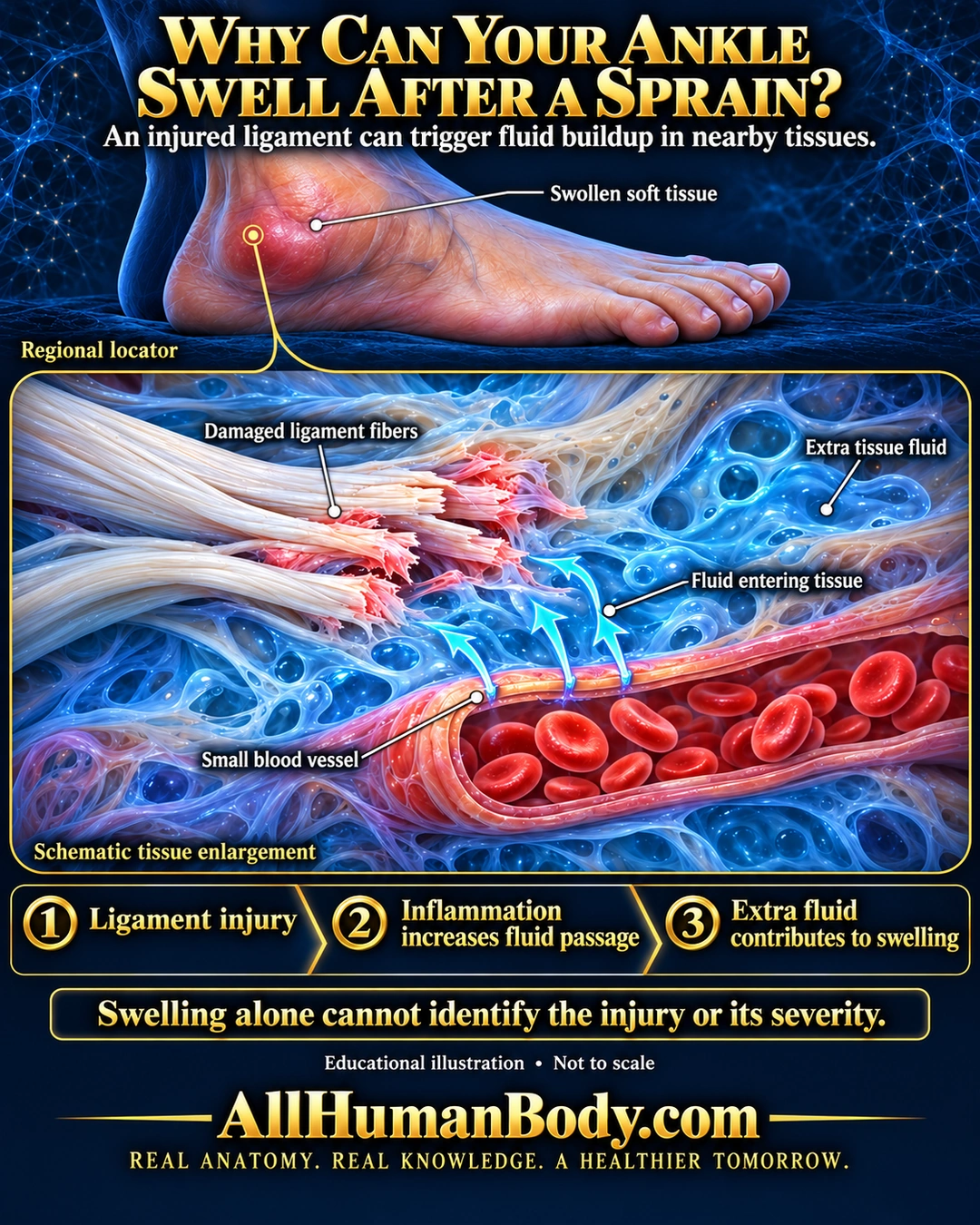
A sprain injures supporting ligaments. Inflammation can increase passage of fluid from small vessels into nearby tissue, contributing to swelling. Swelling alone does not identify the injury or its severity.
READ THE IMAGE
What the illustration shows
Navy-and-gold poster titled Why Can Your Ankle Swell After a Sprain? At the top, a side view of an intact foot and ankle has a modest red swollen region labeled Swollen soft tissue. A gold regional-locator connector leads to a large schematic tissue enlargement. Pale frayed ligament fibers lie above an opened small blood vessel containing red blood cells. Three cyan arrows point outward from the vessel wall into blue extracellular spaces. White leaders identify damaged ligament fibers, the small blood vessel, fluid entering tissue and extra tissue fluid. A three-part band reads Ligament injury; Inflammation increases fluid passage; Extra fluid contributes to swelling. A prominent caution says swelling alone cannot identify the injury or its severity. A plain navy footer carries gold AllHumanBody.com and the complete brand slogan.
How to interpret this poster
- Fluid blue is a visual code, not a pool measurement. No clinical tear grade, recovery time, exercise or treatment advice.
- AI-assisted educational illustration; not physician certification, a diagnosis or individualized medical advice.
- Fine annotations require enlargement; preserve the full uncropped illustration and its qualifiers.
AI-assisted educational illustration, adapted into web-sized images without changing its composition. This is general education, not an individual diagnosis or treatment recommendation.
EVIDENCE / CONTEXT
Sources and what they support
- AAOS: Sprained ankle ↗
Ligament injury and variable symptoms/overlap.
- West Suffolk NHS: What is fluid retention? ↗
Fluid entering tissue can cause swelling; sprains among causes.
- 21.2 Barrier Defenses and the Innate Immune Response ↗
Tissue injury can trigger inflammation and increased vascular permeability, contributing to interstitial fluid and swelling.