Integumentary / VISUAL EXPLAINER
Why Can Shaving Leave Ingrown Hairs?
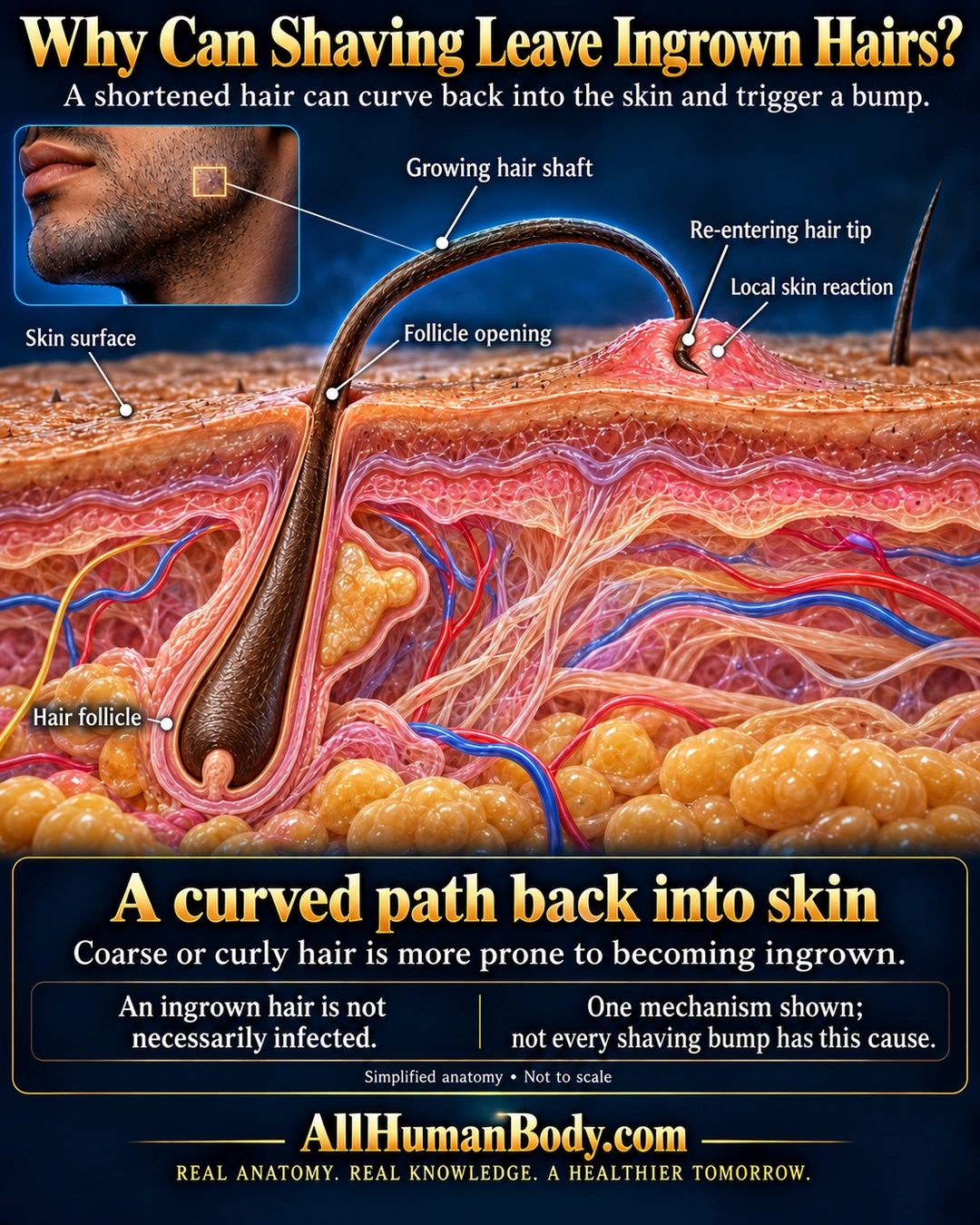
After shortening, a curved hair can grow back into nearby skin and trigger a local bump. Coarse or curly hairs are more susceptible. An ingrown hair is not necessarily infected, and not every shaving bump has this cause.
READ THE IMAGE
What the illustration shows
Navy-and-gold educational poster titled “Why Can Shaving Leave Ingrown Hairs?” A small inset of an adult lower face with stubble marks a skin site. In the main enlarged skin cutaway, one continuous dark hair rises from a follicle at lower left, leaves its opening, arches above the surface and curves into a separate shallow pink bump at the right. A small cutaway exposes the short re-entering tip within that bump. The original follicle has a rounded base and a pale central papilla; a second hair extends outward at far right. Leaders identify the shaft, follicle opening, undamaged skin surface, re-entering tip, local skin reaction and follicular sleeve. Lower text notes greater susceptibility with coarse or curly hair, that an ingrown hair is not necessarily infected, and that not every shaving bump has this cause. Gold AllHumanBody.com and the full project slogan appear below.
How to interpret this poster
- One extrafollicular mechanism, not every bump or ingrown hair. No extraction, shaving regimen, product or treatment advice; detailed vessels and tissue texture are schematic.
- AI-assisted educational illustration; not physician certification, a diagnosis or individualized medical advice.
- Fine annotations require enlargement; preserve the full uncropped illustration and its qualifiers.
AI-assisted educational illustration, adapted into web-sized images without changing its composition. This is general education, not an individual diagnosis or treatment recommendation.
EVIDENCE / CONTEXT
Sources and what they support
- AAD: Razor bumps ↗
Shortened curved/coarse hairs can re-enter skin and provoke bumps.
- NHS: Ingrown hairs ↗
Skin re-entry, susceptibility and infected subset distinction.