Respiratory / VISUAL EXPLAINER
Why Can Your Nose Bleed So Easily?
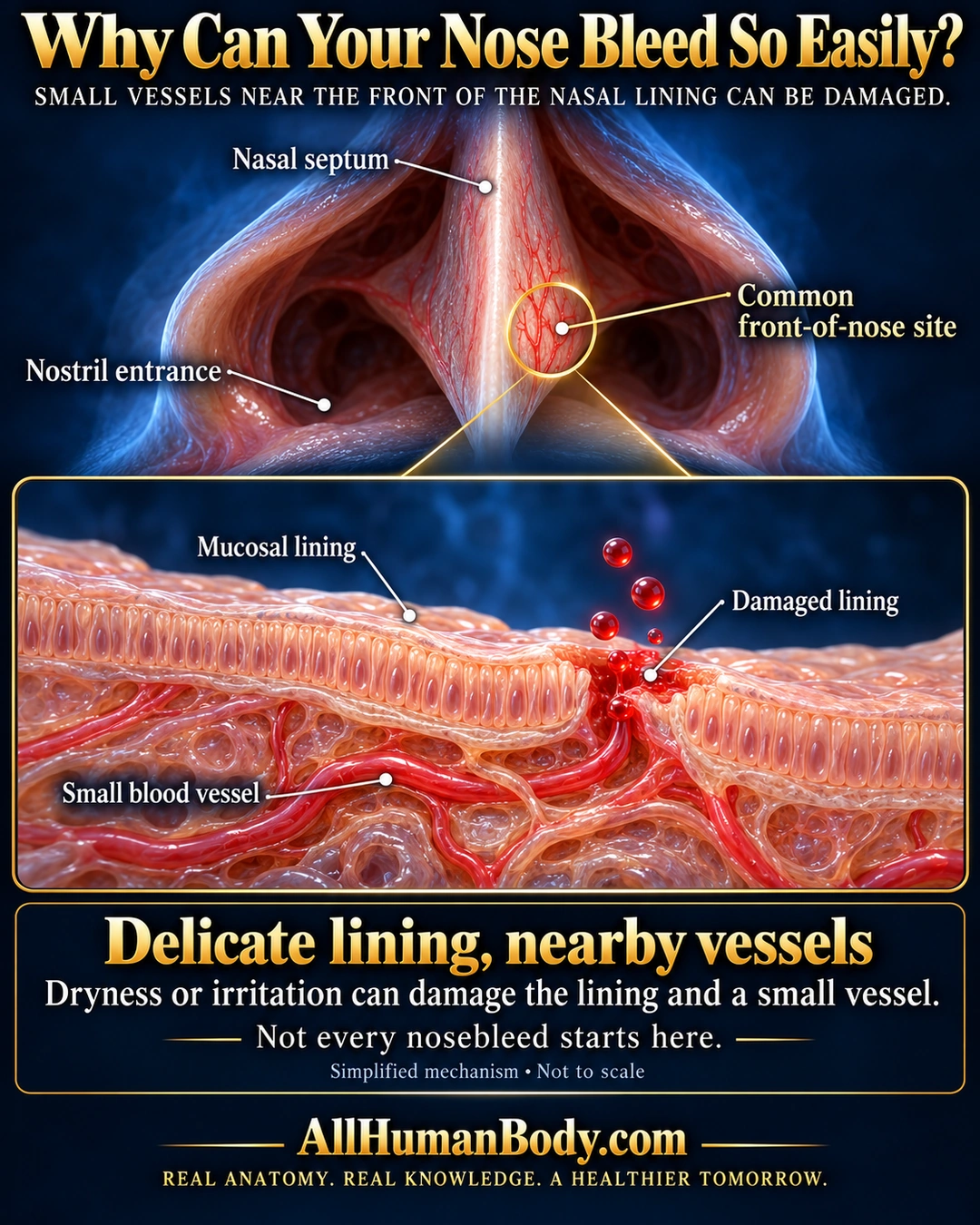
Small vessels near the front of the nasal lining can be damaged when the lining becomes dry or irritated. This illustrates one common front-of-nose site, not the origin of every nosebleed.
READ THE IMAGE
What the illustration shows
Navy-and-gold educational poster titled “Why Can Your Nose Bleed So Easily?” An enlarged front-oblique view of the lower nose shows a central peach nasal septum dividing two dark nasal openings. A gold circle marks a small vessel-rich patch on the front of the septal lining, not the lateral wall. Labels identify the septum, nostril entrance and common front-of-nose site. Gold connector lines lead to a larger mucosal cutaway: intact pale peach surface tissue overlies red vessels, with one local breach reaching a superficial vessel and a few red droplets above it. Leaders label mucosal lining, small blood vessel and damaged lining. A panel says dryness or irritation can damage the lining and a small vessel, while noting that not every nosebleed starts here. Gold AllHumanBody.com and the complete project slogan appear on a plain navy footer.
How to interpret this poster
- Simplified lining, not exact epithelial cell types, vessel map or bleeding volume. No treatment, triage or reassurance that bleeding is harmless.
- AI-assisted educational illustration; not physician certification, a diagnosis or individualized medical advice.
- Fine annotations require enlargement; preserve the full uncropped illustration and its qualifiers.
AI-assisted educational illustration, adapted into web-sized images without changing its composition. This is general education, not an individual diagnosis or treatment recommendation.
EVIDENCE / CONTEXT
Sources and what they support
- NHS: Nosebleed ↗
Lining damage, dryness and other possible causes.
- Epistaxis (nose bleed), South Tees Hospitals ↗
Common small-vessel site near nasal entrance.
- Nose bleed (epistaxis), Wirral Community NHS ↗
Anterior septal location and existence of deeper origins.