Urinary / VISUAL EXPLAINER
Why Can Asparagus Change the Smell of Your Pee?
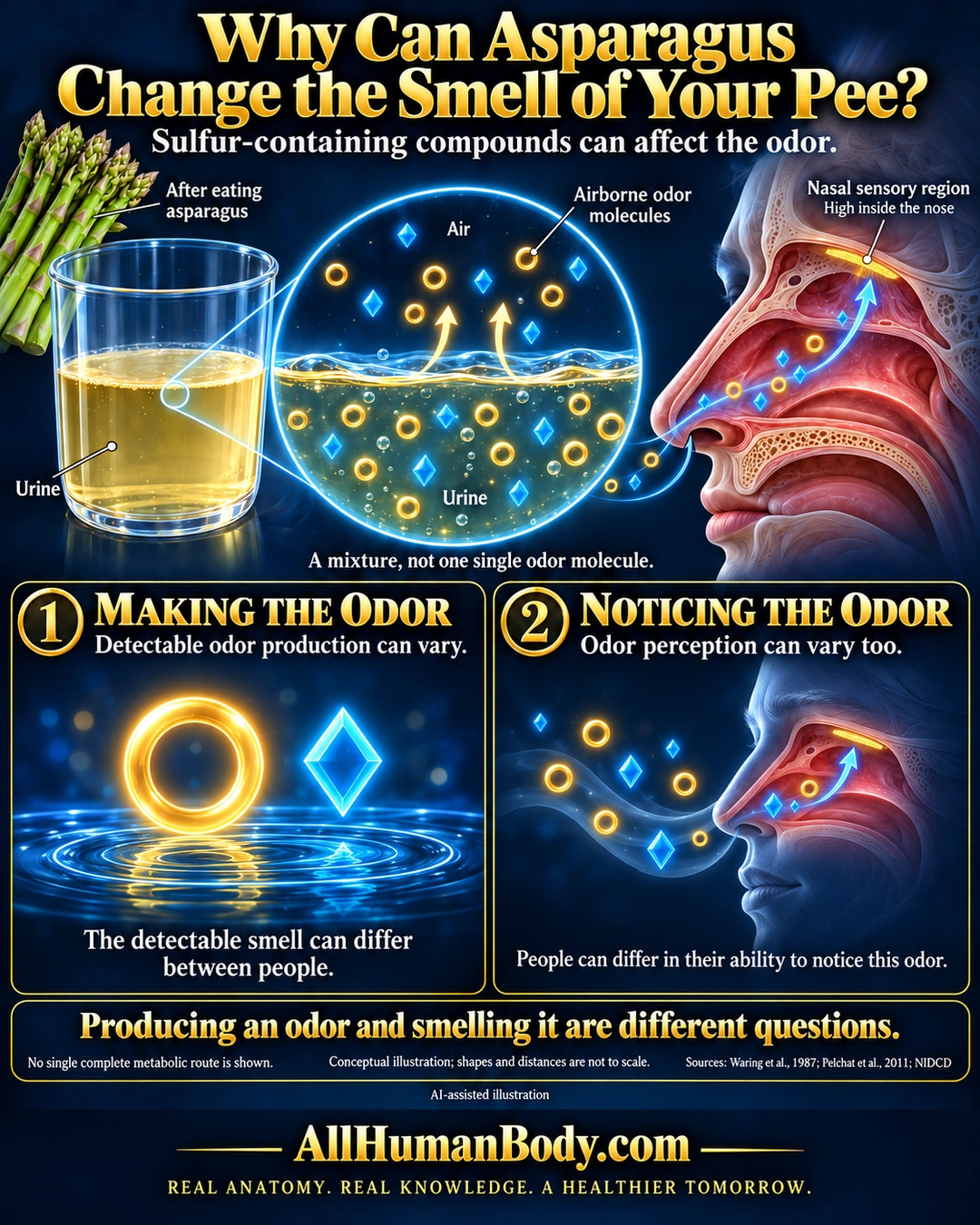
After asparagus, sulfur-containing compounds can contribute to a urine odor. Airborne odorants reach sensory tissue high in the nose. Producing a detectable odor and being able to notice it are different questions.
READ THE IMAGE
What the illustration shows
Navy-and-gold educational poster titled “Why Can Asparagus Change the Smell of Your Pee?” Asparagus at upper left provides food context beside a transparent vessel labeled Urine. A circular enlargement of the liquid-air boundary contains gold rings and cyan diamonds on both sides of the surface, with two upward arrows indicating symbolic odor molecules entering air. No vegetable enters the liquid. At right, a simplified sagittal nose illustration has a blue arrow curving from the nostril through the nasal cavity toward a narrow gold sensory patch high beneath the skull base. Its leader reads Nasal sensory region, High inside the nose. Two lower panels distinguish MAKING THE ODOR from NOTICING THE ODOR: abstract symbols over a fluid surface represent detectable odor production, while a smaller nose locator represents perception. Text states that both can vary. No liver, kidney, genetic chart or metabolic route is shown. Shapes, counts and distances are conceptual rather than measured; this is not a complete nasal anatomy plate. The takeaway says producing an odor and smelling it are different questions. A plain navy footer shows gold AllHumanBody.com and “REAL ANATOMY. REAL KNOWLEDGE. A HEALTHIER TOMORROW.”
How to interpret this poster
- No complete metabolic pathway, exact genes, prevalence or at-home smell test. Symbol shapes and distances are illustrative.
- AI-assisted educational illustration; not physician certification, a diagnosis or individualized medical advice.
- Fine annotations require enlargement; preserve the full uncropped illustration and its qualifiers.
- Production/perception evidence here includes an institutional primary-research report, not a full-paper appraisal; no population prevalence or genetic prediction.
AI-assisted educational illustration, adapted into web-sized images without changing its composition. This is general education, not an individual diagnosis or treatment recommendation.
EVIDENCE / CONTEXT
Sources and what they support
- The chemical nature of the urinary odour produced by man after asparagus ingestion ↗
Sulfur-containing mixture, rather than one unique odor compound.
Evidence correspondence is limited to the abstract. - Smell Disorders: normal smell physiology ↗
Airborne odor molecules and superior nasal sensory location.
- Monell primary-research report: Asparagus odor production and perception ↗
Institution-authored human study report distinguishes variability in detectable odor production from odor perception.