Integumentary / VISUAL EXPLAINER
Why Can Metal Leave a Smell on Your Hands?
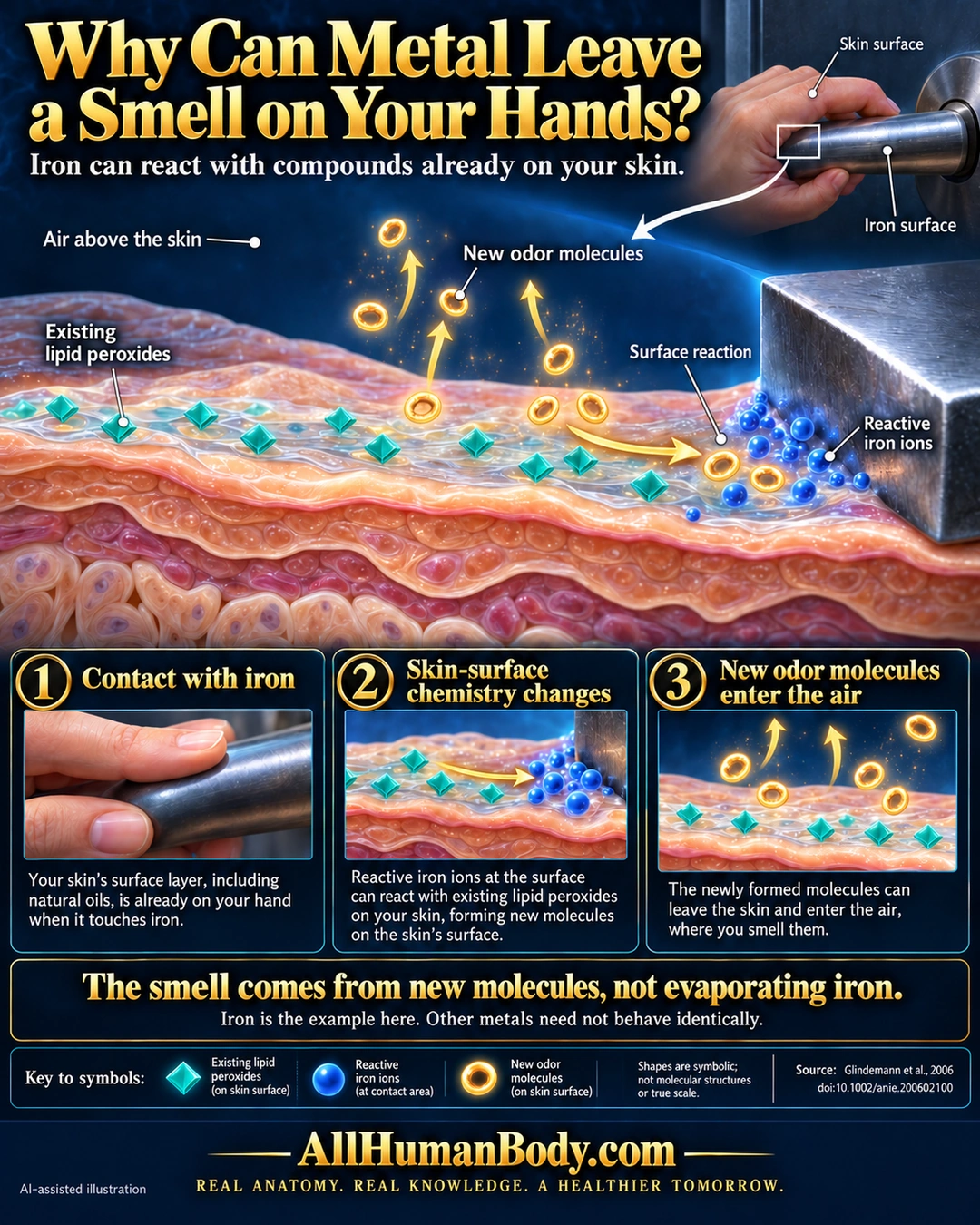
Iron contact can react with compounds already on skin to form new volatile odor molecules. The smell is not solid iron evaporating. This is an iron example, not a claim that every metal behaves identically.
READ THE IMAGE
What the illustration shows
Navy-and-gold educational poster titled “Why Can Metal Leave a Smell on Your Hands?” A hand touches a solid iron handle at upper right. A white magnification cue points toward a large skin-surface illustration. Teal diamonds represent existing lipid peroxides, blue circles represent reactive iron ions near a solid iron block, and gold rings represent newly formed odor molecules. A gold arrow runs along the skin surface toward the contact area; upward arrows from gold rings show new odor molecules entering air above the skin. The block stays solid. Three smaller panels repeat contact, surface chemistry and airborne release. The takeaway says the smell comes from new molecules, not evaporating iron, and identifies iron as the example rather than all metals. A key says the shapes are symbolic, not molecular structures or true scale. Tissue layers are illustrative, not a microscopic measurement. No palm oil gland or bacterial mechanism is shown. Plain navy footer carries gold AllHumanBody.com and the full slogan “REAL ANATOMY. REAL KNOWLEDGE. A HEALTHIER TOMORROW.”
How to interpret this poster
- One small primary contact study, not independent replications. Symbols are not structures, stoichiometry or measured diffusion directions; no handling experiment or health inference.
- AI-assisted educational illustration; not physician certification, a diagnosis or individualized medical advice.
- Fine annotations require enlargement; preserve the full uncropped illustration and its qualifiers.
AI-assisted educational illustration, adapted into web-sized images without changing its composition. This is general education, not an individual diagnosis or treatment recommendation.
EVIDENCE / CONTEXT
Sources and what they support
- The Two Odors of Iron when Touched or Pickled: (Skin) Carbonyl Compounds and Organophosphines ↗
Skin-contact iron chemistry and formation of volatile carbonyl odorants.