Digestive / VISUAL EXPLAINER
Why Do Baby Teeth Fall Out Without Long Roots?
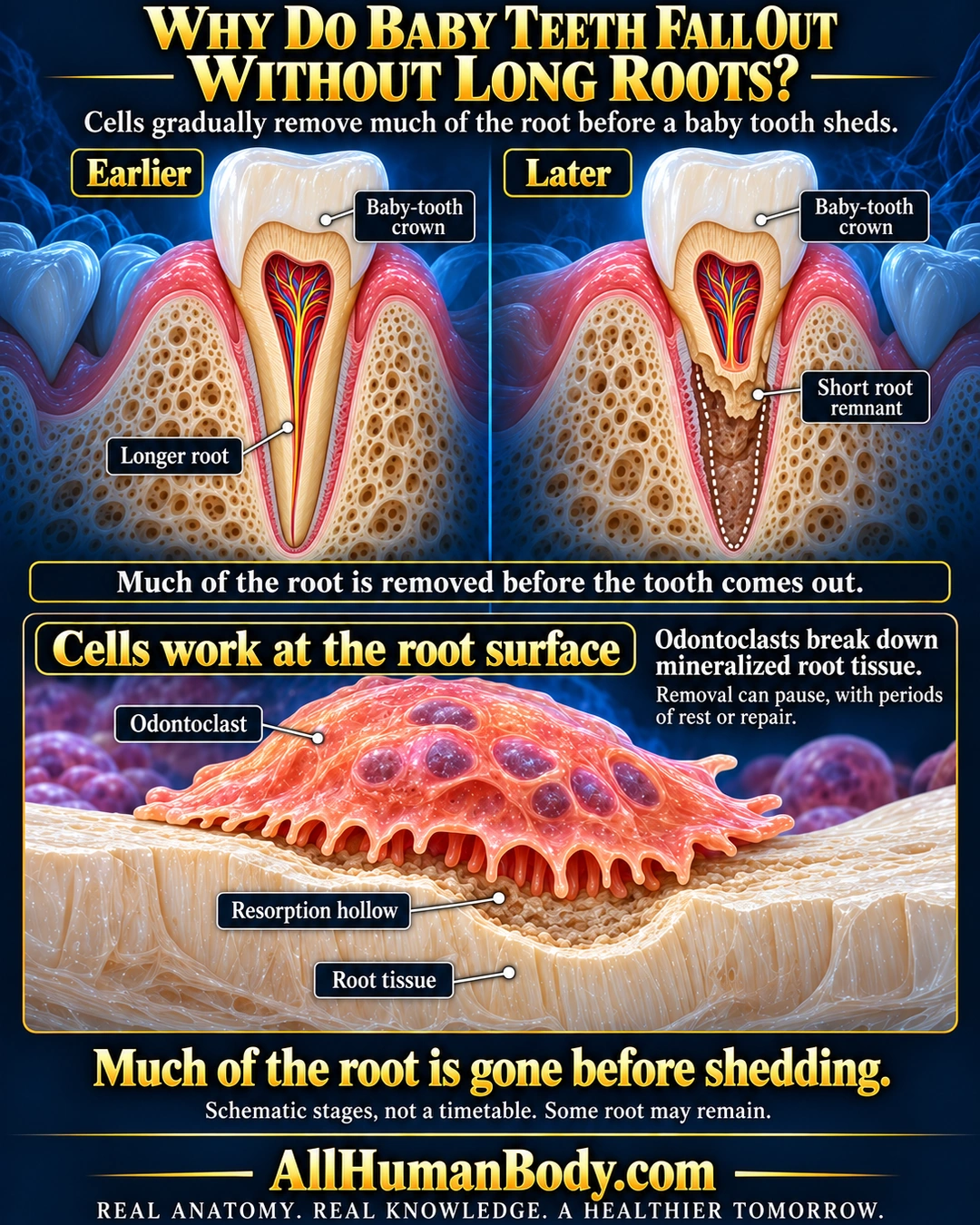
Before normal shedding, cells gradually resorb much of a baby tooth’s root. Odontoclasts work at mineralized root surfaces, and removal can alternate with rest or repair. Some root can remain when the tooth comes out.
READ THE IMAGE
What the illustration shows
Dark-navy and gold educational poster titled Why Do Baby Teeth Fall Out Without Long Roots? Two same-sized upright baby-tooth cutaways are labeled Earlier and Later. The left has a long tapered root; the right has a short irregular remnant and dotted outline marking the earlier root extent. Pale socket bone, pink gum and a narrow attachment region surround each root. Below, an enlarged coral cell containing several purple nuclei sits against a concave hollow in pale root tissue. Leaders label Odontoclast, Resorption hollow and Root tissue. Text explains that odontoclasts remove mineralized root tissue, with possible rest or repair periods. The takeaway says much of the root is gone before shedding. A note says schematic stages are not a timetable and some root may remain. Gold AllHumanBody.com and the full brand slogan sit on a plain navy footer.
How to interpret this poster
- Normal primary-tooth shedding, not adult disease or extraction advice. No fixed age or speed; cell shapes, nuclei and stages are schematic.
- AI-assisted educational illustration; not physician certification, a diagnosis or individualized medical advice.
- Fine annotations require enlargement; preserve the full uncropped illustration and its qualifiers.
AI-assisted educational illustration, adapted into web-sized images without changing its composition. This is general education, not an individual diagnosis or treatment recommendation.
EVIDENCE / CONTEXT
Sources and what they support
- Sasaki et al.1988: human deciduous-root resorption ↗
Odontoclasts and resorption surfaces in human deciduous teeth.
Evidence correspondence is limited to the abstract. - Domon et al.2000: human deciduous-root ultrastructure ↗
Alternating resorption and rest/repair.
Evidence correspondence is limited to the abstract.