Integumentary / VISUAL EXPLAINER
Why Do Your Fingers Leave Marks on Glass?
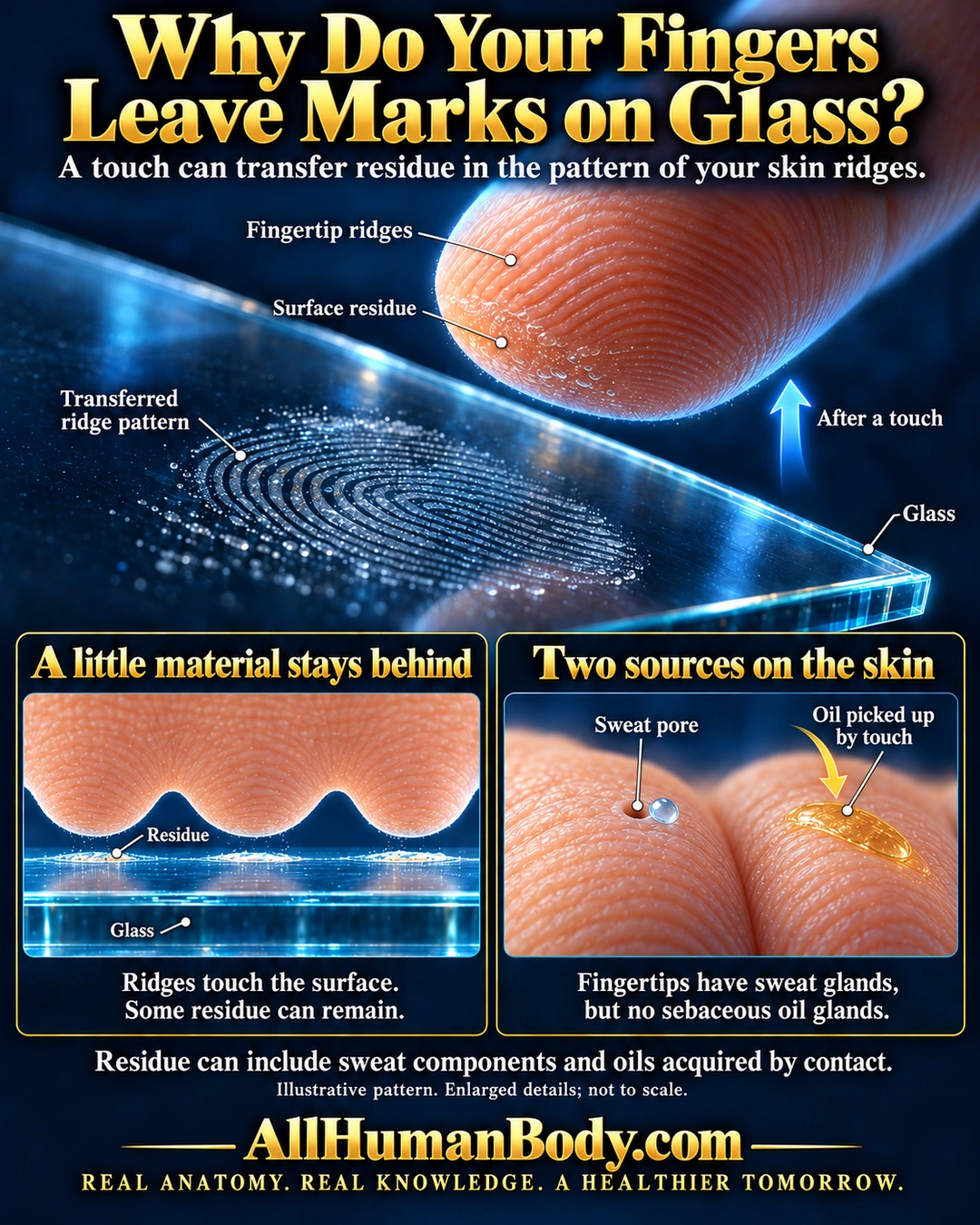
Touch can leave a little surface residue in the pattern of fingertip ridges. The material can include sweat components and oils acquired through contact. Fingertip skin has sweat glands but no sebaceous oil glands.
READ THE IMAGE
What the illustration shows
Gold title: “Why Do Your Fingers Leave Marks on Glass?” The subtitle explains that a touch can transfer residue in the pattern of skin ridges. On a navy background, a large peach-colored fingertip hovers above an angled transparent blue-edged glass pane. White labels point to fingertip ridges, surface residue, glass and a pale curved residue pattern on the glass. A blue arrow points upward beside the fingertip and says “After a touch”. The lower-left enlargement shows a connected strip of skin with three rounded ridges lifted above thin deposits on a flat glass surface. It says some residue can remain. The lower-right enlargement labels a small sweat-pore opening beside a blue droplet and an amber patch identified as oil picked up by touch; a gold arrow comes from outside the skin toward the patch. Text states that fingertips have sweat glands but no sebaceous oil glands, and that residue can include sweat components and acquired oils. A qualifier says the pattern is illustrative and enlarged details are not to scale. The plain navy footer carries gold AllHumanBody.com and “REAL ANATOMY. REAL KNOWLEDGE. A HEALTHIER TOMORROW.”
How to interpret this poster
- No biometric identity, print age or fixed residue composition. Ridge pattern and thickness are illustrative, not a matched forensic specimen.
- AI-assisted educational illustration; not physician certification, a diagnosis or individualized medical advice.
- Fine annotations require enlargement; preserve the full uncropped illustration and its qualifiers.
AI-assisted educational illustration, adapted into web-sized images without changing its composition. This is general education, not an individual diagnosis or treatment recommendation.
EVIDENCE / CONTEXT
Sources and what they support
- The Fingerprint Sourcebook, Chapter 7 ↗
Residue transfer, eccrine contribution and absence of palmar sebaceous glands.