Digestive / VISUAL EXPLAINER
Why Can Tea Make Your Mouth Feel Dry?
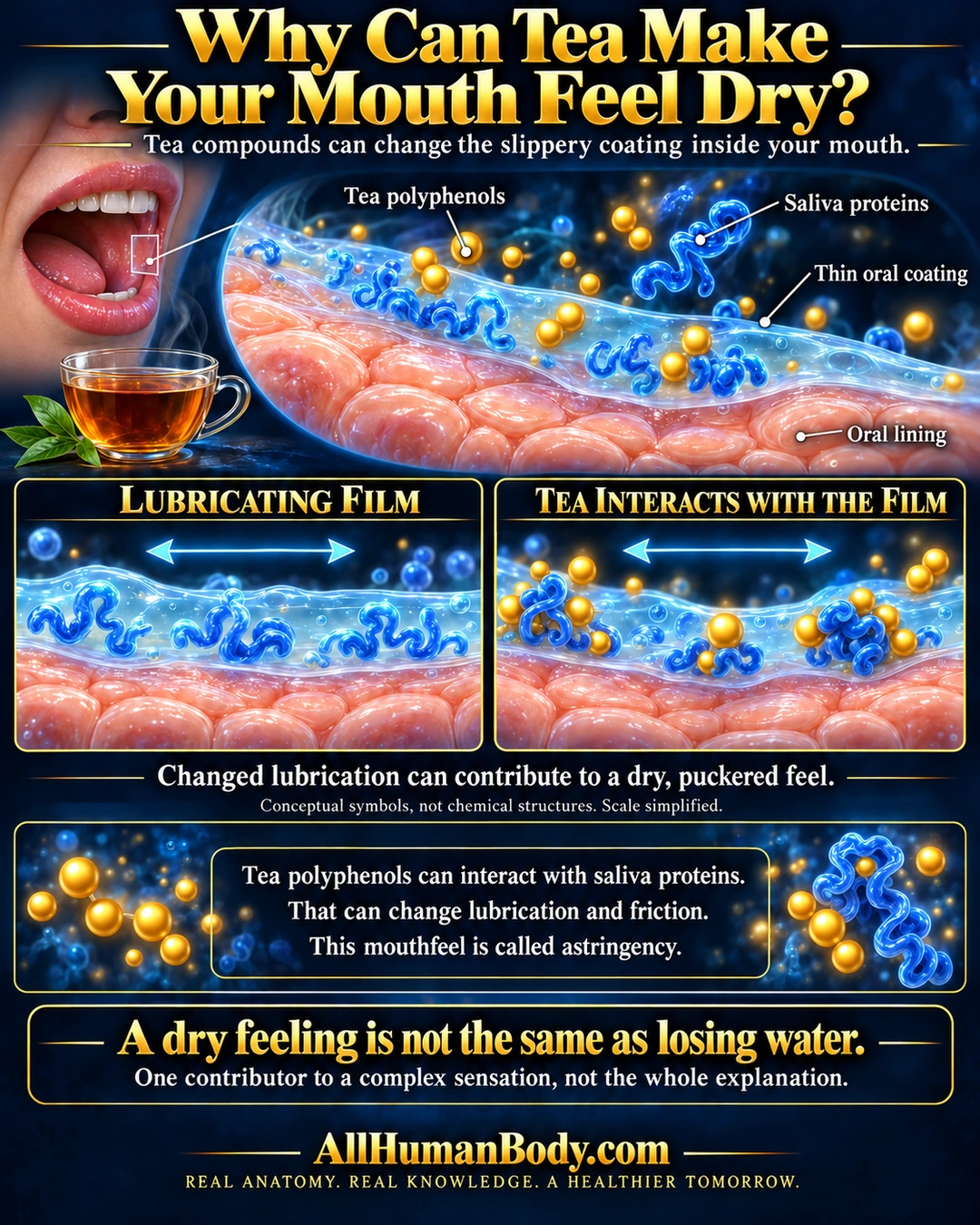
Tea polyphenols can interact with proteins in saliva and the oral coating, changing lubrication and contributing to a dry, puckered sensation called astringency. A dry feeling does not necessarily mean the surface has lost water.
READ THE IMAGE
What the illustration shows
Portrait educational poster on a deep navy background titled “Why Can Tea Make Your Mouth Feel Dry?” An open mouth, tea cup and leaves sit at the upper left. A leader from the inner cheek connects to a magnified peach oral surface covered by a continuous translucent blue film. Abstract gold beads labeled Tea polyphenols meet blue curled shapes labeled Saliva proteins. Other leaders identify Thin oral coating and Oral lining. Two panels compare a lubricating film with a film containing tea-compound and protein clusters; blue double-headed arrows indicate sliding. Both panels retain their fluid coating and intact tissue. Text explains that altered lubrication can contribute to a dry, puckered feeling called astringency, distinguishes that feeling from losing water, and calls this one contributor rather than the whole explanation. The diagram note explicitly says the symbols are not chemical structures and the scale is simplified. Gold AllHumanBody.com and the full slogan appear on a plain navy footer.
How to interpret this poster
- One contributor to a complex sensation, not the sole pathway. Symbols are not molecular structures; no clinical dry-mouth diagnosis, brewing or hydration advice.
- AI-assisted educational illustration; not physician certification, a diagnosis or individualized medical advice.
- Fine annotations require enlargement; preserve the full uncropped illustration and its qualifiers.
AI-assisted educational illustration, adapted into web-sized images without changing its composition. This is general education, not an individual diagnosis or treatment recommendation.
EVIDENCE / CONTEXT
Sources and what they support
- Human tea-astringency study, Nayak and Carpenter2008 ↗
Astringency changed while measured mucosal wetness did not.
Evidence correspondence is limited to the abstract. - Oral-pellicle model, Ployon et al.2018 ↗
Tannin-related mucin aggregation and friction in a cell-based model.
Evidence correspondence is limited to the abstract. - Human-saliva lubrication study, Prinz and Lucas2000 ↗
Tannic-acid effects on lubrication and friction in vitro.
Evidence correspondence is limited to the abstract.