Nervous / VISUAL EXPLAINER
Why Does Metal Feel Colder Than Wood?
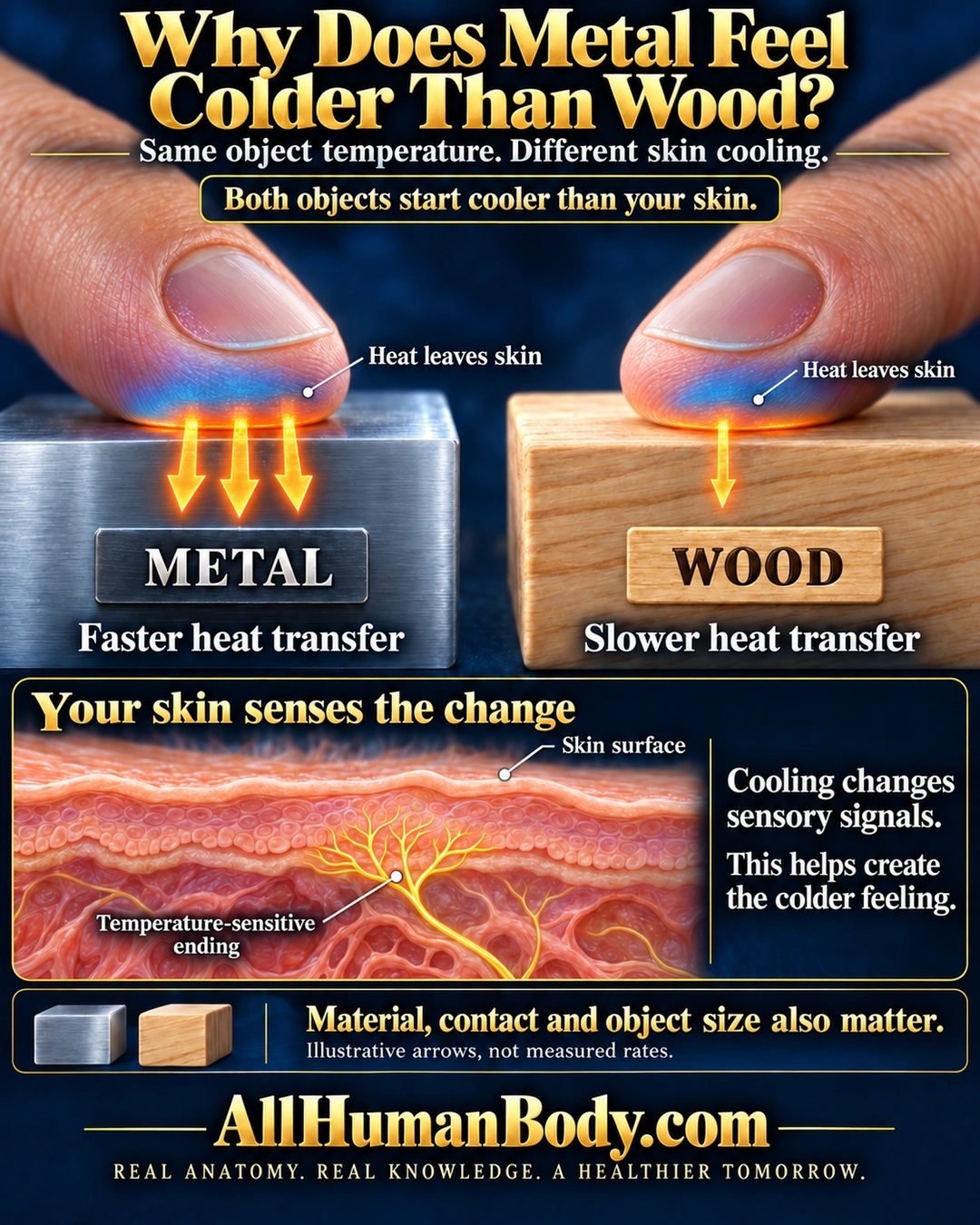
Objects at the same temperature can feel different. When both start cooler than skin, metal generally removes heat faster than wood. The resulting skin cooling changes sensory activity and contributes to the colder feeling.
READ THE IMAGE
What the illustration shows
Navy-and-gold educational poster titled Why Does Metal Feel Colder Than Wood? Two fingertip pads rest on a silver metal block and a wood block. The subtitle says the objects have the same temperature, and a banner states that both start cooler than the skin. Three broad orange arrows point downward from skin into metal; one thinner arrow points downward into wood. Labels say faster and slower heat transfer. Blue skin shading is illustrative. A lower skin section shows a branching yellow temperature-sensitive ending below the surface and explains that cooling changes sensory signals. A note says material, contact and object size also matter and arrows are not measured rates. The plain navy footer carries AllHumanBody.com and the full slogan.
How to interpret this poster
- Arrow number and width are qualitative, not a measured three-to-one rate. Material, contact and size matter; no cold-injury or testing advice.
- AI-assisted educational illustration; not physician certification, a diagnosis or individualized medical advice.
- Fine annotations require enlargement; preserve the full uncropped illustration and its qualifiers.
AI-assisted educational illustration, adapted into web-sized images without changing its composition. This is general education, not an individual diagnosis or treatment recommendation.
EVIDENCE / CONTEXT
Sources and what they support
- University of Illinois Physics Van: Why does metal feel cold? ↗
Same-temperature material differences and transfer of heat.
- Thermal touch review ↗
Thermal perception and physical contact factors.