Integumentary / VISUAL EXPLAINER
Why Does Hair Fly Away After You Remove a Hat?
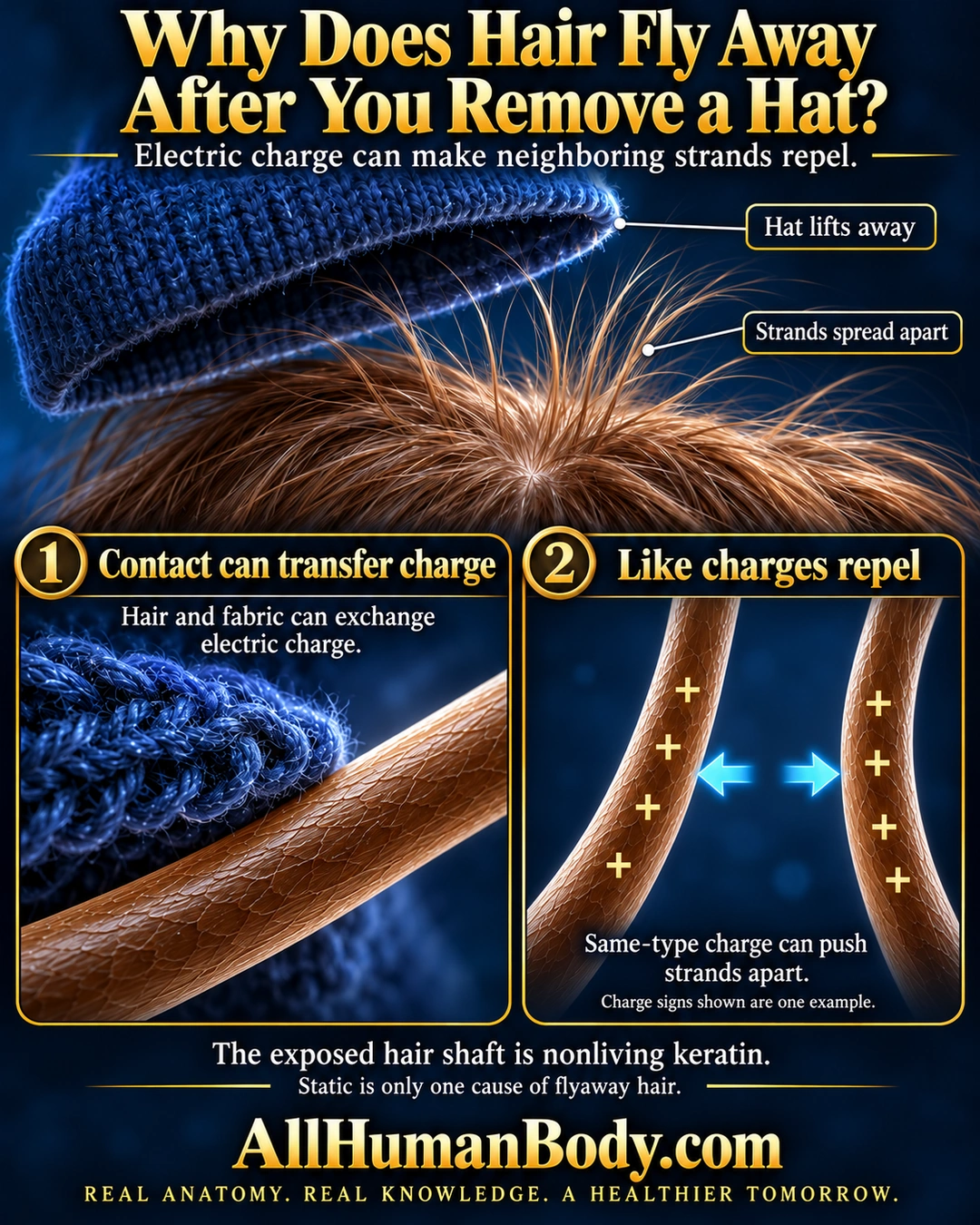
Contact between hair and some materials can transfer electric charge. Neighboring strands with the same type of charge may repel and spread apart. This acts on nonliving exposed shafts and is only one cause of flyaway hair.
READ THE IMAGE
What the illustration shows
English science poster titled “Why Does Hair Fly Away After You Remove a Hat?” on deep navy. A blue knitted hat lifts above the crown of an adult head, where some brown hairs fan apart. White leaders label the lifted hat and spreading strands. Below, the left panel, “Contact can transfer charge,” shows a knitted fabric edge touching one enlarged brown hair shaft with a continuous cuticle-textured surface. The right panel, “Like charges repel,” shows two separate intact shafts carrying matching gold plus signs. Cyan arrows point left and right, away from one another. Text says same-type charge can push strands apart and that the signs are one example. Lower statements identify exposed hair as nonliving keratin and static as only one cause of flyaway hair. A gold AllHumanBody.com brand and full slogan appear on a plain navy footer.
How to interpret this poster
- Charge signs are one example, not universal hair polarity or particle counts. No electrical experiment, product or hair-growth claim.
- AI-assisted educational illustration; not physician certification, a diagnosis or individualized medical advice.
- Fine annotations require enlargement; preserve the full uncropped illustration and its qualifiers.
AI-assisted educational illustration, adapted into web-sized images without changing its composition. This is general education, not an individual diagnosis or treatment recommendation.
EVIDENCE / CONTEXT
Sources and what they support
- Plastic and Hair: A Static-ey Situation ↗
Material-dependent contact charging and same-charge repulsion.
- 5.2 Accessory Structures of the Skin ↗
Nonliving keratinized exposed hair shaft.