Special Senses / VISUAL EXPLAINER
How Do Eyelashes Help Protect Your Eyes?
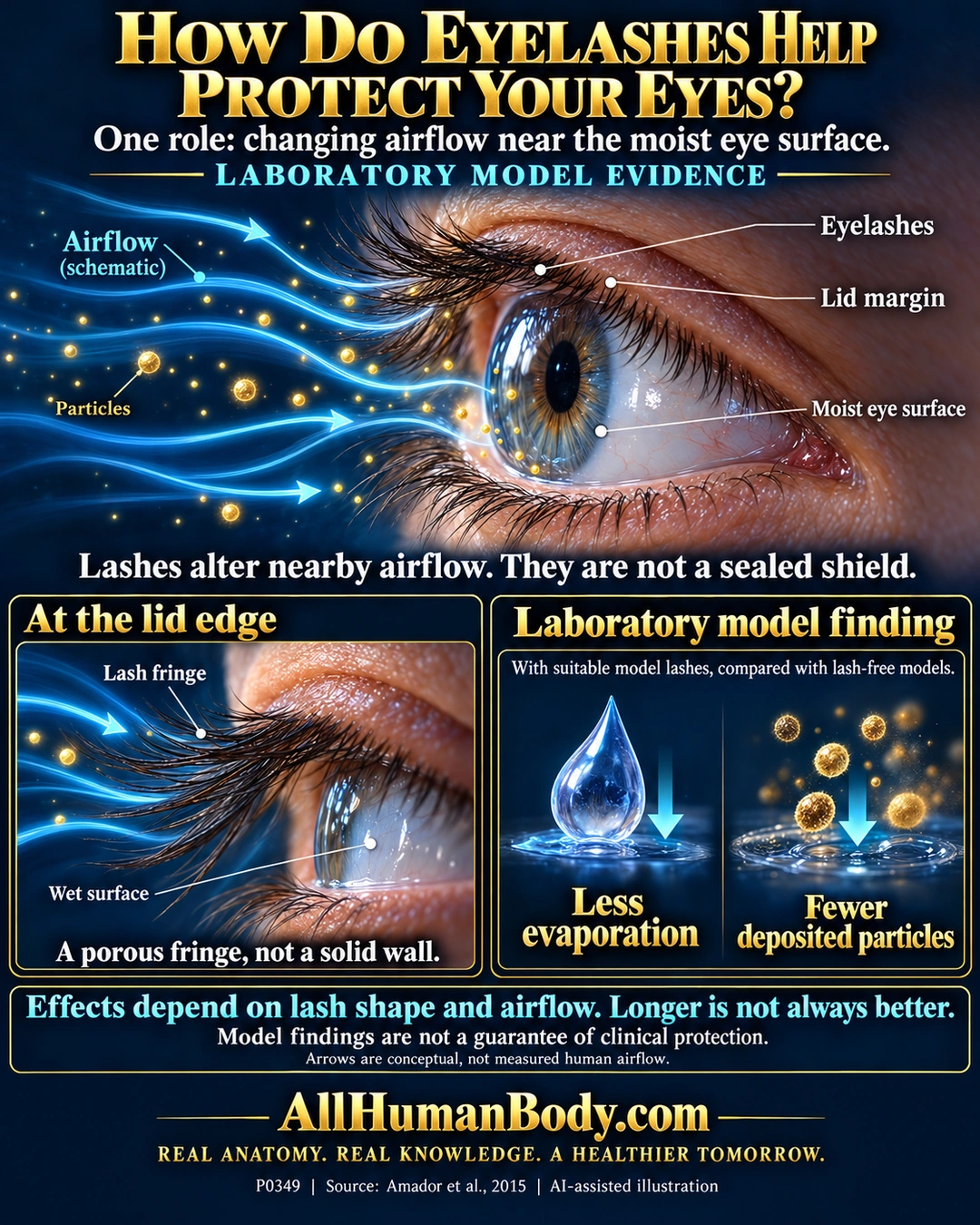
Eyelashes can alter airflow near the wet eye surface. Laboratory models found that suitable lash arrangements reduced evaporation and deposited particles compared with lash-free models.
READ THE IMAGE
What the illustration shows
Portrait educational poster titled “How Do Eyelashes Help Protect Your Eyes?” A prominent cyan banner says “LABORATORY MODEL EVIDENCE.” An oblique close-up of an open human eye shows upper and lower eyelashes, a blue-brown iris, moist white eye surface and peach eyelids. White leaders identify eyelashes, lid margin and moist eye surface. Cyan airflow curves approach from the left around the lash fringe; some gold symbolic particles remain near the eye. Text says lashes are not a sealed shield. A lower-left enlargement labels the lash fringe and wet surface. A separate laboratory-model panel uses a drop and particle icons with downward arrows meaning decreases, captioned “Less evaporation” and “Fewer deposited particles,” compared with lash-free models. A strip says effects depend on lash shape and airflow, longer is not always better, model findings do not guarantee clinical protection, and arrows are conceptual rather than measured human airflow. Gold AllHumanBody.com and the full slogan appear on a plain navy footer. Source: Amador et al., 2015. AI-assisted illustration.
How to interpret this poster
- These are model effects, not guaranteed clinical protection. Lash shape and airflow matter; no ideal human lash length or cosmetic recommendation is given.
- AI-assisted educational illustration; not physician certification, microscopy, a diagnosis or individualized medical advice.
- Fine annotations need enlargement; the full description provides an accessible text alternative.
- Display the full uncropped illustration; do not trim titles, legends or boundary annotations.
AI-assisted educational illustration, adapted into web-sized images without changing its composition. This is general education, not an individual diagnosis or treatment recommendation.
EVIDENCE / CONTEXT
Sources and what they support
- Amador et al., J R Soc Interface 2015, primary comparative anatomy, wind-tunnel and modeling study; author-hosted Georgia Tech PDF ↗
Analyzed mammalian specimens and flat experimental eye mimics. Supports airflow modification and model reductions in evaporation/deposition. Model ratios and reductions are not universal human clinical effect sizes; disease/extension speculation excluded.
- Washington State University, reader-question science education ↗
Confirms ordinary human upper/lower lid lash placement and public question provenance. Its veterinary examples and broad protection wording are not used as clinical proof.