Respiratory / VISUAL EXPLAINER
Why Can You See Your Breath in Cold Air?
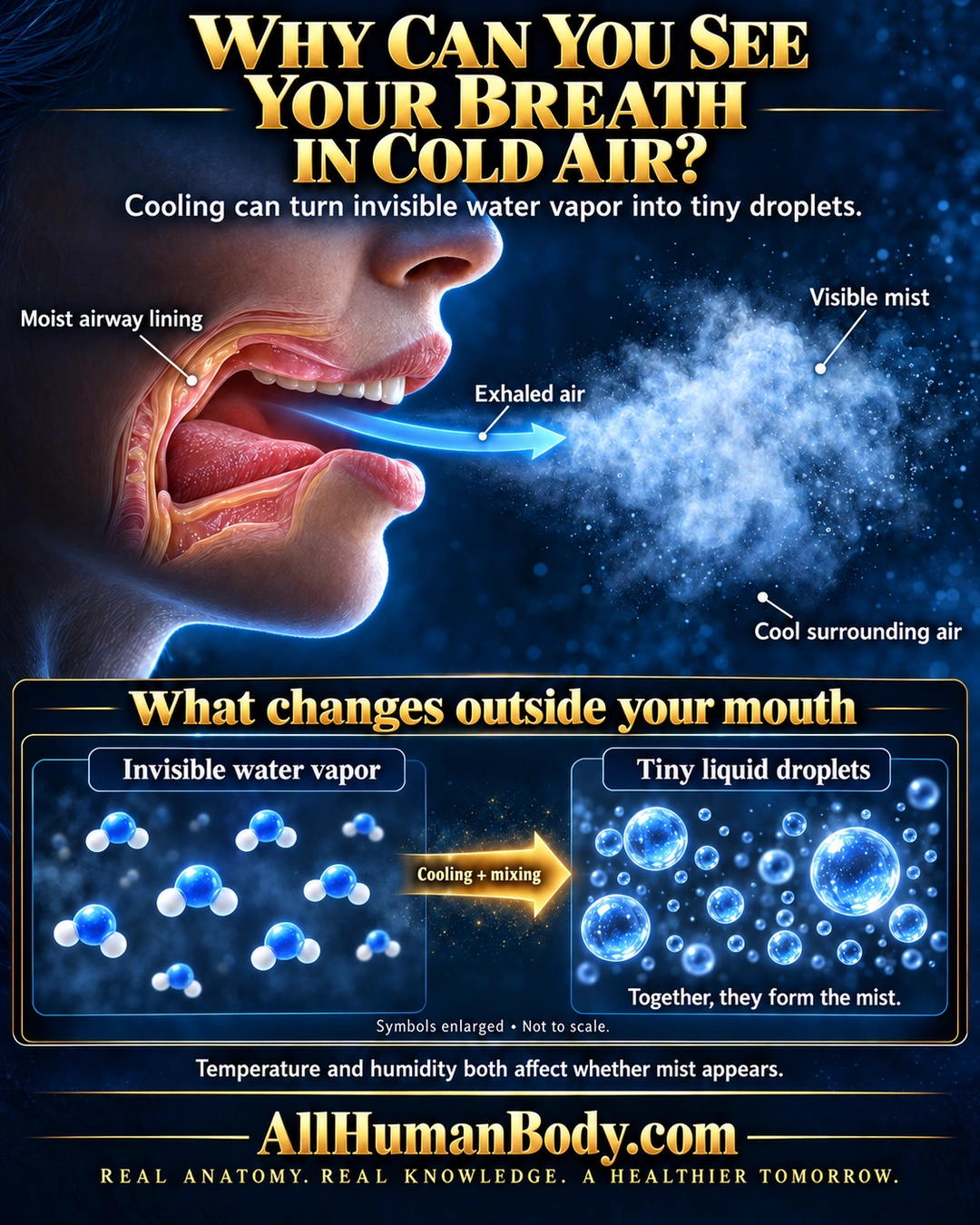
Moist exhaled air can form a visible mist as it cools and mixes with cooler surrounding air. The visible material is tiny liquid droplets rather than water vapor itself; temperature and humidity affect whether it appears.
READ THE IMAGE
What the illustration shows
An English poster titled “Why Can You See Your Breath in Cold Air?” uses a deep navy background, gold headings and cyan highlights. A right-facing lower-face cutaway shows upper teeth, a tongue below the clear oral air space, and a pointer to moist inner lining. A cyan arrow labeled “Exhaled air” travels out between parted lips toward a white-blue mist entirely outside the mouth. Labels identify the mist and cool surrounding air. A lower panel titled “What changes outside your mouth” shows separated bent water-molecule symbols on the left under “Invisible water vapor.” A gold “Cooling + mixing” arrow points toward round liquid-droplet symbols on the right under “Tiny liquid droplets.” A caption says that together they form the mist, and the symbols are labeled enlarged and not to scale. A bottom line says temperature and humidity both affect whether mist appears. The plain navy footer carries gold AllHumanBody.com branding and the full project slogan.
How to interpret this poster
- No fixed temperature threshold or breath-health test. Molecular and droplet symbols are not to scale or one-to-one transformations.
- AI-assisted educational illustration; not physician certification, a diagnosis or individualized medical advice.
- Fine annotations require enlargement; preserve the full uncropped illustration and its qualifiers.
AI-assisted educational illustration, adapted into web-sized images without changing its composition. This is general education, not an individual diagnosis or treatment recommendation.
EVIDENCE / CONTEXT
Sources and what they support
- Measurement system for respiratory water vapor and temperature dynamics ↗
Human respiratory air contains measurable water vapor.
Evidence correspondence is limited to the abstract. - Cooking up a storm: Atmospheric science in your kitchen ↗
Invisible vapor and visible condensed liquid droplets.
- GML Water Vapor: Instrument Description ↗
Cooling, condensation and dependence on moisture content.