Integumentary / VISUAL EXPLAINER
Why Do Your Lips Get Chapped?
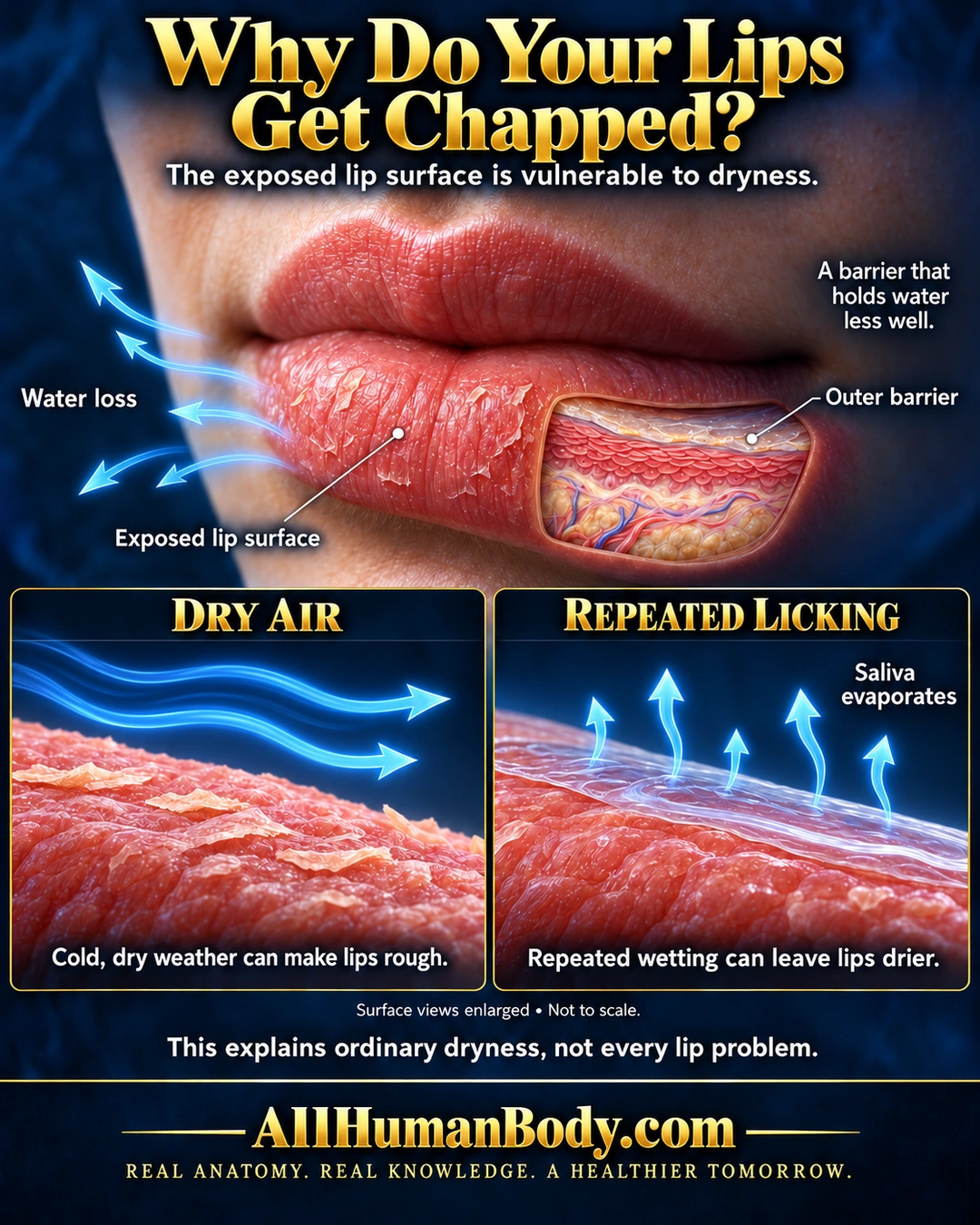
Cold, dry conditions and repeated licking can contribute to ordinary lip dryness. The illustration distinguishes the exposed lip surface from deeper supporting tissue; it does not identify every cause of a lip problem.
READ THE IMAGE
What the illustration shows
An English medical illustration titled “Why Do Your Lips Get Chapped?” on a deep navy background. A large close view of closed peach-red lips shows fine superficial scales on the lower lip. Cyan arrows point outward to the left beside “Water loss.” A white pointer identifies the exposed lip surface. A small window in the lower lip reveals a thin outer surface over simplified epithelial and deeper connective tissue layers; the top is labeled “Outer barrier.” Text says the barrier holds water less well. Below, “Dry air” shows blue wind arrows moving above a dry, gently curved lip surface. “Repeated licking” shows a thin saliva film on the surface with upward arrows labeled “Saliva evaporates.” Captions explain that cold, dry weather can make lips rough and repeated wetting can leave them drier. The enlarged views are labeled not to scale. A final line limits the explanation to ordinary dryness, not every lip problem. Gold AllHumanBody.com branding and the full project slogan appear on a plain navy footer.
How to interpret this poster
- Ordinary dryness only; no treatment, product effect, universal water-loss ratio or exact tissue-layer count.
- AI-assisted educational illustration; not physician certification, a diagnosis or individualized medical advice.
- Fine annotations require enlargement; preserve the full uncropped illustration and its qualifiers.
- Comparative lip evidence is from a winter lip-versus-cheek study in Japanese adult women; no universal ratio is asserted.
AI-assisted educational illustration, adapted into web-sized images without changing its composition. This is general education, not an individual diagnosis or treatment recommendation.
EVIDENCE / CONTEXT
Sources and what they support
- 7 dermatologists’ tips for healing dry, chapped lips ↗
Cold/dry conditions and repeated-licking evaporation cycle.
- The differentiation profile of the epithelium of the human lip ↗
Different exposed and internal lip epithelial regions; simplified surface boundary.
Evidence correspondence is limited to the abstract. - Kobayashi and Tagami2004: Lip vermilion compared with cheek ↗
Human lip-versus-cheek comparison supports lower surface hydration and weaker water-loss barrier qualitatively.
Evidence correspondence is limited to the abstract.