Digestive / VISUAL EXPLAINER
Why Can Your Mouth Water Before You Eat?
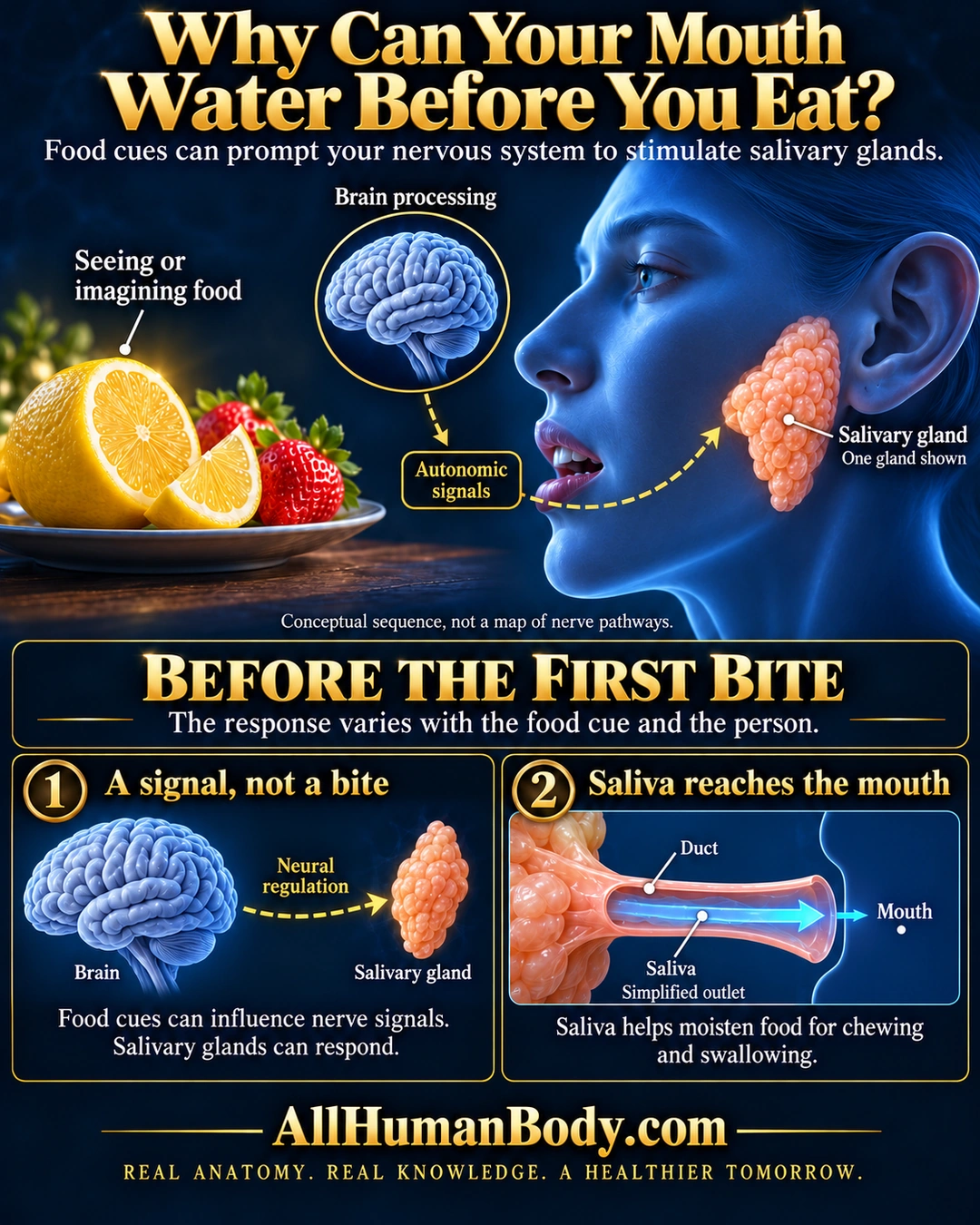
Seeing or imagining food can prompt salivation before eating. Neural regulation can influence salivary glands, whose ducts deliver fluid to the mouth.
READ THE IMAGE
What the illustration shows
Medical illustration titled “Why Can Your Mouth Water Before You Eat?” A plate of cut lemon and strawberries sits apart from a blue adult head in left-facing profile, with no food inside the slightly open mouth. A separate, evenly blue brain symbol is labeled “Brain processing.” Gold dashed arrows pass through an “Autonomic signals” box toward a peach salivary gland shown in front of and below the ear. A note says the sequence is conceptual, not a map of nerve pathways. “Before the first bite” is followed by a statement that the response varies with the cue and person. A lower panel repeats a schematic brain-to-gland relationship. Another shows a short duct with a cyan flow arrow through its lumen and open end toward a blue area labeled “Mouth,” with the caption “Simplified outlet.” The plain navy footer has gold AllHumanBody.com branding and the full project slogan.
How to interpret this poster
- Response varies with cue and person. Dashed arrows are not a traced neural route, and autonomic control is not a simple opposing on/off switch.
- AI-assisted educational illustration; not physician certification, microscopy, a diagnosis or individualized medical advice.
- Fine annotations need enlargement; the full description provides an accessible text alternative.
- Display the full uncropped illustration; do not trim titles, legends or boundary annotations.
AI-assisted educational illustration, adapted into web-sized images without changing its composition. This is general education, not an individual diagnosis or treatment recommendation.
EVIDENCE / CONTEXT
Sources and what they support
- Keesman et al., PLOS ONE 2016, primary human experiments ↗
Two human experiments found increased salivation to food cues, with stronger responses when participants imagined consuming attractive/sour foods. Behavioral evidence supports can, not one universal amount or a proven complete neural circuit.
Evidence correspondence is limited to the abstract. - Proctor, Periodontology 2000 2016, expert physiology review ↗
Supports nerve-mediated secretion and modulation by other central signals. Both parasympathetic and sympathetic nerves can evoke secretion; the image must not show a universal on/off opposition.
Evidence correspondence is limited to the abstract. - NIH NIDCR normal salivary anatomy/function ↗
Supports gland locations, ducts and moistening food for chewing/swallowing. Disease content and categorical claims about killing germs or gland-removal outcomes are not used.