Integumentary / VISUAL EXPLAINER
Why Does Pressed Skin Briefly Look Paler?
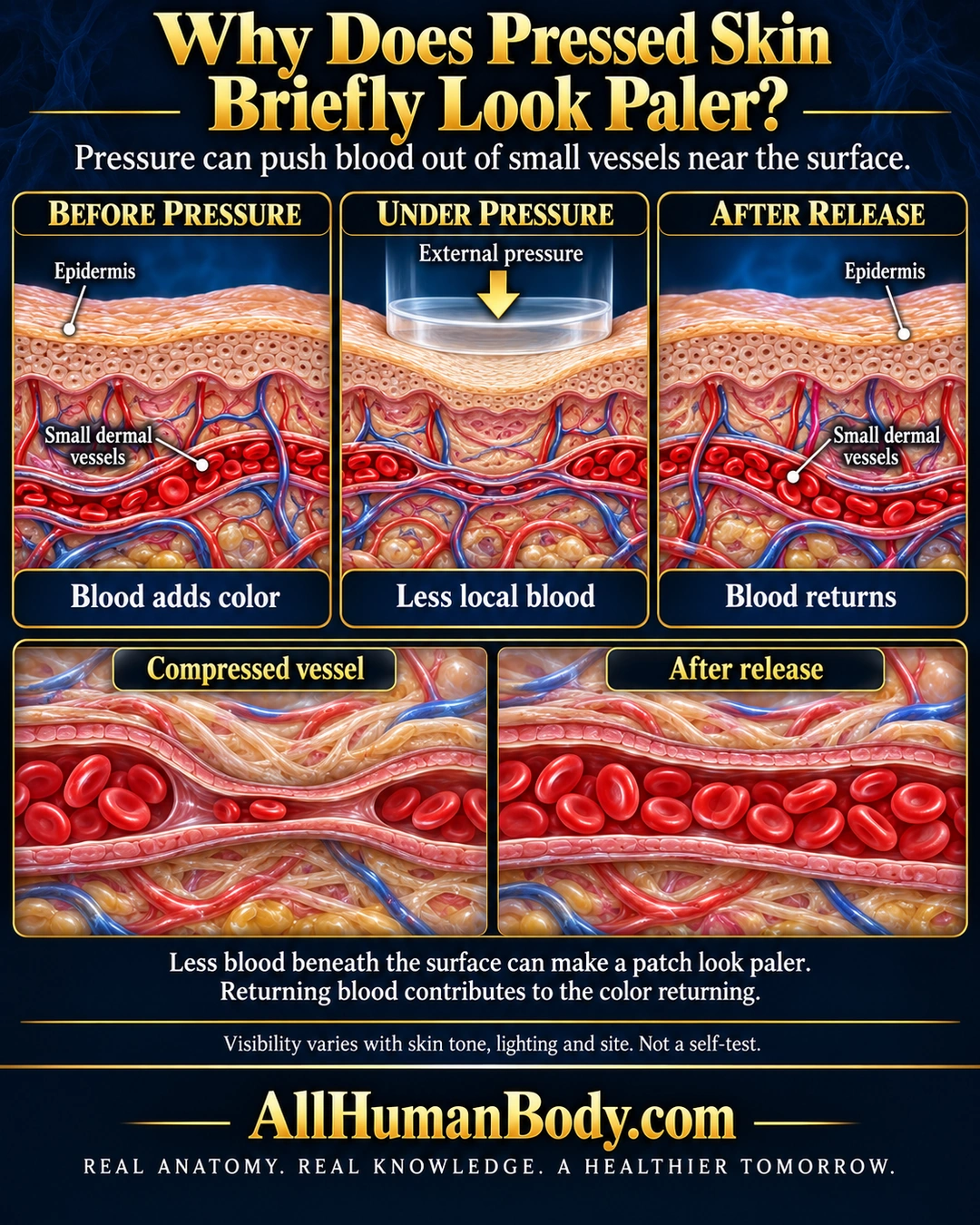
Pressure can reduce local blood within small skin vessels, making a patch look paler. Returning blood contributes to color returning after pressure is released.
READ THE IMAGE
What the illustration shows
English anatomy poster titled “Why Does Pressed Skin Briefly Look Paler?” with a navy background, gold headings and luminous peach skin sections. Three upper panels compare before pressure, under pressure and after release. The outer panels show a layered epidermis above connected red and blue dermal vessels. A transparent contact pad and downward gold arrow indent the skin in the center panel; a central vessel segment is narrower and contains fewer visible red blood cells. Captions say “Blood adds color,” “Less local blood,” and “Blood returns.” Labels point to the epidermis and small dermal vessels. Two enlarged vessel cutaways below compare a compressed narrow segment with an open segment after release; red cells stay inside the vessel lumen. Text explains that less blood beneath the surface can make a patch look paler and returning blood contributes to color returning. A qualifier reads, “Visibility varies with skin tone, lighting and site. Not a self-test.” The flat navy footer has gold AllHumanBody.com and the full slogan, “REAL ANATOMY. REAL KNOWLEDGE. A HEALTHIER TOMORROW.”
How to interpret this poster
- Appearance varies with skin tone, lighting and site. There are no timing thresholds or instructions; this is not a circulation self-test.
- AI-assisted educational illustration; not physician certification, microscopy, a diagnosis or individualized medical advice.
- Fine annotations need enlargement; the full description provides an accessible text alternative.
- Display the full uncropped illustration; do not trim titles, legends or boundary annotations.
AI-assisted educational illustration, adapted into web-sized images without changing its composition. This is general education, not an individual diagnosis or treatment recommendation.
EVIDENCE / CONTEXT
Sources and what they support
- Henricson et al., Journal of Visualized Experiments 2017, primary human measurement/method paper ↗
Directly records local blood-content changes during pressure blanching and refill. Its clinical testing protocol, seconds-based thresholds and triage interpretation are excluded.
Evidence correspondence is limited to the abstract. - MedlinePlus reviewed medical encyclopedia ↗
Nail-bed example corroborates pressure displacing local blood and color returning with refill. Used only for the physical explanation; no clinical test or numerical interpretation is reproduced.