Special Senses / VISUAL EXPLAINER
What Makes Eye Crust While You Sleep?
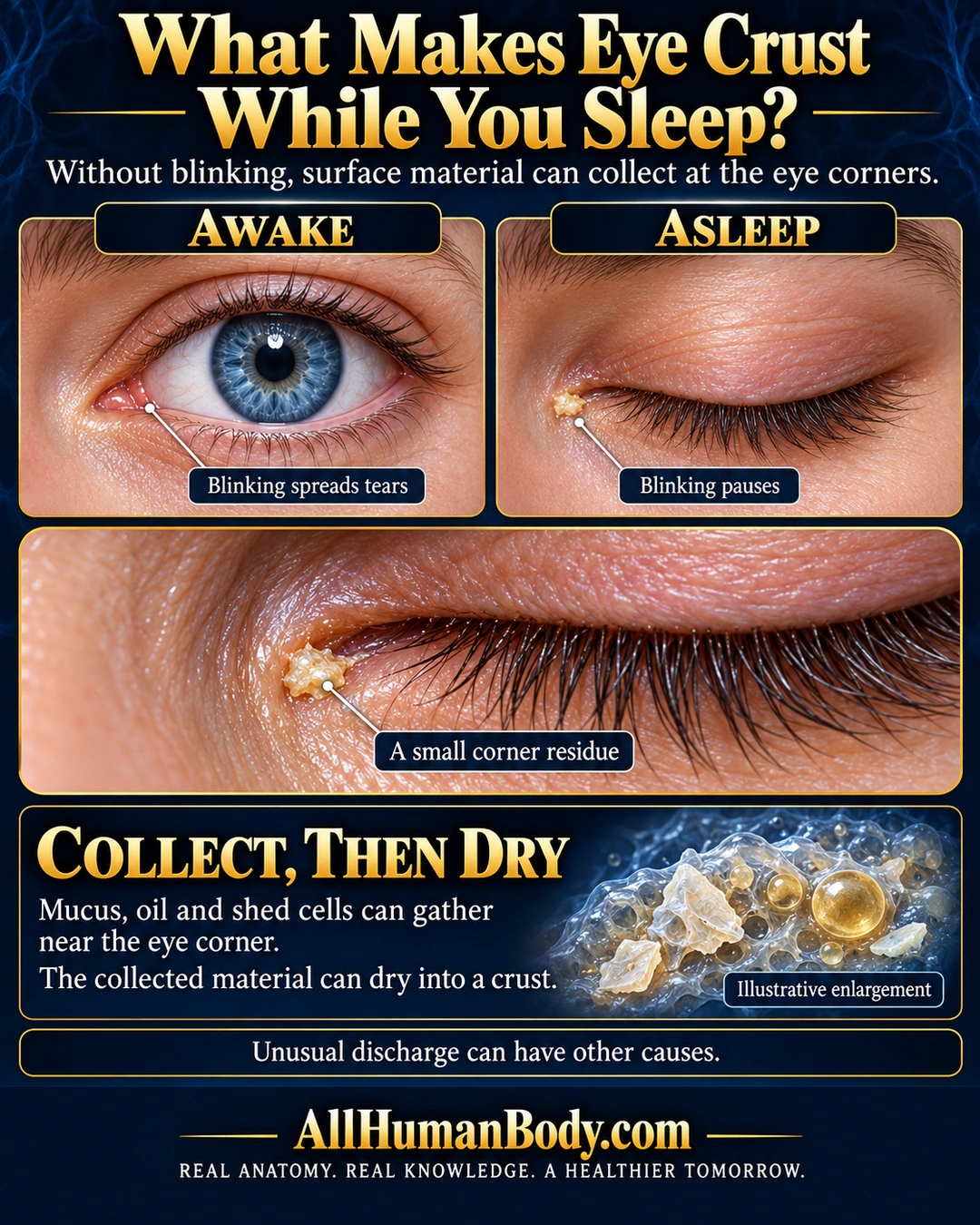
During sleep, surface material can gather near the eye corners while ordinary blinking pauses. Mucus, oil and shed cells can collect and dry into a small crust.
READ THE IMAGE
What the illustration shows
English anatomy poster titled “What Makes Eye Crust While You Sleep?” on a dark navy background with gold headings. At the top, matching closeups show an open blue eye on the left and a closed eye on the right, both with the inner corner at image left. Labels read “Blinking spreads tears” and “Blinking pauses.” A small pale beige residue sits outside the closed eye at the inner lid corner. A wider closeup below enlarges that external residue and labels it “A small corner residue.” A lower section headed “Collect, Then Dry” says mucus, oil and shed cells can gather near the corner and that collected material can dry into a crust. Beside it, an illustrative enlargement shows pale flakes and amber droplets in a translucent mixture. A boundary states, “Unusual discharge can have other causes.” The flat navy footer bears gold AllHumanBody.com and “REAL ANATOMY. REAL KNOWLEDGE. A HEALTHIER TOMORROW.”
How to interpret this poster
- Unusual discharge can have other causes. The inset is not measured composition or a color-based diagnosis; no cleaning, drops or contact-lens advice.
- AI-assisted educational illustration; not physician certification, microscopy, a diagnosis or individualized medical advice.
- Fine annotations need enlargement; the full description provides an accessible text alternative.
- Display the full uncropped illustration; do not trim titles, legends or boundary annotations.
AI-assisted educational illustration, adapted into web-sized images without changing its composition. This is general education, not an individual diagnosis or treatment recommendation.
EVIDENCE / CONTEXT
Sources and what they support
- Cleveland Clinic ophthalmologist explanation ↗
Supports normal overnight accumulation, missing blink clearance and drying of mucus/oil/cells/debris. Distinguishes ordinary residue from other discharge; clinical treatment content is excluded.
- NIH National Eye Institute normal tear physiology ↗
Supports blink spreading and tear contributions. Its three-layer shorthand is not rendered as three rigid layers; no overnight crust mechanism is attributed to this page.