Integumentary / VISUAL EXPLAINER
Why Does Repeated Rubbing Make a Callus?
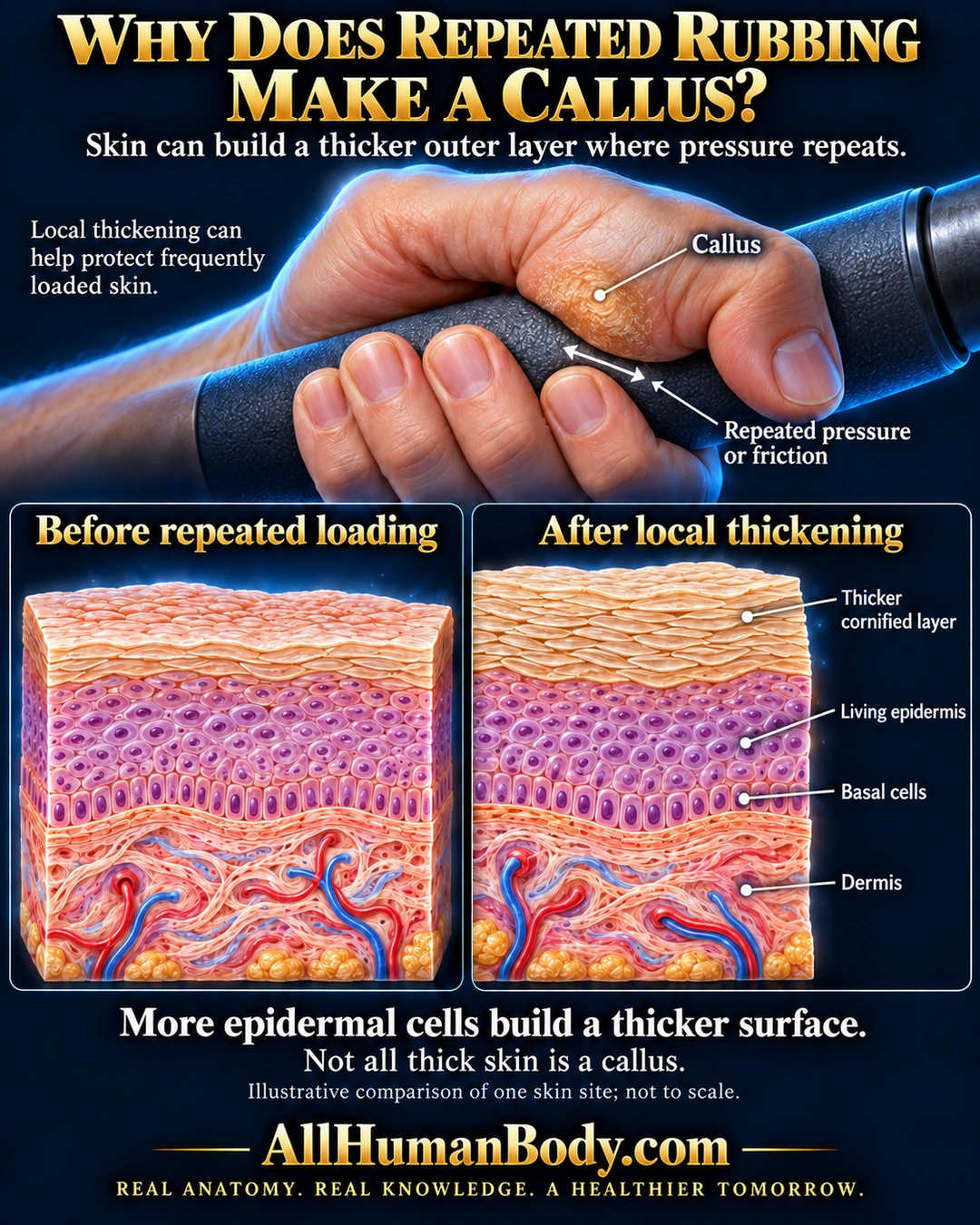
Repeated friction or pressure can lead to a thicker outer skin layer, forming a callus. The illustration separates this surface change from the living layers beneath it.
READ THE IMAGE
What the illustration shows
English educational poster titled “Why Does Repeated Rubbing Make a Callus?” on deep navy. A hand with one thumb and four curled fingers grips a dark tool handle. A white leader identifies an intact thickened patch on the thumb-side contact area, and a short double arrow marks repeated pressure or friction. Below, two skin blocks compare one hairless site before repeated loading and after local thickening. The right block has a thicker ivory cornified surface above purple nucleated living epidermal cells, a single basal row and peach dermis with vessels below the epidermis. Labels identify those layers. Text says more epidermal cells build a thicker surface, not all thick skin is a callus, and the comparison is not to scale. Gold branding and the full slogan appear on a plain navy footer.
How to interpret this poster
- Not every thickened or painful skin area is a callus. No diagnosis, removal technique or guarantee of painless protection is offered.
- AI-assisted educational illustration; not physician certification, microscopy, a diagnosis or individualized medical advice.
- Fine annotations need enlargement; the full description provides an accessible text alternative.
- Display the full uncropped illustration; do not trim titles, legends or boundary annotations.
AI-assisted educational illustration, adapted into web-sized images without changing its composition. This is general education, not an individual diagnosis or treatment recommendation.
EVIDENCE / CONTEXT
Sources and what they support
- American Academy of Dermatology, official dermatologist guidance ↗
Definition, repeated mechanical exposure, protection and familiar hand examples. Only formation explanation adopted; treatment section excluded.
- DermNet dermatologist-authored clinical education ↗
Explicitly describes increased basal keratinocyte number with thicker spinous and cornified layers. Its categorical painless wording is not adopted.
- MedlinePlus Medical Encyclopedia ↗
Corroborates pressure/friction and protective local thickening; notes pain can occur, so no blanket harmless/painless promise.