Nervous / VISUAL EXPLAINER
Why Does Your Own Touch Feel Less Ticklish?
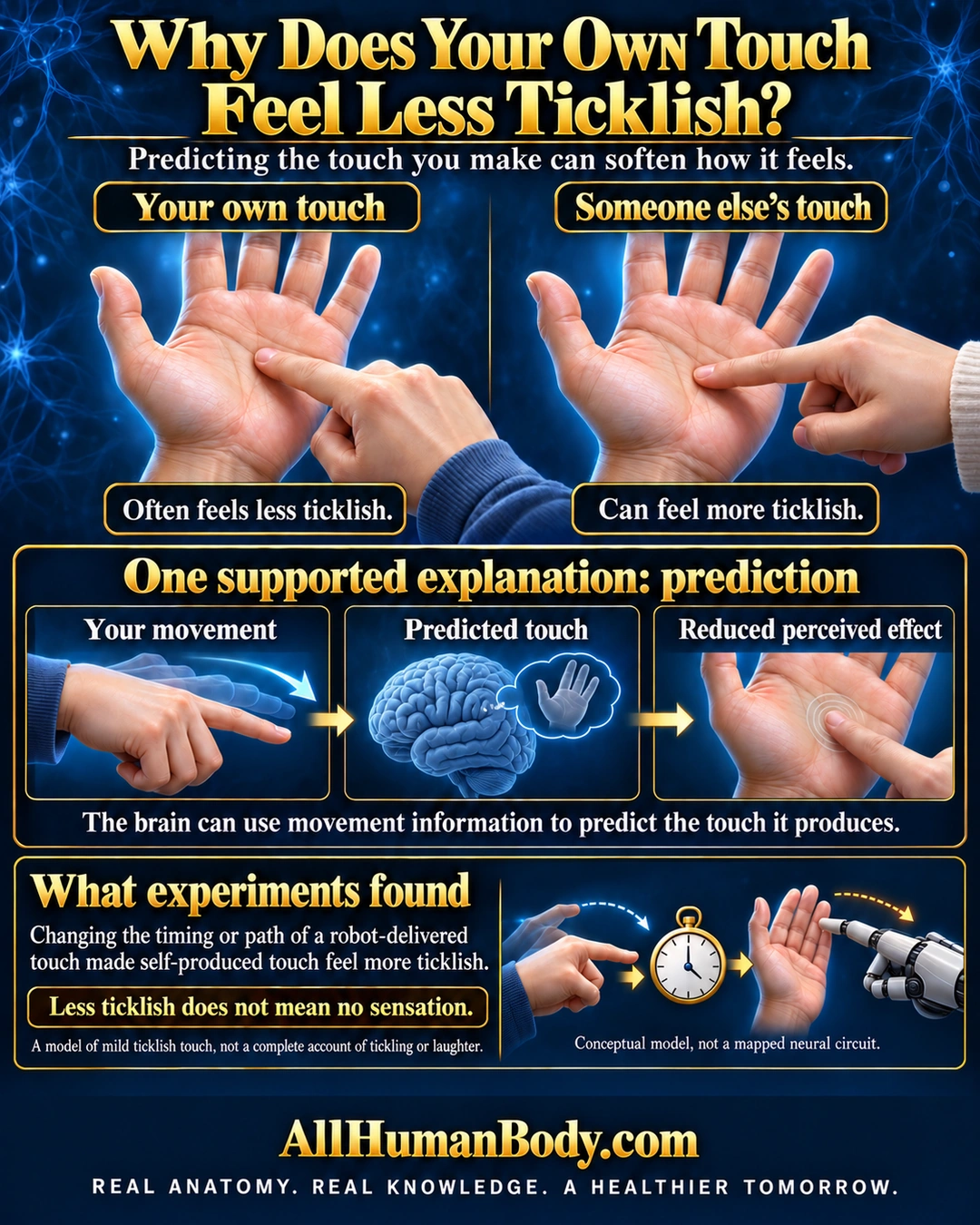
Touch made by your own movement often feels less ticklish. Predicting the sensory result of that movement is one supported explanation, not a complete account of all tickling.
READ THE IMAGE
What the illustration shows
English teaching poster titled “Why Does Your Own Touch Feel Less Ticklish?” Two matched views show an open right palm contacted by an index finger: the person’s own hand on the left and another person’s hand with a different cuff on the right. Captions say own touch often feels less ticklish and someone else’s touch can feel more ticklish. A conceptual strip shows movement, predicted touch as a neutral blue brain and hand thought bubble, and a reduced perceived effect. A separate hand, clock and robot illustration accompanies a statement about experiments changing touch timing or path. Text says less ticklish does not mean no sensation, limits the explanation to mild ticklish touch, and says it is not a mapped neural circuit. Gold branding and the complete slogan appear on a plain navy footer.
How to interpret this poster
- Less ticklish does not mean no sensation. Laboratory mild-touch findings do not fully explain laughter, social tickling or an individual diagnostic sign.
- AI-assisted educational illustration; not physician certification, microscopy, a diagnosis or individualized medical advice.
- Fine annotations need enlargement; the full description provides an accessible text alternative.
- Display the full uncropped illustration; do not trim titles, legends or boundary annotations.
AI-assisted educational illustration, adapted into web-sized images without changing its composition. This is general education, not an individual diagnosis or treatment recommendation.
EVIDENCE / CONTEXT
Sources and what they support
- Blakemore, Wolpert and Frith, 2000 NeuroReport author review of their experiments ↗
Explains prediction-versus-feedback model and reports the robotic results. Cerebellar involvement is proposed rather than a standalone tickle center. Clinical speculation excluded.