Integumentary / VISUAL EXPLAINER
Why Can Skin Peel After a Sunburn?
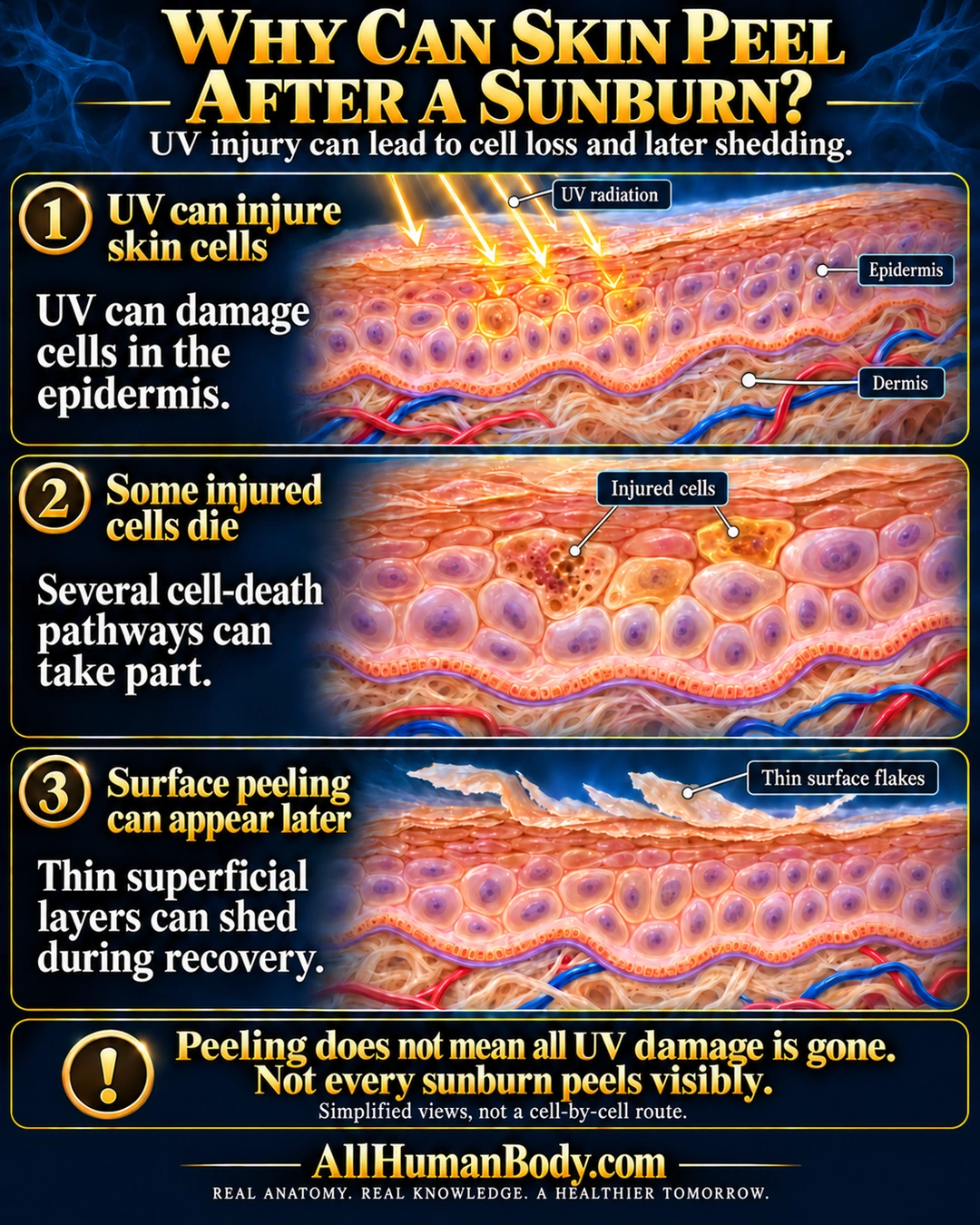
Ultraviolet exposure can injure epidermal cells. Later shedding of superficial skin can contribute to peeling after sunburn, without removing every consequence of the exposure.
READ THE IMAGE
What the illustration shows
Gold-titled educational poster, “Why Can Skin Peel After a Sunburn?”, on a dark blue background. Three stacked skin cutaways show: gold UV arrows entering the epidermis; a few amber injured cells among neighboring cells; and later thin surface flakes lifting above intact deeper layers. Red and blue vessels stay in the dermis below the epidermis. Labels identify UV radiation, epidermis, dermis, injured cells and thin surface flakes. The text says several cell-death pathways can take part. A prominent caution says peeling does not mean all UV damage is gone and not every sunburn peels visibly. The views are simplified, not a cell-by-cell route. Gold AllHumanBody.com branding and the full slogan appear at the bottom.
How to interpret this poster
- Peeling does not show that all UV damage is gone. Cell-death pathways vary; the diagram is not a complete damage map or a treatment guide.
- AI-assisted educational illustration; not physician certification, microscopy, a diagnosis or individualized medical advice.
- Fine annotations need enlargement; the full description provides an accessible text alternative.
- Display the full uncropped illustration; do not trim titles, legends or boundary annotations.
AI-assisted educational illustration, adapted into web-sized images without changing its composition. This is general education, not an individual diagnosis or treatment recommendation.
EVIDENCE / CONTEXT
Sources and what they support
- FDA official explanation of UV skin injury ↗
Sunburn is UV injury involving epidermal damage and later peeling. Treatment, numerical timing and simplified immune-cell removal details are not copied into the poster.
- Mass et al., primary human-skin study, Archives of Dermatological Research, 2003 ↗
Observed premature keratinocyte death and apoptotic markers after UVB. Very limited human experimental sample and supplemental biopsy material; does not establish universal timing or show the entire visible-peeling mechanism.
Evidence correspondence is limited to the abstract. - OpenStax Anatomy and Physiology 2e, authored textbook ↗
Epidermal/dermal boundary, avascular epidermis and superficial shedding context. Normal renewal is background, not the new central explanation.
- Bi et al., primary mouse, human keratinocyte and human-skin-explant study, Cell Death & Disease, 2025 ↗
Multiple regulated cell-death pathway markers were activated after UVB; prevents an apoptosis-only story. Experimental models do not establish a universal sequence or the precise contribution of each route to every real-life sunburn.
Evidence correspondence is limited to the abstract.