Respiratory / VISUAL EXPLAINER
What Makes the Sound of Snoring?
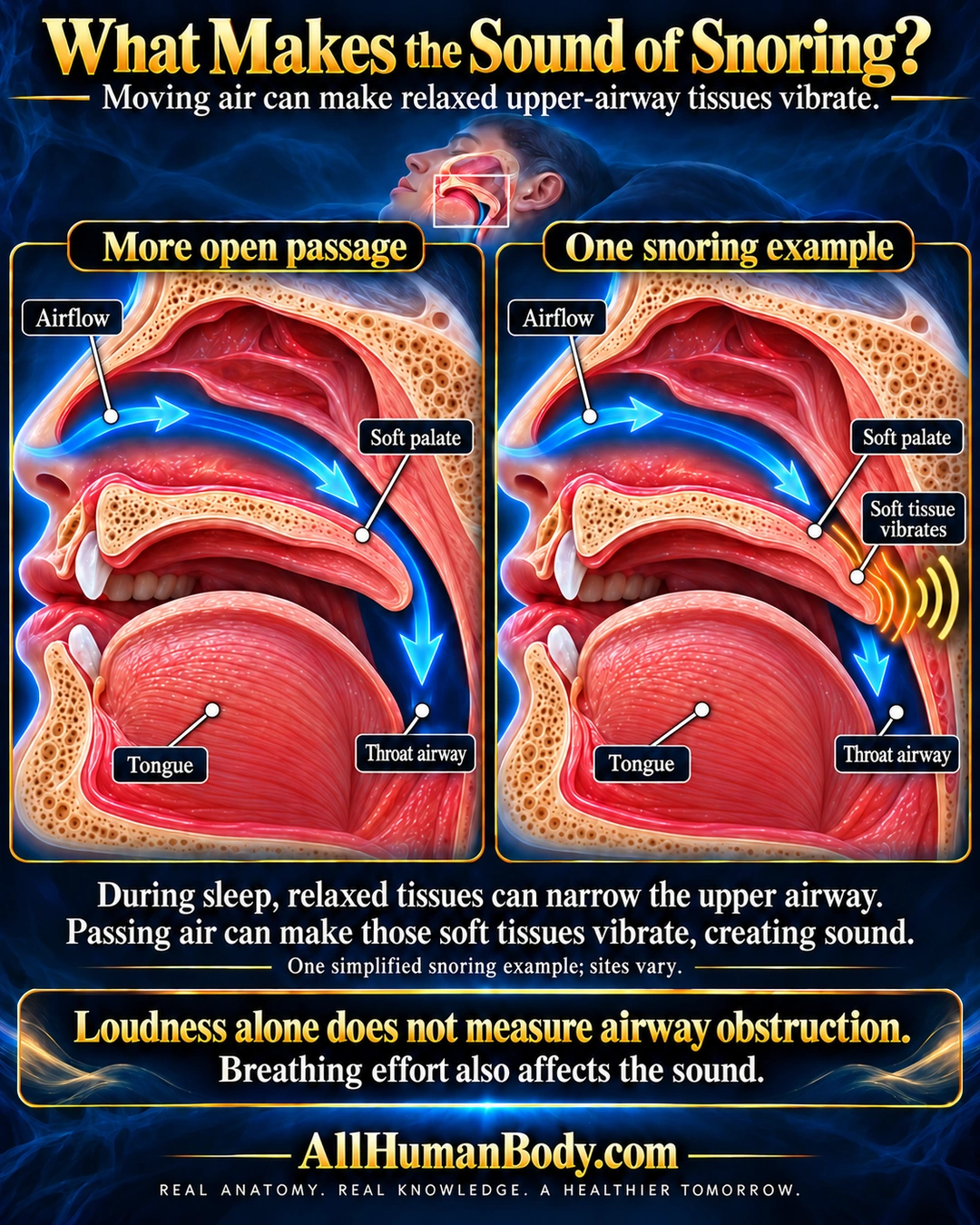
Snoring can arise when airflow makes relaxed upper-airway tissues vibrate. Loudness alone does not reliably indicate how obstructed the airway is.
READ THE IMAGE
What the illustration shows
English poster titled “What Makes the Sound of Snoring?” on a luminous navy and cyan background. A small reclining adult head locator sits above two enlarged left-facing sagittal views labeled “More open passage” and “One snoring example.” Each view shows the nasal cavity above the palate, tongue below, and a blue throat-airway space behind the tongue and soft palate. Cyan arrows pass backward through the nasal cavity and bend down into the upper pharyngeal space; the arrows stop in this upper-throat crop. White label leaders identify airflow, soft palate, tongue and throat airway. In the right view, gold contours and curved sound marks beside the soft palate indicate soft-tissue vibration; the passage remains open. Text explains that relaxed tissues can narrow the airway during sleep and moving air can make them vibrate. A note says this is one simplified example and sites vary. The takeaway states that loudness alone does not measure airway obstruction and breathing effort also affects sound. Gold AllHumanBody.com and the full project slogan appear at the bottom.
How to interpret this poster
- No sleep-apnea diagnosis or reassurance follows from loudness. The physiological study involved selected patients, not a universal population rule.
- AI-assisted educational illustration; not physician certification, microscopy, a diagnosis or individualized medical advice.
- Fine annotations need enlargement; the full description provides an accessible text alternative.
- Display the full uncropped illustration; do not trim titles, legends or boundary annotations.
AI-assisted educational illustration, adapted into web-sized images without changing its composition. This is general education, not an individual diagnosis or treatment recommendation.
EVIDENCE / CONTEXT
Sources and what they support
- NHLBI direct research feature, March 2024 ↗
Explains upper-airway soft-tissue vibration and a study showing breathing effort influences loudness. Do not inherit a simplistic light-to-deep sleep-only sequence.
- Vena et al., primary human physiological study, Annals of the American Thoracic Society, 2024 ↗
Forty patients with suspected/diagnosed sleep apnea: both ventilatory drive and obstruction affected snore loudness; very severe obstruction could be quieter. No diagnostic threshold or general-population prevalence is inferred.
Evidence correspondence is limited to the abstract. - OpenStax Anatomy and Physiology 2e, authored textbook ↗
Soft palate behind hard palate, pharyngeal route behind oral cavity and continuation into larynx/trachea. Used for original anatomy, not source figures.