Digestive / VISUAL EXPLAINER
Why Can Beans Make You Gassy?
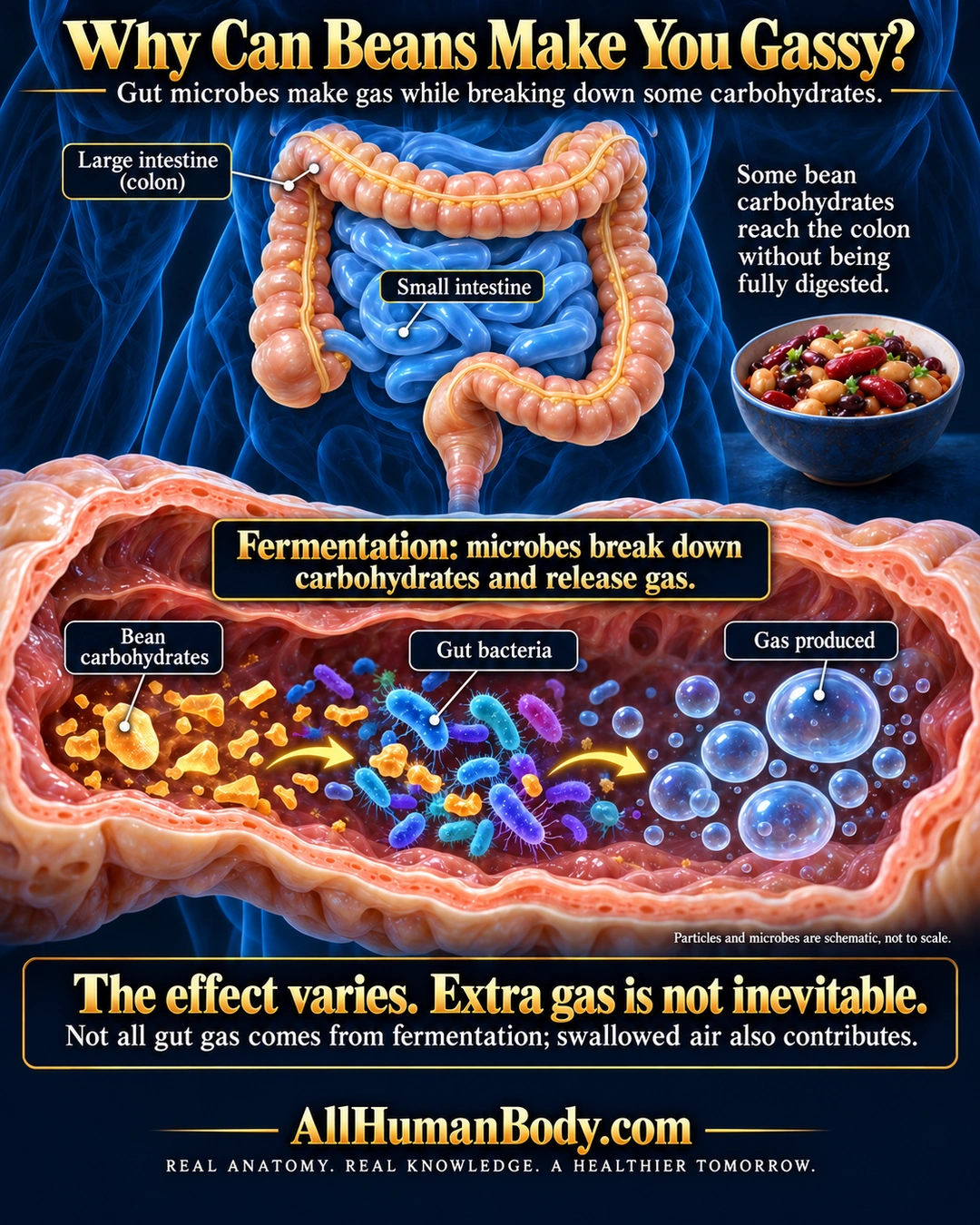
Some carbohydrates in beans reach the large bowel, where microbes can break them down and produce gas. The amount people notice varies, and swallowed air is another source of digestive gas.
READ THE IMAGE
What the illustration shows
English poster titled “Why Can Beans Make You Gassy?” on a dark navy and cyan background. An upper front-view abdominal locator shows a peach segmented colon surrounding blue small-intestinal coils. A short blue terminal segment reaches the medial cecum on image left. White leaders identify the large intestine and small intestine. A bowl of cooked beans appears to the right beside text explaining that some bean carbohydrates reach the colon without full digestion. Below, an enlarged cut-open colon segment contains gold carbohydrate fragments, cyan and violet schematic microbes, and pale-blue bubbles. Two gold conceptual arrows point from the fragments toward microbes and then toward gas production inside the lumen. Labels identify bean carbohydrates, gut bacteria and gas produced. A prominent sentence defines fermentation as microbes breaking down carbohydrates and releasing gas. A small note says particles and microbes are schematic and not to scale. The takeaway states that extra gas is not inevitable and that swallowed air also contributes to gut gas. Gold AllHumanBody.com and the full project slogan sit on a plain navy footer.
How to interpret this poster
- This is not a diet prescription or a measurement of gas volume. Self-reported effects vary; whole beans are not shown traveling intact through the bowel.
- AI-assisted educational illustration; not physician certification, microscopy, a diagnosis or individualized medical advice.
- Fine annotations need enlargement; the full description provides an accessible text alternative.
- Display the full uncropped illustration; do not trim titles, legends or boundary annotations.
AI-assisted educational illustration, adapted into web-sized images without changing its composition. This is general education, not an individual diagnosis or treatment recommendation.
EVIDENCE / CONTEXT
Sources and what they support
- NIDDK official digestive physiology education ↗
Lists beans/legumes among carbohydrate-containing foods that can increase gas through large-intestinal bacterial breakdown; dietary treatment suggestions excluded.
- NIDDK official digestive physiology education ↗
Distinguishes microbial carbohydrate gas production in the large intestine from swallowed air and gastric belching.
- Winham and Hutchins, primary analysis of three adult bean-feeding studies, Nutrition Journal, 2011 ↗
Self-reported flatulence varied among people and bean types. This is perceived change, not direct gas-volume measurement; no adaptation deadline, prescription or universal percentage is adopted.
Evidence correspondence is limited to the abstract.