Special Senses / VISUAL EXPLAINER
Why Can Reading in a Car Make You Queasy?
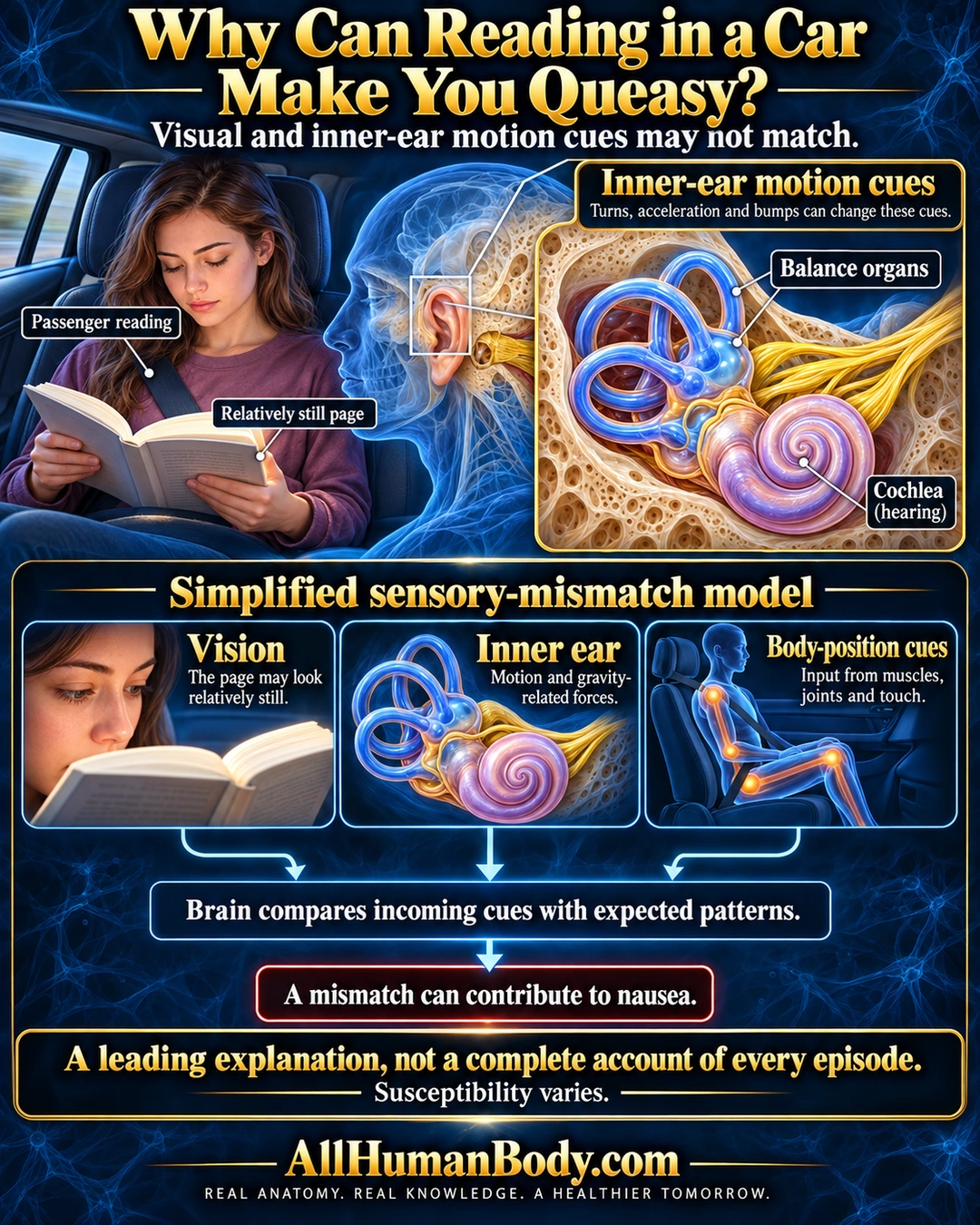
Reading during travel can leave visual and inner-ear information in disagreement. Sensory conflict is a leading explanation for why some passengers feel motion sick.
READ THE IMAGE
What the illustration shows
English anatomy poster titled “Why Can Reading in a Car Make You Queasy?” on a navy-and-blue field with gold headings. At upper left, a seat-belted adult passenger reads an open book. Labels identify the passenger and relatively still page. A translucent side-view head and ear locator lead to a separate enlarged inner-ear model at upper right. Blue looping balance structures and a pink-ivory cochlear spiral are labeled Balance organs and Cochlea (hearing); yellow nerve-like bundles extend beside them. Text says turns, acceleration and bumps can change inner-ear motion cues. The lower “Simplified sensory-mismatch model” has three illustrated tiles: Vision with a reader and book, Inner ear with balance structures, and Body-position cues with a seated body and highlighted joints. Three schematic arrows outside the anatomy converge on “Brain compares incoming cues with expected patterns.” One downward arrow leads to “A mismatch can contribute to nausea.” A prominent final statement calls this a leading explanation, not a complete account of every episode, followed by “Susceptibility varies.” Gold AllHumanBody.com branding and the full slogan appear at the bottom.
How to interpret this poster
- This is a supported explanatory model, not the only mechanism or a diagnosis. Susceptibility varies; the image offers no prevention or treatment instructions.
- AI-assisted educational illustration; not physician certification, microscopy, a diagnosis or individualized medical advice.
- Fine annotations need enlargement; the full description provides an accessible text alternative.
- Display the full uncropped illustration; do not trim titles, legends or boundary annotations.
AI-assisted educational illustration, adapted into web-sized images without changing its composition. This is general education, not an individual diagnosis or treatment recommendation.
EVIDENCE / CONTEXT
Sources and what they support
- CDC Yellow Book 2026, John F. Golding, updated 2025 ↗
Sensory-conflict/internal-model theory; limited outside visual information can disagree with vestibular cues, visual reading tasks are relevant, and susceptibility varies. Treatment and prevention instructions excluded.
- NIH/NIDCD balance education ↗
Normal integration of vision, inner-ear and bodily sensory inputs. Semicircular/otolith anatomical context only; do not import clinical diagnoses or oversimplified receptor geometry.