Special Senses / VISUAL EXPLAINER
Why Does Your Recorded Voice Sound Different?
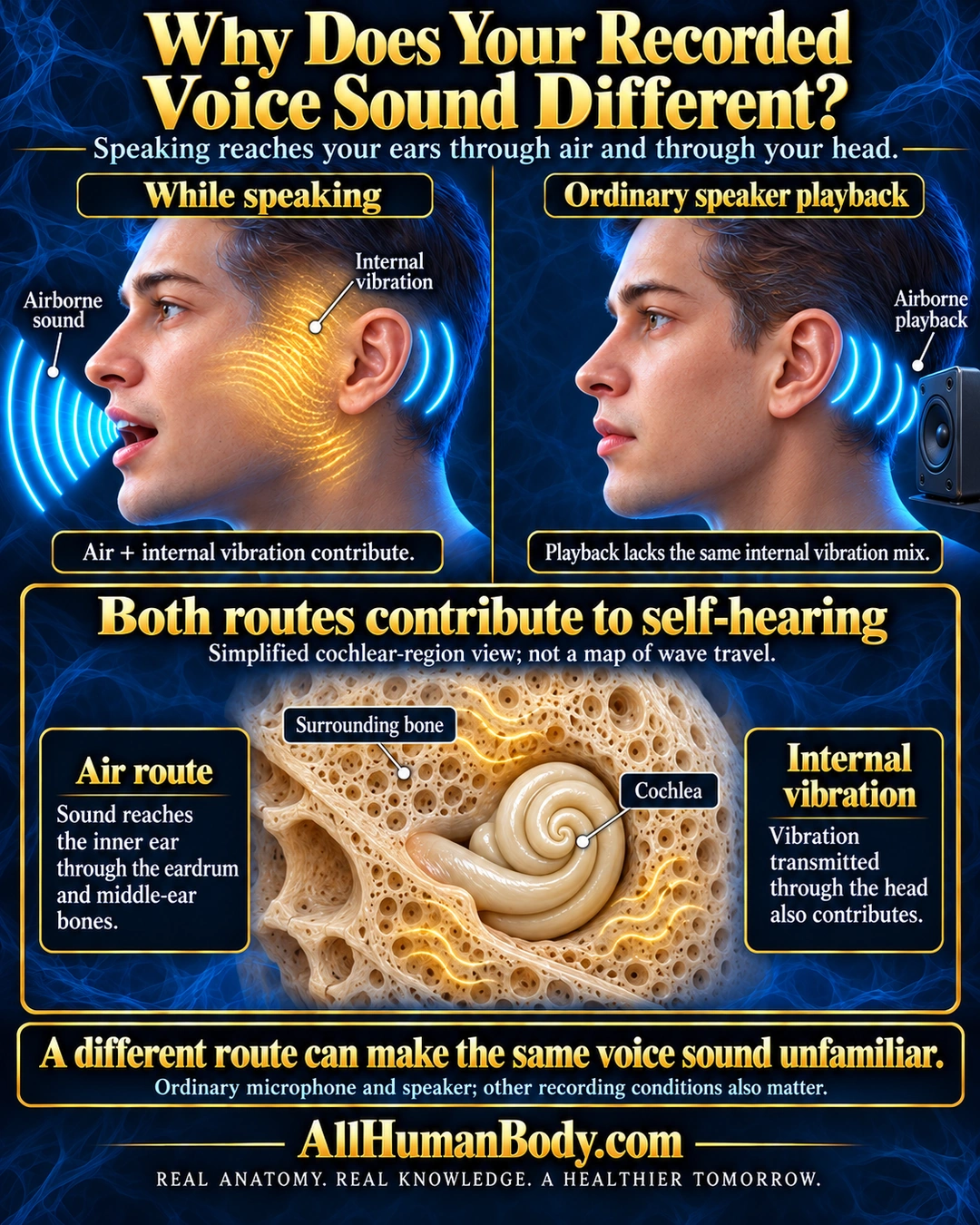
While speaking, you hear both airborne sound and internally transmitted vibration. Ordinary microphone-and-speaker playback lacks the same internal mixture, which can make your recorded voice sound unfamiliar.
READ THE IMAGE
What the illustration shows
English anatomy poster titled “Why Does Your Recorded Voice Sound Different?” on a deep navy field with blue luminous texture and gold headings. Two large left-facing male profiles compare “While speaking,” with an open mouth, cyan waves outside the mouth and ear, and gold vibration marks over the cheek and temple, against “Ordinary speaker playback,” with a closed mouth and a speaker outside the ear. Neither head is cut open. The captions say air plus internal vibration contribute during speech and playback lacks the same internal vibration mix. Below, a separate enlarged ivory cochlear spiral sits in cut bone, with leaders labeled Cochlea and Surrounding bone. Two text boxes explain the air route through the eardrum and middle-ear bones and vibration transmitted through the head. The inset explicitly says it is a simplified cochlear-region view, not a map of wave travel. The takeaway says a different route can make the same voice sound unfamiliar. A scope line names ordinary microphone and speaker playback and notes other recording conditions matter. Gold AllHumanBody.com branding and the full project slogan finish the poster.
How to interpret this poster
- Ordinary playback only, not bone-conduction headsets. No fixed pitch shift, air/bone percentage or claim a recording perfectly equals another listener’s hearing.
- AI-assisted educational illustration; not physician certification, microscopy, a diagnosis or individualized medical advice.
- Fine annotations need enlargement; the full description provides an accessible text alternative.
- Display the full uncropped illustration; do not trim titles, legends or boundary annotations.
AI-assisted educational illustration, adapted into web-sized images without changing its composition. This is general education, not an individual diagnosis or treatment recommendation.
EVIDENCE / CONTEXT
Sources and what they support
- University of Tokyo expert educational Q&A, 2023 ↗
Air- and bone-transmitted routes explain a major source of self-voice/playback difference. Do not adopt an absolute assertion that a recording perfectly equals what every other listener hears.
- Hosaka et al., primary human auditory-perception study, Scientific Reports, 2021 ↗
Introduction establishes air-plus-bone self-voice background; experiment studies perception of filtered recorded voices and reports individual differences. Not a direct experiment measuring the full bone-transmission pathway.
- NIH/NIDCD hearing education ↗
Airborne sound travels through the ear canal, eardrum and ossicles toward the inner ear. Used only for that basic path, not the page’s simplified hair-cell or image-alt details.