Integumentary / VISUAL EXPLAINER
Why Does a Mosquito Bite Itch?
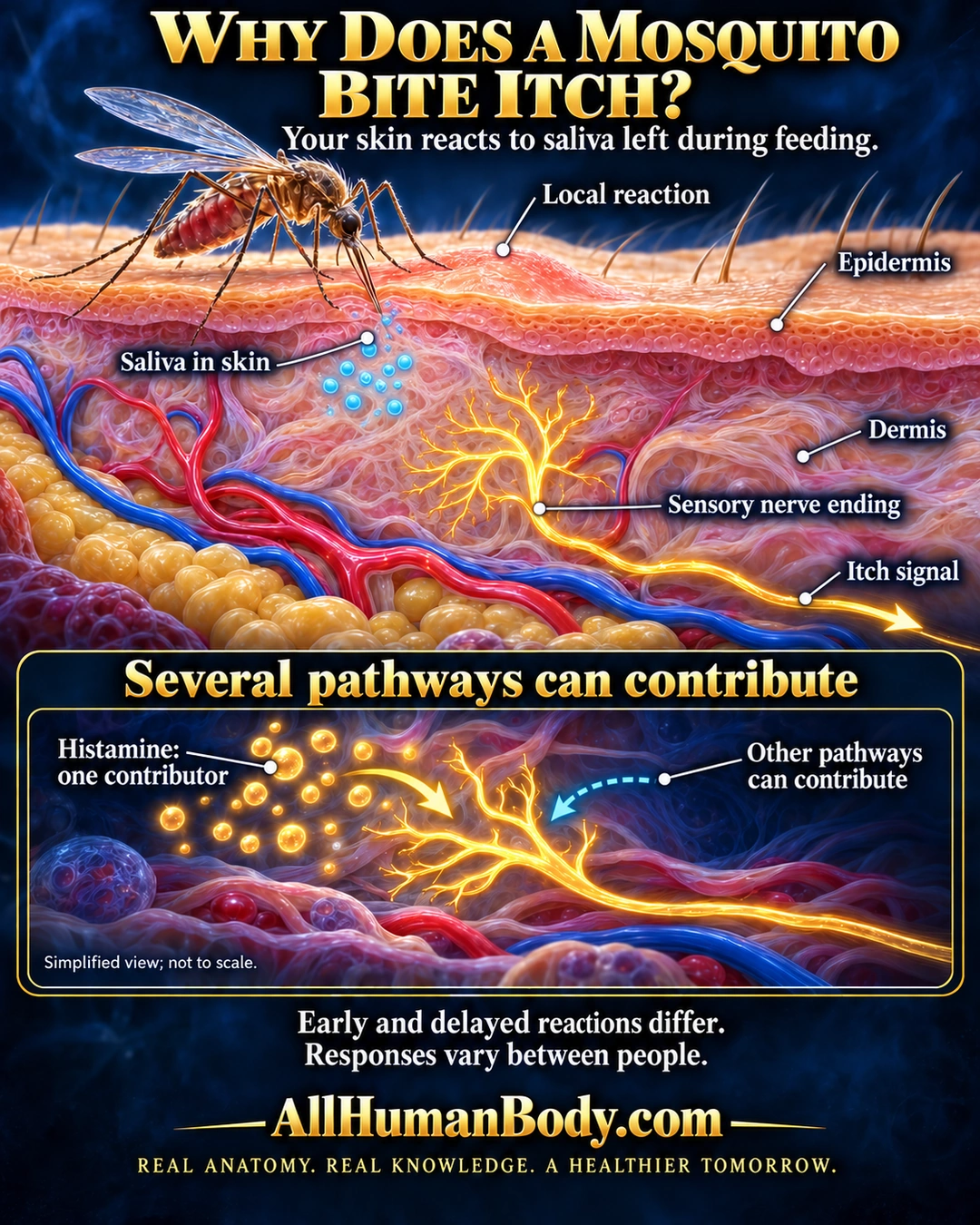
Mosquito saliva deposited during feeding can trigger a local reaction and itch. Histamine is one contributor, but other pathways can also participate, and responses differ between people.
READ THE IMAGE
What the illustration shows
English medical poster titled “Why Does a Mosquito Bite Itch?” on a dark navy background. A mosquito feeds at the surface of a peach-colored skin cutaway. A modest raised area is labeled Local reaction. Cyan symbols labeled Saliva in skin sit beneath the puncture, separated by tissue from a branching gold sensory nerve ending. Epidermis and dermis labels identify the skin layers; red and blue vessels and yellow fat provide context. A gold Itch signal arrow follows the nerve away from its skin branches toward the lower right. A lower inset titled Several pathways can contribute shows gold dots labeled Histamine: one contributor and a separate cyan dashed arrow labeled Other pathways can contribute, both directed toward a nerve ending. A note says the view is simplified and not to scale. Below it: Early and delayed reactions differ. Responses vary between people. Gold AllHumanBody.com branding and the full slogan finish the poster.
How to interpret this poster
- Not a universal timing sequence or histamine-only pathway; no diagnosis, pathogen inference, treatment or immune-strength comparison.
- AI-assisted educational illustration; not physician certification, microscopy, a diagnosis or individualized medical advice.
- Fine annotations need enlargement; the full description provides an accessible text alternative.
- Display the full uncropped illustration; do not trim titles, legends or boundary annotations.
AI-assisted educational illustration, adapted into web-sized images without changing its composition. This is general education, not an individual diagnosis or treatment recommendation.
EVIDENCE / CONTEXT
Sources and what they support
- CDC educational explanation, 2024 ↗
Saliva introduced during feeding, itchy local reaction and person-to-person variation. No prevention or treatment advice imported.
- Vander Does et al., specialist review, Frontiers in Immunology, 2022 ↗
Histaminergic sensory signaling and mast-cell contribution alongside proposed non-histaminergic/IgE-independent mechanisms; precise pathophysiology remains incomplete. Animal findings are not relabeled proven human pathways.
- Horsmanheimo et al., primary human microdialysis study, 1996 ↗
Small mosquito-sensitive sample showed histamine and leukotriene release in some participants after bites, supporting multiple mediators without universal timing or magnitude.
Evidence correspondence is limited to the abstract.