Musculoskeletal / VISUAL EXPLAINER
What Happens When a Knuckle Cracks?
A cavity can appear in joint fluid as finger-joint surfaces separate around a crack. Exactly how the sound arises remains debated.
READ THE IMAGE
What the illustration shows
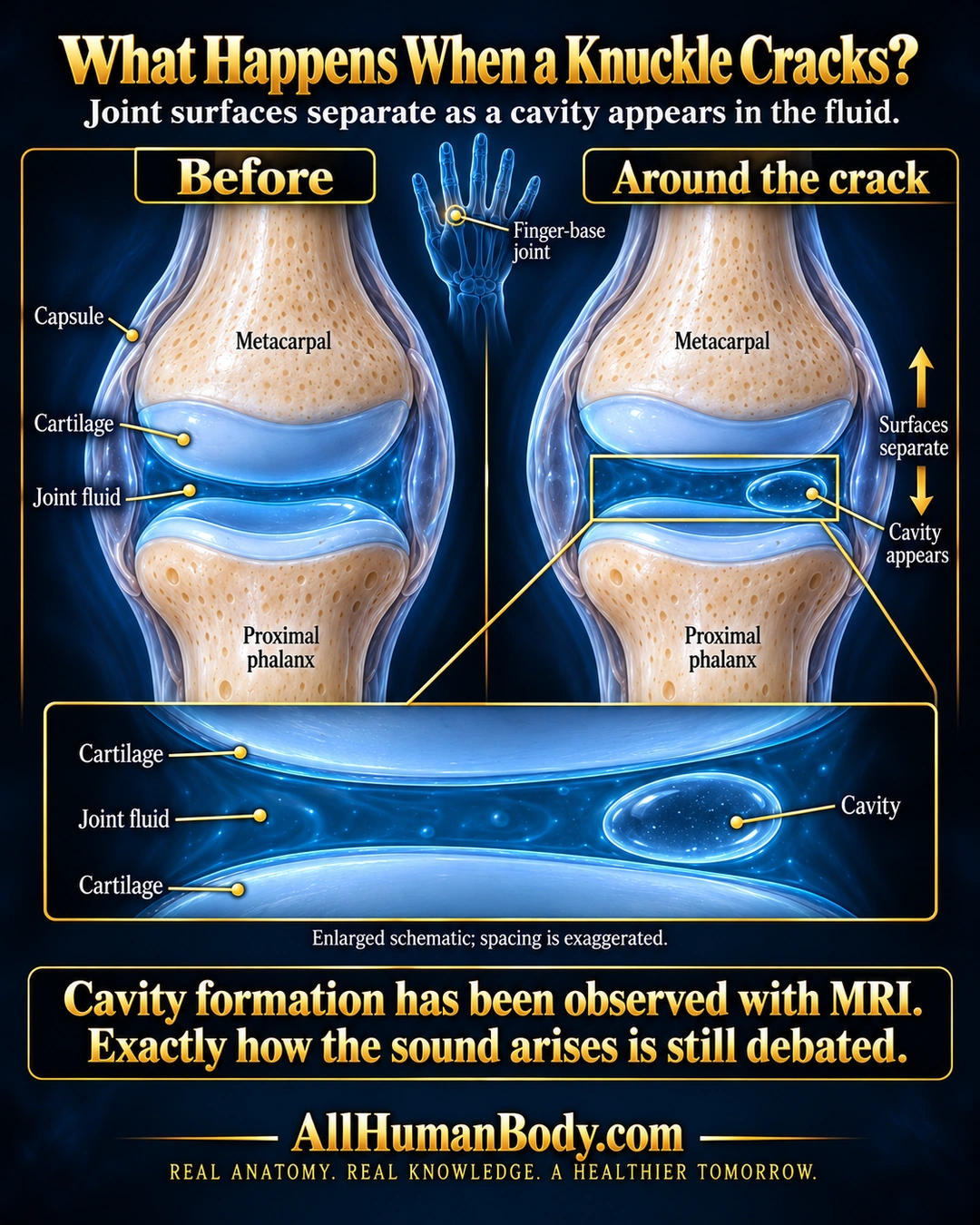
Navy-and-gold poster titled “What Happens When a Knuckle Cracks?” Two matched upright finger-base joint illustrations are labelled Before and Around the crack. Each has an upper metacarpal and lower proximal phalanx, pale-blue cartilage, cyan joint fluid and an enclosing capsule. A small blue hand locator marks a joint where a finger meets the palm. In the right view, two separate gold arrows point up and down to show surface separation, and a transparent oval cavity sits in the joint fluid. A gold rectangle around that fluid space connects to a lower enlarged inset with cartilage, joint-fluid and cavity labels. The caption says spacing is exaggerated. Prominent text states that cavity formation has been observed with MRI and exactly how the sound arises is still debated. Gold AllHumanBody.com and the full slogan appear at the bottom.
How to interpret this poster
- MRI observations came from ten joints in one participant; the partial-collapse explanation is a model. No universal sound mechanism, safety claim or cracking instructions.
- AI-assisted educational illustration; not physician certification, microscopy, a diagnosis or individualized medical advice.
- Fine annotations need enlargement; the full description provides an accessible text alternative.
- Display the full uncropped illustration; do not trim titles, legends or boundary annotations.
AI-assisted educational illustration, adapted into web-sized images without changing its composition. This is general education, not an individual diagnosis or treatment recommendation.
EVIDENCE / CONTEXT
Sources and what they support
- OpenStax Anatomy and Physiology 2e, authored textbook ↗
Capsule, cartilage-covered surfaces and synovial-fluid space; finger-base joint anatomy context.
- Kawchuk et al., primary human MRI study, PLOS ONE, 2015 ↗
Ten MCP joints from one participant: rapid surface separation and a persistent cavity appeared around cracking. Limited temporal resolution and single-person design do not establish a universal exact sound source.
- Chandran Suja and Barakat, primary mathematical/acoustic study, Scientific Reports, 2018 ↗
Partial-collapse model can produce comparable acoustics while leaving a bubble; authors identify substantial assumptions and unresolved debate. Modeling is not direct visualization of every sound-producing event.