Digestive / VISUAL EXPLAINER
How Can Stomach Acid Travel Back Up?
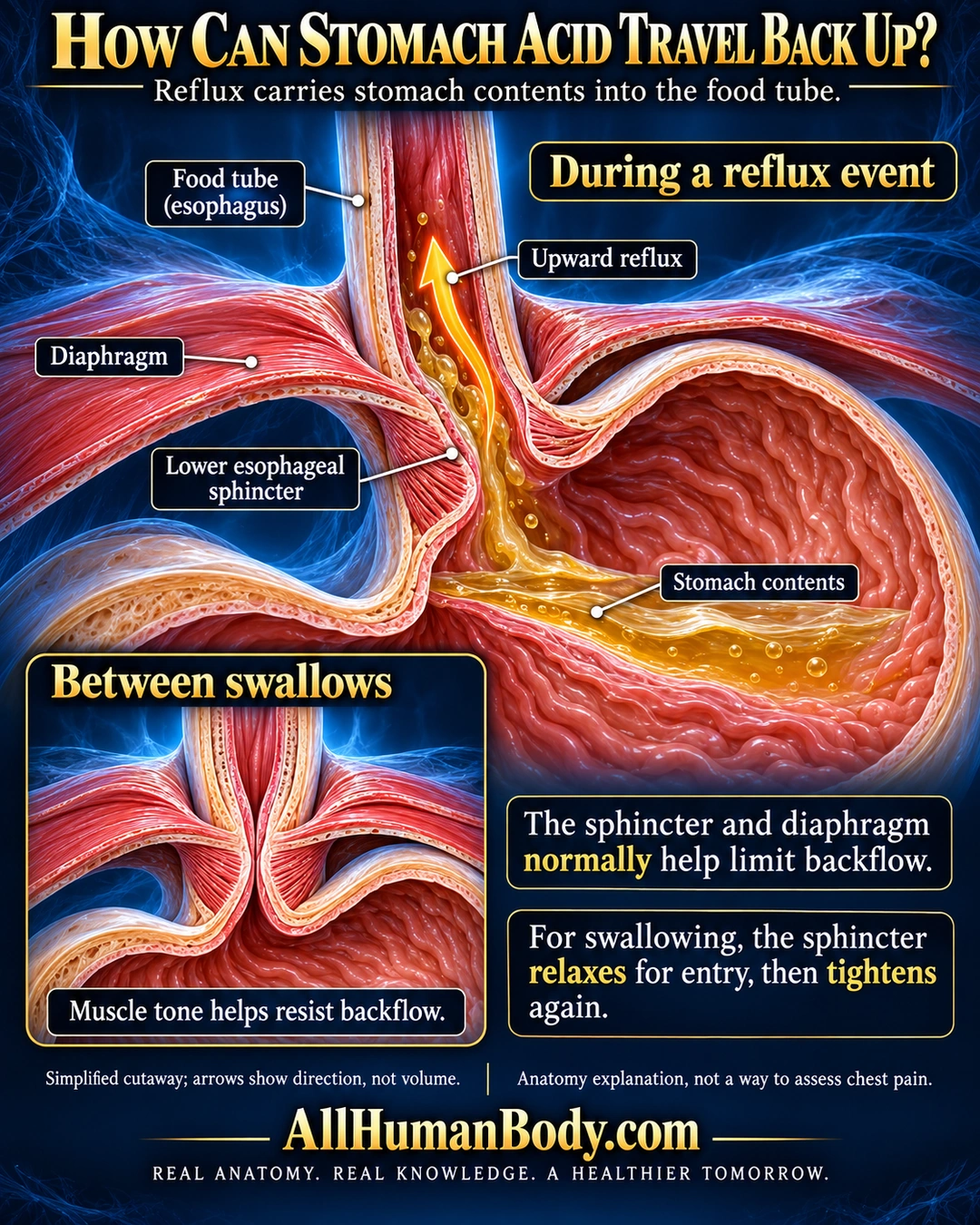
The lower esophageal sphincter and diaphragm normally help limit backward movement from stomach to food tube. The illustration contrasts one reflux event with the narrower junction between swallows.
READ THE IMAGE
What the illustration shows
Navy-and-gold English anatomy poster titled “How Can Stomach Acid Travel Back Up?” with the subtitle “Reflux carries stomach contents into the food tube.” A large cutaway shows the food tube descending through a pink diaphragm into the upper stomach, which curves toward the right. The diaphragm remains outside the tube. The lower esophageal sphincter label points to the muscle wall at the lower junction. Golden liquid in the stomach rises into the food tube beside a single upward amber arrow under the heading “During a reflux event.” Labels identify the food tube, diaphragm, lower esophageal sphincter, stomach contents and upward reflux. A smaller lower-left inset titled “Between swallows” shows the walls narrowing together and says muscle tone helps resist backflow. Two text panels explain that the sphincter and diaphragm normally limit backflow and that swallowing relaxes the sphincter for entry before it tightens again. Small text states that the cutaway and arrow are simplified and that the poster is not a way to assess chest pain. Gold AllHumanBody.com and the complete slogan appear along the bottom.
How to interpret this poster
- A functional muscle zone, not a trapdoor or permanently open pipe. Arrow shows direction, not liquid volume; not a way to assess chest pain.
- AI-assisted educational illustration; not physician certification, microscopy, a diagnosis or individualized medical advice.
- Fine annotations need enlargement; the full description provides an accessible text alternative.
- Display the full uncropped illustration; do not trim titles, legends or boundary annotations.
AI-assisted educational illustration, adapted into web-sized images without changing its composition. This is general education, not an individual diagnosis or treatment recommendation.
EVIDENCE / CONTEXT
Sources and what they support
- NIDDK official digestive education ↗
Lower esophageal sphincter plus diaphragm as anti-reflux barrier; abnormal relaxation or weakness can permit reflux. Symptoms alone do not establish diagnosis.
- Mayo Clinic patient education ↗
Lower esophageal muscle relaxes for swallowing then retightens; reflux into the food tube can cause heartburn. Also explicitly warns that chest pain can be cardiac.